
A Municipal Ranger Staffing Plan After NGCOA's Seasonal Labor Deal
NGCOA announced a partnership with masLabor to help member courses fill seasonal H-2B positions. This guide is for municipal courses and daily-fee operators who staff rangers and player assistants seasonally and feel the pinch every spring when the crew doesn't show up at full strength.
A new tool for an old problem
According to The Golf Wire, NGCOA's partnership with masLabor gives member courses discounted enrollment and direct access to staffing specialists who handle the H-2B federal process. masLabor CEO Chris Ball described the core question every course owner faces each spring: will there be a crew to deliver the season promised to members and the community.
That question applies directly to ranger staffing. Rangers and player assistants are seasonal, hourly, and often part time. They're exactly the kind of role this partnership is built to address.
Why ranger roles get cut first
Rangers don't generate direct revenue. Turf crews keep the course playable. Pro shop staff process transactions. Rangers manage pace and course flow, which is easy to defer when a budget tightens.
That makes ranger headcount the first line item cut when seasonal labor is short. Fewer applicants, fewer approved H-2B slots, fewer bodies to put on a cart in July.
What happens when ranger headcount drops
A ranger who's short-staffed can't cover the whole course. Slow groups back up on par 5s. Carts leave the path chasing a group instead of staying where turf protection matters.
This pattern shows up at courses of every size once staffing thins out: fewer rangers means less course coverage, not just slower play. It's the kind of gap that's easy to spot in hindsight and hard to plan around in advance, which is exactly why it needs a plan now instead of in June.
We wrote about this exact operational squeeze in Running a Golf Course While Short-Staffed? Here's How to Stay in Control.
What a ranger does differently with real-time pace data
A ranger patrolling blind drives the same loop over and over, hoping to spot the group that's fallen behind. That's a guess dressed up as coverage, and it burns labor hours on holes that are already moving fine.
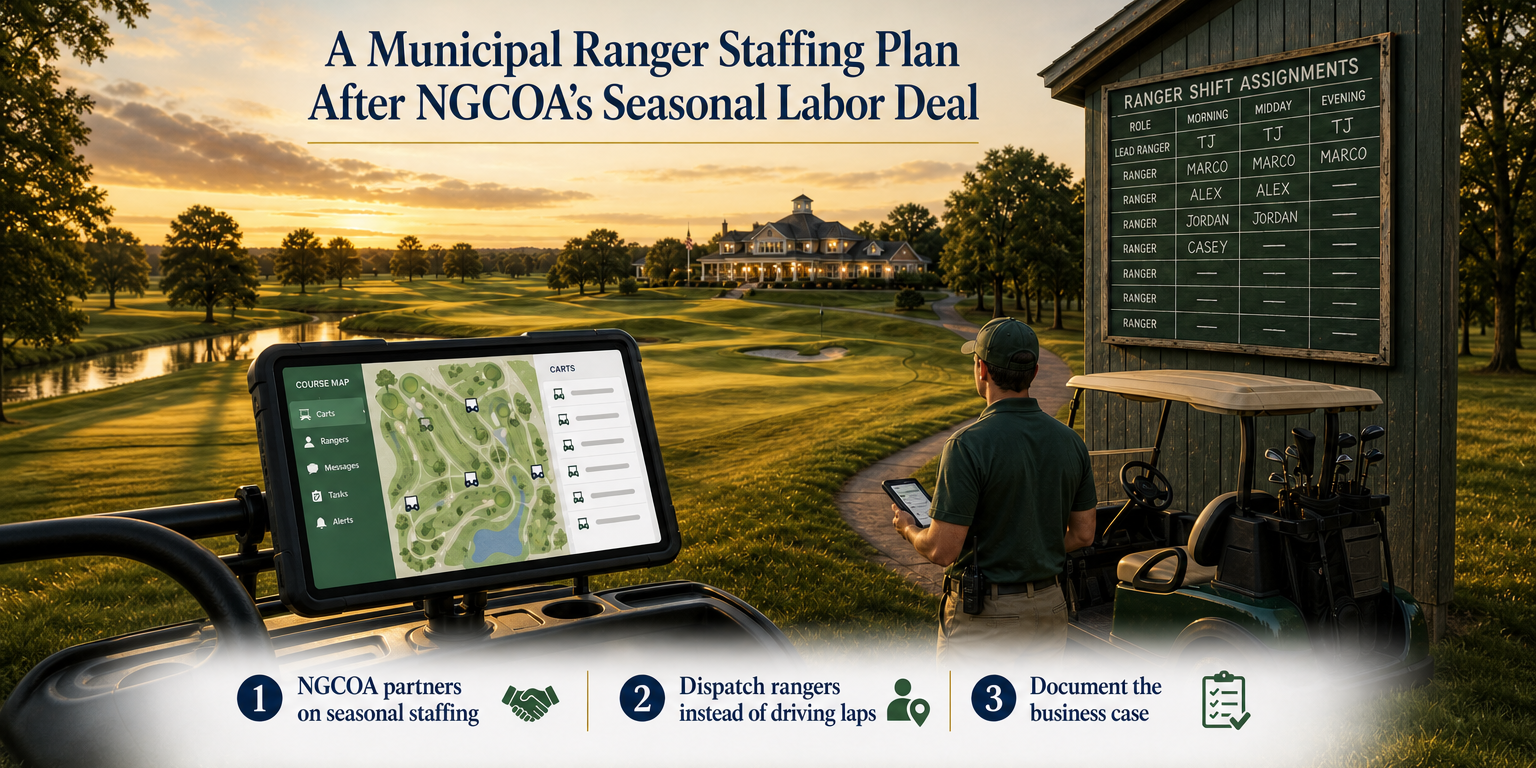
A ranger working from real-time cart position data gets dispatched to the actual slow group, not the loop that might contain one. The screen shows which hole is backing up before it's visible from the clubhouse, so the ranger drives straight to the problem instead of circling the course looking for it. One set of eyes on a screen covers ground that used to take multiple laps to check, and the ranger spends more of the shift managing pace and less of it driving.
That shift changes the staffing math. A course doesn't need a ranger on every loop at every hour if the rangers it has are being routed instead of guessing. Fewer wasted laps means the hours a course does have staffed go further, which matters most in the exact weeks when seasonal hiring comes up short.
We cover the difference between those two approaches in The End of the Driving-Around-Looking-for-Slow-Play Ranger. Courses using FAIRWAYiQ's real-time pace data report ranger labor savings of about $14,000 per year. That figure is fewer wasted hours per week, added up over a season.
A ranger's effectiveness depends entirely on the data behind the cart. We wrote about that in Your Rangers Are Only as Good as Their Data. Standard GPS drifts 6 to 16 feet. A cart path is 8 to 10 feet wide. A ranger acting on drifted position data is guessing, not managing, no matter how many hours are on the schedule.
What to do this week
- Count ranger hours scheduled per week last season, then count hours actually worked. The gap between the two is your real coverage problem.
- Cost those hours out at fully loaded wage rate, including any overtime paid to cover gaps. This is the number a council or ownership group needs to see first.
- List every shift that went unfilled last season by week, and note what happened on the course those days: pace complaints, cart path damage, or both.
- Calculate what happens to those hours if dispatch replaces laps. If a ranger currently drives four loops a shift to find slow play, estimate the time saved if that ranger is sent directly to the group instead, and multiply by the number of shifts per week.
- Check your NGCOA membership status and look into the masLabor Smart Buy Marketplace pricing before your next hiring cycle.
- If you're a public course, find one council member or parks department contact who already cares about pace of play and bring them into the conversation early.
Building the business case before the budget vote
Public and municipal courses answer to a council or parks department, and the budget gets approved once a year. The case needs to be built before that vote, not during it. A clear ROI case built on the course's own numbers is what fast-tracks a committee's or council's understanding of the value, and that understanding is what moves the vote quickly.
Start with one champion on the council or in the parks department who already feels the pace-of-play pain. Bring them real numbers: current ranger hours, current labor cost, current complaint volume. Then sell the rest of the members or council one by one before the formal vote, rather than presenting cold to the full group for the first time.
Vendors can take a course's own repair and staffing records and organize them into a clear ROI case. With the AI tools every vendor should be using today, that part of the work is fast. It's worth asking a vendor to help build that presentation before you go in front of the full council.
Connect council or committee members to other municipal courses that have already made this decision. Hearing it from a peer operator carries more weight than any vendor pitch.
We laid out the broader operational picture in Navigating the Challenges of the Golf Course Labor Shortage: Solutions and Strategies and the pace fundamentals in Pace of Play: A Practical, Science-Based Plan to Restore the 4-Hour Round.
If you're comparing pace systems
Any vendor you evaluate for pace or GPS technology needs a written, contractual GPS accuracy guarantee with a specific number and a stated test method. Verbal assurances from a sales rep don't count for anything once the system is on the course. Demand this in writing every time, regardless of which vendor you're talking to.
Ask what happens if the guarantee isn't met. Get the answer in writing before you sign.
Where FAIRWAYiQ fits
We built FAIRWAYiQ as an independent GPS provider for golf carts, and we've been doing this for 11 years across any cart brand. Our system runs on RTK-corrected precision GPS, a different measurement category from standard GPS, so rangers work from position data accurate enough to trust. Courses that use it report ranger labor savings of about $14,000 a year, which eases exactly the seasonal staffing pressure NGCOA and masLabor are now trying to solve.
If you want help building the ROI case for your council or ownership group, book a call with Mike.
Revolutionize Your Golf Operations with FAIRWAYiQ
Unlock the power of data analytics to optimize your golf course management