
Your Rangers Are Only as Good as Their Data
The Setup Nobody Talks About
A ranger pulls up to a foursome on the 11th hole. The GPS dashboard showed them behind pace. The ranger says something. The group pushes back. They've been keeping up all day. The ranger isn't sure. The moment gets uncomfortable. The group finishes the round irritated, and the ranger drives away feeling like the bad guy.
This happens hundreds of times every weekend across golf courses of every category. It is not a people problem. It is not a training problem. It is a data problem. And it has a direct solution.
The Ranger's Impossible Job Without Real-Time Data
Rangers are expected to make credible, real-time judgments about pace of play. That job requires accurate information. Without it, they are working on instinct, experience, and guesswork.
Dr. Lou Riccio, whose research on pace of play is the most rigorous academic work in the field, put it plainly: rangers can only help golfers when they can tell them whether they are ahead or behind. That is the baseline. A ranger who cannot answer that question with confidence cannot give useful feedback. And a ranger who gives wrong feedback does more damage than one who says nothing.
Most rangers know this. They feel the uncertainty every time they approach a group. The result is inconsistent enforcement, golfer pushback, and staff credibility that erodes over time. None of that is the ranger's fault. They are working with inadequate information.
What Inaccurate GPS Does to Marshal Decision-Making
Standard GPS systems can display a cart's position one to two holes off from where it actually is. That is not a small margin of error in this context. It changes the entire basis of the pace conversation.
A ranger looking at a dashboard that shows a group on hole 9 when they are actually on hole 11 makes calls based on wrong data. The group may be right on pace. The ranger has no way to know that from what the screen shows. The approach happens. The pushback follows. The trust is damaged.
The harder problem is that the inaccuracy is not obvious. Staff do not usually know the data is off. They trust the dashboard because it is the tool they were given. When the information is wrong and they act on it, they look uninformed to guests. That is a staff morale and guest experience problem rolled into one.
Wrong calls erode something that takes a long time to rebuild: the sense among your members and guests that your staff know what they are doing.
The Shift from Reactive Patrol to Proactive Management
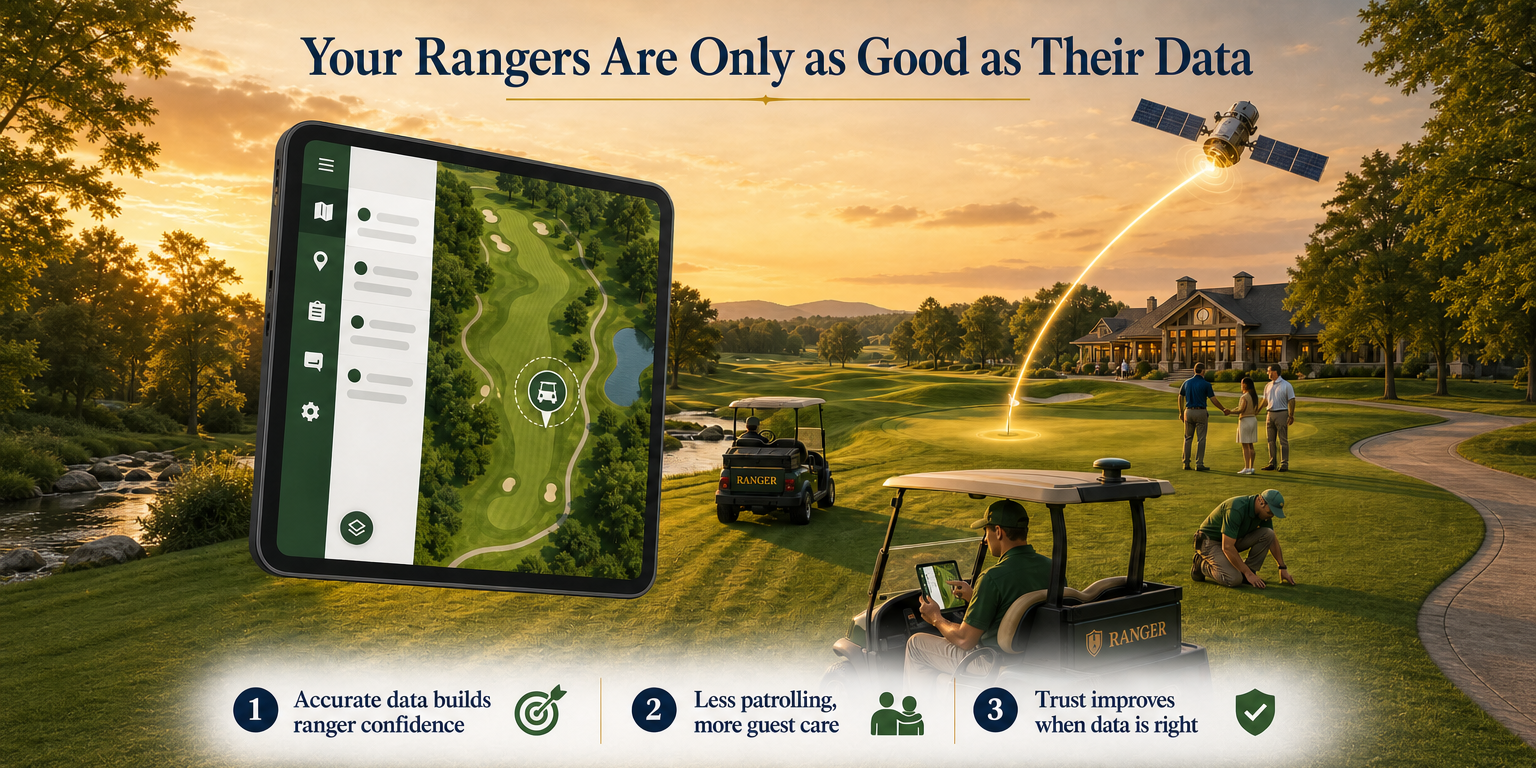
Precision GPS built on RTK correction technology works in a different measurement category than standard GPS. It is accurate to the specific hole, not a general zone. That distinction changes what a ranger can see and when they can see it.
With precise cart positions, rangers have access to real-time pace gaps, actual group locations, and developing stacking points on the course before those stacking points become visible problems. Proactive alerts replace the need for constant patrol loops. The ranger is not driving around looking for slowdowns. The platform is surfacing that information and putting it in front of staff before the situation gets worse.
FAIRWAYiQ operator data shows a 50 to 60 percent reduction in patrol time when rangers work with this kind of accurate, real-time information. That number is significant on its own. What it enables is more significant.
What Rangers Actually Do When They Have Reliable Data
When a ranger spends less time on reactive patrol loops, that time goes somewhere else. In most cases, it goes toward the thing most operators actually want their on-course staff doing: taking care of guests.
Member interactions that feel personal instead of transactional. F&B upsells that happen naturally in conversation rather than through scripted approaches. Proactive hospitality moments that guests remember and mention in reviews. These are not complicated programs. They are what happens when a staff member has time to engage instead of time to drive laps.
The ranger role shifts. Not through a retraining initiative or a culture memo. It shifts because the job description changes when the data improves. Enforcement becomes a smaller part of the work. Player services becomes a larger one. That is better for staff morale. It is better for guest NPS. It is better for course reputation.
Most rangers did not take the job because they wanted to confront people about pace. They took it because they like golf and they like working outdoors and they want to do right by the guests. Accurate data lets them do that.
The Staff Efficiency Math
The operational numbers are real. FAIRWAYiQ data shows an estimated $14,000 per year in labor savings when the full platform is in use. Fifteen minutes of pace improvement measured across rounds. A 96.5 percent net revenue retention rate across 150 accounts, which reflects what operators do when the platform is working for them.
But the number that does not fit cleanly in a spreadsheet is the value of a staff member who makes guests feel taken care of. That shows up in rebooking rates. It shows up in member retention conversations. It shows up in the reviews that drive tee time decisions for new players.
FAIRWAYiQ is a decision-support system, not a surveillance tool. The goal is not to monitor rangers. The goal is to give them information accurate enough to act on, so they can do the job they were hired to do without guessing.
Closing the Information Gap
Rangers want to do a good job. Most of them are working as hard as they can with inadequate information. The question for operators is not how to train staff to be better at guessing. The question is how to close the information gap so they do not have to guess at all.
When a ranger rolls up to a group, they should already know whether that group is on pace, ahead, or behind. They should know it from accurate data, not instinct. That confidence changes the entire conversation. It changes how the group responds. It changes how the ranger feels about the interaction. It changes the experience.
When you close the data gap, the job changes. And so does the experience your guests walk away with.
See how FAIRWAYiQ gives your on-course staff the real-time data they need to manage pace and guest experience with confidence.
Revolutionize Your Golf Operations with FAIRWAYiQ
Unlock the power of data analytics to optimize your golf course management