
The End of the Driving-Around-Looking-for-Slow-Play Ranger
If you run a municipal or daily-fee public course in Texas or Florida, your ranger payroll is one of the easiest line items for your decision maker to cut. Whether the cut comes from a city manager, an ownership group, or a regional VP, the result is the same: less coverage on the course at exactly the moment more coverage is needed. The job is also the role most likely to generate a one-star Google review. The math is going the wrong way and most operators know it.
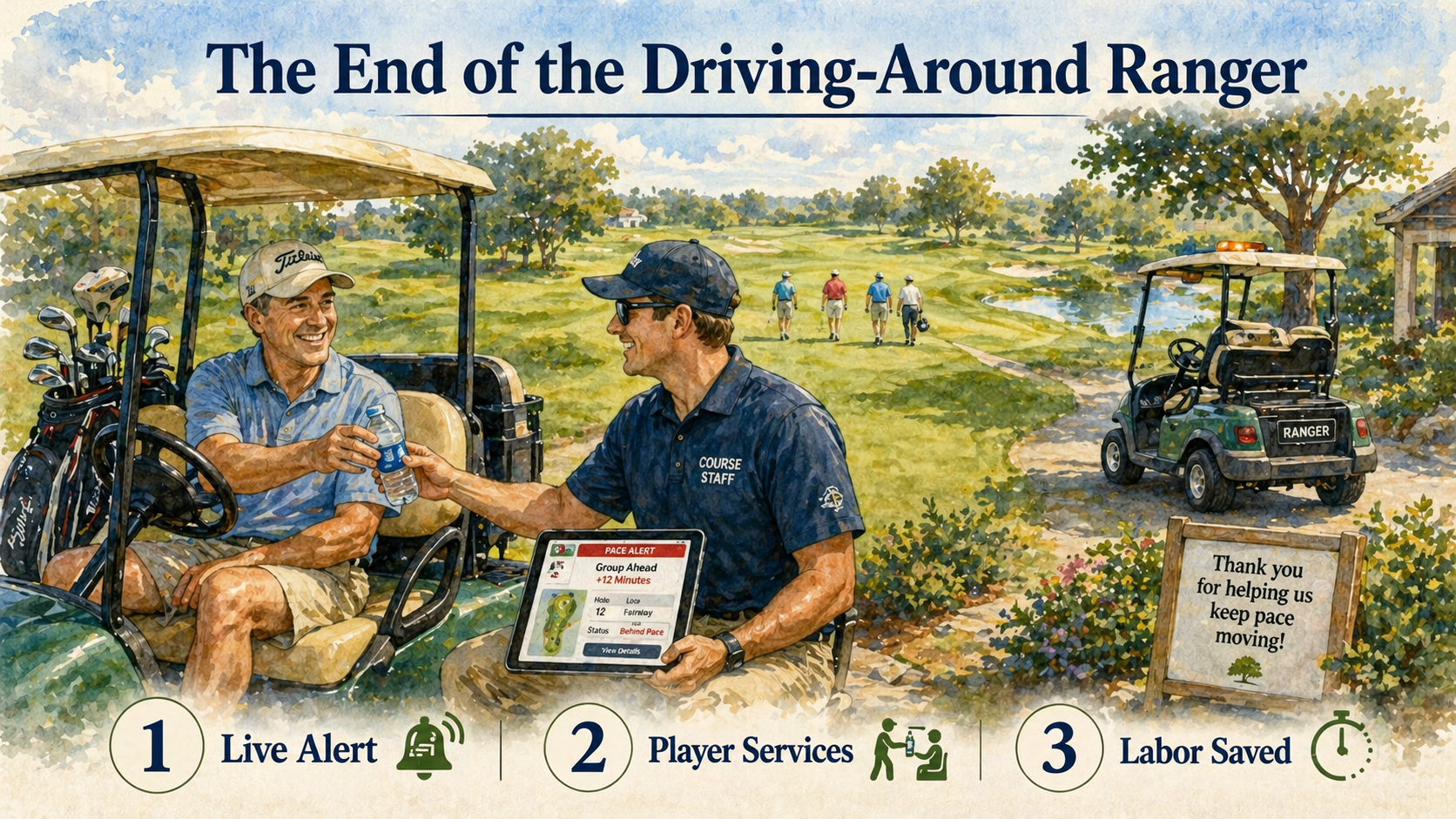
The role has not changed in 40 years. A staff member drives the cart paths looking for groups that look slow, makes a judgment call, and walks up to the players to ask them to pick up. The interaction is awkward in the best case and confrontational in the worst. The marshal often targets the wrong group because the actual problem is two groups ahead. The player feels accused. The Google review goes up that night.
There is a better job, and the data makes it possible.
The data shift that changes the role
The hard part of pace of play is not driving around looking for problems. The hard part is knowing which group is actually causing the problem and at exactly which moment. Real-time pace alerts on a tablet tell a staff member: group three is 12 minutes behind pace at hole 6, the group ahead is on time, intervention is justified. That is the difference between a guess and a data point.
When the staff member walks up with data, the conversation changes. It stops being "you are slow." It becomes "the group ahead just opened up a hole. We can make up the time on 7 if we tighten up here." Same outcome. Different feeling. Different review.
The new role: player services attendant
The job description for a player services attendant looks like this.
Position summary. The player services attendant moves the field on demand and delivers on-course hospitality. The role is responsive, not patrolling. The attendant operates from data, not subjective observation. The attendant carries water and snacks, identifies high-spending groups, and intervenes only when the data says intervention is needed.
Responsibilities.
- Monitor real-time pace alerts on the issued tablet
- Respond to alerts within five minutes with a non-confrontational pace conversation
- Deliver water, towels, and ice to identified groups during peak heat
- Coordinate with the cart attendant to route F&B orders to the field
- Greet known regular and high-spend players by name
- Submit a daily report of interventions and outcomes
Reports to. Director of Golf or Head Professional.
Qualifications. PGA HOPE program graduate or equivalent hospitality background. Comfortable on a tablet. Able to drive a golf cart. Prior course experience preferred.
Pay. $14 to $18 per hour, depending on market.
Hours. Variable based on tee sheet, with peak coverage during weekend prime times.
A municipal HR department or a private operator's HR team can put that into the system the day they read it.
The labor math
A typical public course operates one or two rangers across two daily shifts. A ranger driving four to six hours per day at $14 to $18 per hour, across 200 to 250 operating days, is a $14,000 to $20,000 annual line item for the labor alone. Add cart depreciation and fuel, and the loaded cost is closer to $16,000 to $22,000.
The data-driven model cuts that figure by half. The attendant covers the same field with shorter shifts driven by alerts, not patrol. The course saves at least $14,000 in direct ranger labor. The redirected hours go to high-value player interactions, which lift reviews and replays.
The number to put in the capital memo is $14,000 in annual labor savings.
A 30-day rollout plan that does not lose your veteran ranger
Most public course operators have a long-tenured ranger team and do not want to lose them. The rollout protects them.
Days 1 to 7. Install the alert system. Train the existing ranger team on the tablet. Run the system in observation mode (alerts visible, no role change yet).
Days 8 to 21. Convert the ranger team to player services attendants on weekend prime time. Issue water and ice as part of every shift. Start tracking intervention outcomes (did the group catch up).
Days 22 to 30. Move full-time to the new role. Consolidate to one attendant per peak shift, with overlap during the busiest two hours. Track the labor savings.
By day 30 the team has the new identity, the role is sustainable, and the memo to your decision maker has a number.
How public course operators are running the new model
Lozano Golf Center and Plum Creek Golf Course in Texas operate with FAIRWAYiQ beeper hardware. Pace alerts run on the tablet and the on-course staffing model is responsive rather than patrol-based.
Debary Golf & Country Club and Champions Turf Club in Florida run the same setup, with the labor model shifted toward player services and the alert system replacing the older patrol routine.
Each of these courses operates with a smaller patrol footprint and uses the saved hours where they do more good.
What HR will want to see in writing
Three documents make the HR conversation easy, whether you are working with a city HR department or a private operator's HR lead.
- The new job description (above).
- A line item showing the $14,000 in annual savings.
- A retention plan for the existing ranger team that converts the role rather than eliminating it.
Submit those three together and the conversation is short.
Next step
If your weekend pace is the conversation your decision maker keeps starting, see the alert workflow live. A 20-minute walk-through is enough to see how the data actually changes the staff conversation on the course.
Revolutionize Your Golf Operations with FAIRWAYiQ
Unlock the power of data analytics to optimize your golf course management