
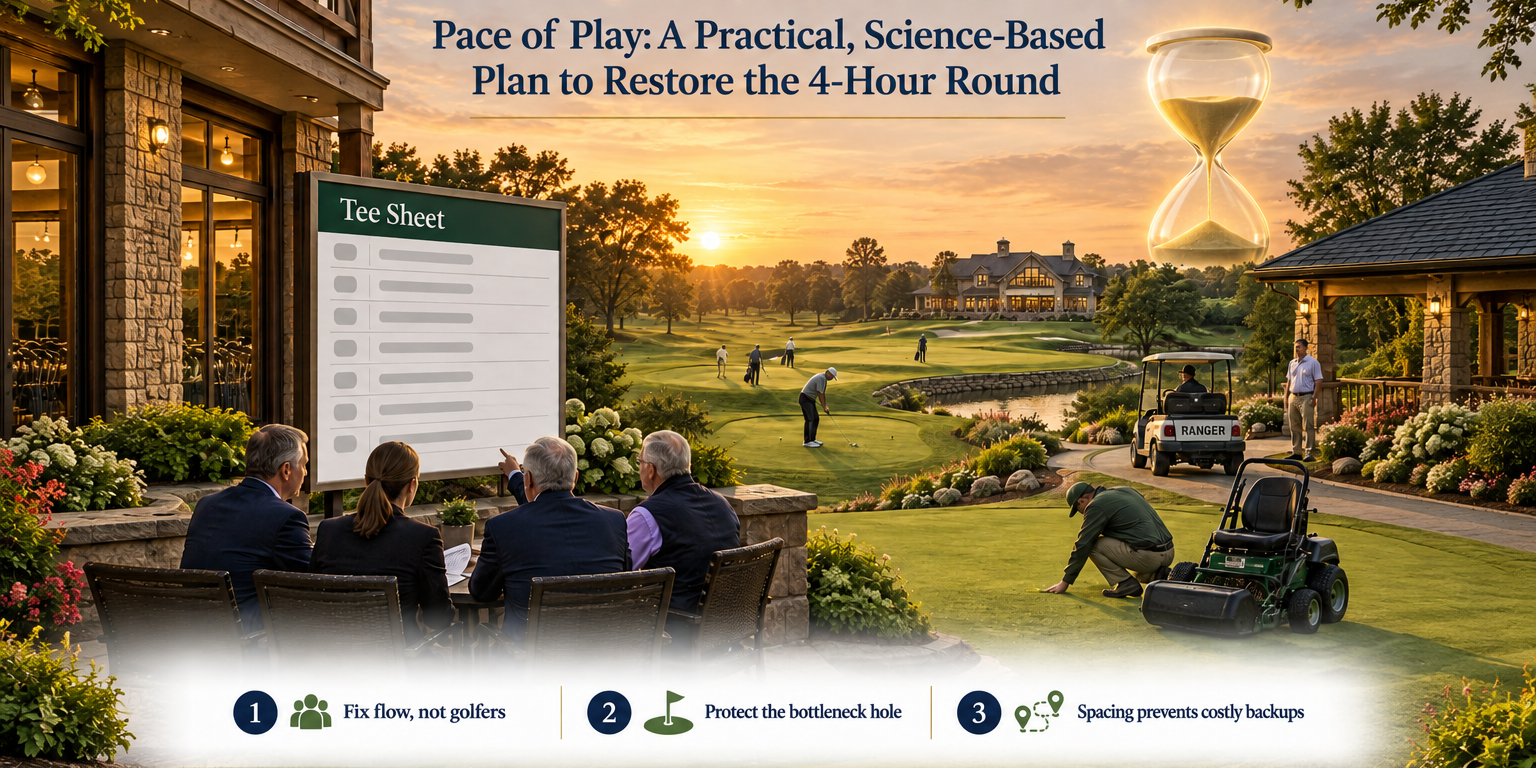
Pace of Play: A Practical, Science-Based Plan to Restore the 4-Hour Round
Introduction
Slow rounds are one of the most persistent problems in golf—and one of the most misunderstood.
Most courses experiencing five-hour rounds blame golfers: beginners, lack of etiquette, slow walkers, or players who “don’t care anymore.” Those explanations are common, comforting, and wrong.
Pace of play is not primarily a golfer problem.
It is a systems problem.
Courses that consistently deliver four-hour rounds don’t rely on reminders, signs, or lectures. They design and manage their operation so congestion never forms in the first place.
This hub lays out a practical, science-based approach to pace of play, grounded in how golf courses actually function: where bottlenecks form, why tee sheet decisions matter more than behavior campaigns, and how operators can intervene early—without conflict or lost revenue.
Why Pace of Play Is a Business Problem (Not Just a Playing Problem)
Slow rounds affect far more than on-course experience.
They reduce:
- replay rates and membership satisfaction
- food and beverage spend
- staff morale and retention
- online reviews and reputation
They also increase:
- ranger conflict
- refunds and rain checks
- customer complaints
- operational stress during peak hours
Courses that tolerate slow play often assume it’s unavoidable. In reality, most pace issues are predictable, diagnosable, and preventable.
What Actually Determines Round Time
Round time is governed by waiting, not walking or swinging.
If players are waiting before nearly every shot, the round is already lost. No amount of encouragement or enforcement can “speed up” a congested system after backups form.
Three forces determine pace on every course:
- Tee sheet spacing – how much demand enters the system
- Bottlenecks – where service capacity is constrained
- Group interaction – how spacing compresses over time
When arrival rate exceeds capacity—even slightly—delays compound.
This is why courses with well-intentioned pace policies still struggle: they focus on symptoms instead of flow.
(See: /pace-of-play/what-causes-slow-play/)
The Factory Physics of Golf Courses
Golf courses behave like production systems.
They have:
- fixed capacity (holes, daylight, green complexes)
- variable demand (tee sheet volume)
- sequential stations (holes)
In any system like this, one bottleneck controls overall throughput.
On golf courses, that bottleneck is usually:
- a par 3
- a forced carry
- a long green-to-tee walk
- a difficult green complex
Once groups stack at the bottleneck, spacing collapses everywhere behind it—and the round cannot recover.
Rangers don’t cause pace problems, and they can’t fix them alone. By the time congestion is visible, it’s already too late.
(See: /pace-of-play/bottlenecks-factory-physics/)
Why Tee Time Spacing Is the Throttle
Tee intervals determine how much demand enters the system.
They are the single most powerful lever operators control.
When tee times are too tight:
- backups are guaranteed
- ranger enforcement becomes reactive
- golfer frustration rises quickly
When tee times are set appropriately:
- spacing absorbs natural variability
- minor delays self-correct
- enforcement becomes rare, not constant
Par 3s often set the true limit. If groups arrive faster than a par 3 can clear, the system will fail regardless of golfer skill or intent.
The idea that tighter tee times always produce more revenue is a myth. Slow rounds reduce replay, reduce spend, and damage long-term demand.
(See: /pace-of-play/tee-interval-math/)
The 4-Hour Round Requires a System, Not a Slogan
Courses that restore consistent four-hour rounds do not rely on one fix. They align multiple decisions across the operation.
A practical pace-of-play system includes five components:
- Tee Sheet Discipline
Demand aligned with capacity—not optimism. - Bottleneck Management
Identifying and protecting the limiting hole(s). - Defined Checkpoints
Objective timing locations that detect compression early. - Ranger Workflows
Clear authority, early intervention, consistent messaging. - Enforced Standards
Fair expectations applied evenly and predictably.
Partial fixes fail because pace is cumulative. Systems succeed because they preserve spacing.
(See: /pace-of-play/the-4-hour-round-plan/)
Diagnosing Pace Problems at Your Course
Most operators can identify their bottleneck quickly by asking a few questions:
- Where do groups wait first?
- Which hole never clears during peak times?
- When does spacing disappear—early or late?
Once congestion is visible on the back nine, the cause almost always occurred earlier.
The goal is not to react faster—it’s to intervene before compression spreads.
(See: /pace-of-play/how-to-find-your-course-bottleneck/)
Where Technology Fits (and Where It Doesn’t)
Technology does not “fix” pace of play.
It helps operators:
- see problems earlier
- remove subjectivity from enforcement
- support rangers with objective data
- apply standards consistently
The best results come when technology supports people and workflows—not when it replaces judgment or leadership.
(See: /pace-of-play/how-technology-supports-pace/)
Start with a Plan, Not a Policy
Pace of play improves fastest when operators stop blaming golfers and start managing flow.
The principles are universal. The application is course-specific.
This hub breaks pace of play into its component parts so you can:
- diagnose accurately
- intervene early
- restore spacing
- reduce conflict
- protect revenue
If you want help applying these principles to your course, the next step is a structured evaluation—not another reminder sign.
Frequently Asked Questions About Pace of Play
What is considered good pace of play in golf?
For an average 18-hole course, a four-hour round is widely considered the standard for good pace of play. Some courses can support slightly faster rounds, while others—due to terrain or design—may target 4:15–4:30. The key is consistency, not chasing an unrealistic number.
What actually causes slow play on a golf course?
Slow play is primarily caused by system congestion, not individual golfers. Tight tee intervals, unmanaged bottlenecks (often par 3s), and lost spacing between groups create waiting that compounds throughout the round. Once players are waiting on every shot, pace has already broken down.
Do beginners and high-handicap golfers cause slow play?
Not by themselves. Beginner golfers only become a pace problem when the system lacks enough spacing to absorb natural variability. Courses with proper tee intervals and early intervention can accommodate mixed skill levels without pace issues.
Why do par 3 holes cause so many pace problems?
Par 3s often have higher service time and less variability, which makes them natural bottlenecks. If groups arrive at a par 3 faster than it can clear, backups form quickly and ripple through the entire course. Most chronic pace problems can be traced to one or two bottleneck holes.
What is the best tee time interval to prevent slow play?
There is no universal answer, but tee intervals must be matched to the course’s bottleneck capacity, not revenue targets. Many courses struggle at 8-minute intervals because even small delays compound. The correct spacing depends on par 3 throughput, course setup, and starting method.
Do pace of play signs and etiquette reminders work?
On their own, no. Signs and reminders do not change system flow. They can support a broader pace program, but without proper spacing, checkpoints, and enforcement, they tend to frustrate golfers rather than improve pace.
What role do rangers or marshals play in pace of play?
Rangers are most effective when they intervene early, using objective checkpoints and clear authority. When rangers are forced to react late—after congestion forms—they end up managing conflict instead of pace.
How can a golf course diagnose its pace of play problem?
The fastest way is to identify where spacing disappears first. Operators should look for the hole where groups consistently wait, the time of day congestion begins, and whether the issue originates early or late in the round. Most pace problems are visible long before the back nine.
Can technology actually improve pace of play?
Technology does not fix pace by itself, but it helps courses see problems earlier, remove subjectivity, and support ranger workflows with real data. When paired with a clear pace plan, technology improves consistency and accountability.
Is it possible to improve pace without losing revenue?
Yes—and often revenue improves. Courses that restore consistent pace typically see higher replay rates, better food and beverage performance, and fewer refunds or complaints. The perceived revenue loss from wider tee intervals is often offset by improved customer satisfaction and retention.
What’s the first step to fixing pace of play?
Stop treating pace as a behavior issue and start treating it as a flow problem. Identify your bottleneck, review tee spacing, and establish early checkpoints. A structured evaluation is far more effective than adding new rules or signage.
Revolutionize Your Golf Operations with FAIRWAYiQ
Unlock the power of data analytics to optimize your golf course management