
Running Outing and League Days Without Losing the Back Nine
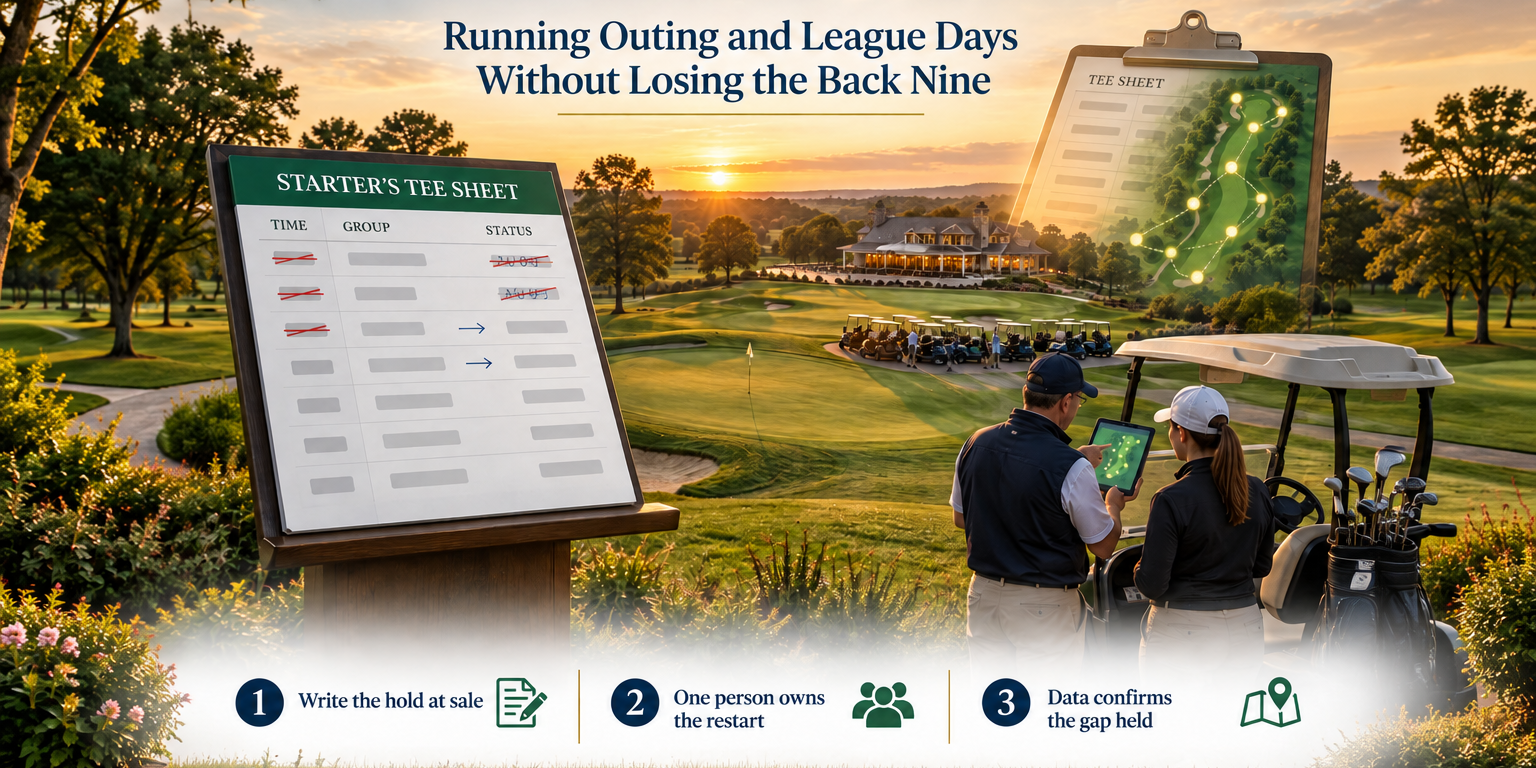
Outing and league days are booked revenue. Most municipal and daily-fee courses still run them on a paper tee sheet and a radio call, and the public field behind the outing pays for it all afternoon. This guide is for the general managers, head professionals and tournament coordinators who sell and run these days, not for private clubs running member events under a committee calendar.
What an outing day really costs the public tee sheet
Count it in tee times, not dollars. Every outing group on the course is a public tee time that did not go out that morning.
The cost shows up twice. Once when the hold is set, and again when the outing runs long and the public gap disappears behind it.
Most operators can tell you the outing's green fee revenue. Fewer can tell you how many public tee times the hold actually consumed. That number belongs on the same sheet as the invoice.
Decide the hold and the public gap when you sell the date, not the week of
The hold and the gap are pricing decisions. They should get made at the sales conversation, in writing, not renegotiated by the starter on the morning of.
Write the hold into the outing contract: field size, start type, and the specific tee times or shotgun window being blocked. Write the gap next to it: how much clear space sits between the outing field and the next public group.
The tee interval formula operators use to set pace of play is the same math that should set this gap. Deciding it during the sale, not during the round, is what keeps the afternoon from being a negotiation with an angry twosome.
Shotgun versus tee-time starts, and what each one does to the field behind it
A shotgun start puts the whole outing field on the course at once. A tee-time start spreads that same field out over the morning.
Each has a different failure mode. A shotgun concentrates the collision with the public field at one point in the round, wherever the outing and the regular rotation cross. A tee-time start spreads that same collision out, but it also spreads the outing's own pace problems across more of the day.
Neither start type is automatically the right call. The right call depends on the field size and the course's own interval data, not on habit. The hidden capacity audit for your tee sheet is the place to run that comparison before the next outing season, not during it.
Roles for the day: who owns the start, the restart and the golfer conversations on the lot
One person owns the start. One person owns the restart decision if the outing falls behind. One person owns the golfer conversations on the lot when a group is unhappy about pace.
These can be three different people or one person wearing three hats, but they cannot be undefined. A restart decision made by committee, in the moment, on the tee, is how a 20-minute problem becomes a 60-minute one.
Write the roles into the outing-day brief the same way the hold and the gap get written into the contract.
The two groups that set the afternoon, and how to reach them before they set it
Two groups determine whether the rest of the field recovers: the first group off, and the slowest group in the field.
The first group sets the pace everyone behind them inherits. The slowest group sets the size of the gap that closes behind them. Reaching both before the round, not after, is the difference between managing the day and reacting to it.
A starter's guess at who those two groups are is a guess. Position data on the cart tells you, in real time, which group is actually setting the afternoon.
Using on-cart position data to confirm interval spacing recovered
The question that matters after an outing clears is simple: did the public gap survive, and did interval spacing come back to normal. A radio call and a walk-through answer that question late and roughly.
Precision GPS on the carts answers it directly. The professional staff sees live position and interval data for the outing field and the public field at the same time, so the restart and the gap are decisions made on data instead of a guess.
Standard GPS drifts 6 to 16 feet. A cart path is 8 to 10 feet wide. That gap between drift and path width is the reason a radio call and a rough estimate are not a substitute for position data built on RTK corrections. Slow play on a golf course is rarely one bad group. It is usually a spacing problem nobody measured.
Staffing the day without adding payroll
Outing days do not have to mean extra rangers on the course. Position data lets existing staff cover the same ground with fewer bodies, because the computer is doing the watching and the human is doing the talking.
Courses that move a dedicated ranger off the course and repurpose that junior golf professional's time onto the golfer conversations technology cannot handle see labor savings of $40,000 or more a year. Courses that keep their staffing model but stop guessing at pace see average labor savings around $14,000 a year. The end of the driving-around-looking-for-slow-play ranger model is the staffing shift behind both numbers.
What to do this week
The plan is only useful if it is written down before the next outing sells. Four steps this week:
- Add a hold-and-gap line to the standard outing contract, filled in at the sales meeting, not the morning of.
- Assign the start, restart and lot-conversation roles by name for every outing on the books this fall.
- Identify the first group and the slowest group for each outing field before it tees off, and brief the starter on both.
- If the course is a municipal facility answering to a council or a parks department, start building the ROI case now: past labor and pace records organized into a business case a vendor can help assemble, with peer references from other municipal courses lined up before the vote, not after.
Where FAIRWAYiQ fits
We give the professional staff live position and interval data for the outing field and the public field at the same time, on any cart brand, so the restart and the gap are decisions made on data instead of a starter's guess. We do not run the outing for the course. We give the staff running it a written, current answer to whether the gap held.
Ready to talk through the numbers for your course? Book a call with Mike.
Revolutionize Your Golf Operations with FAIRWAYiQ
Unlock the power of data analytics to optimize your golf course management