
What Actually Causes Slow Play on Golf Courses
Introduction
When rounds stretch past five hours, the usual explanation is simple:
“Golfers are slow.”
That explanation is also wrong.
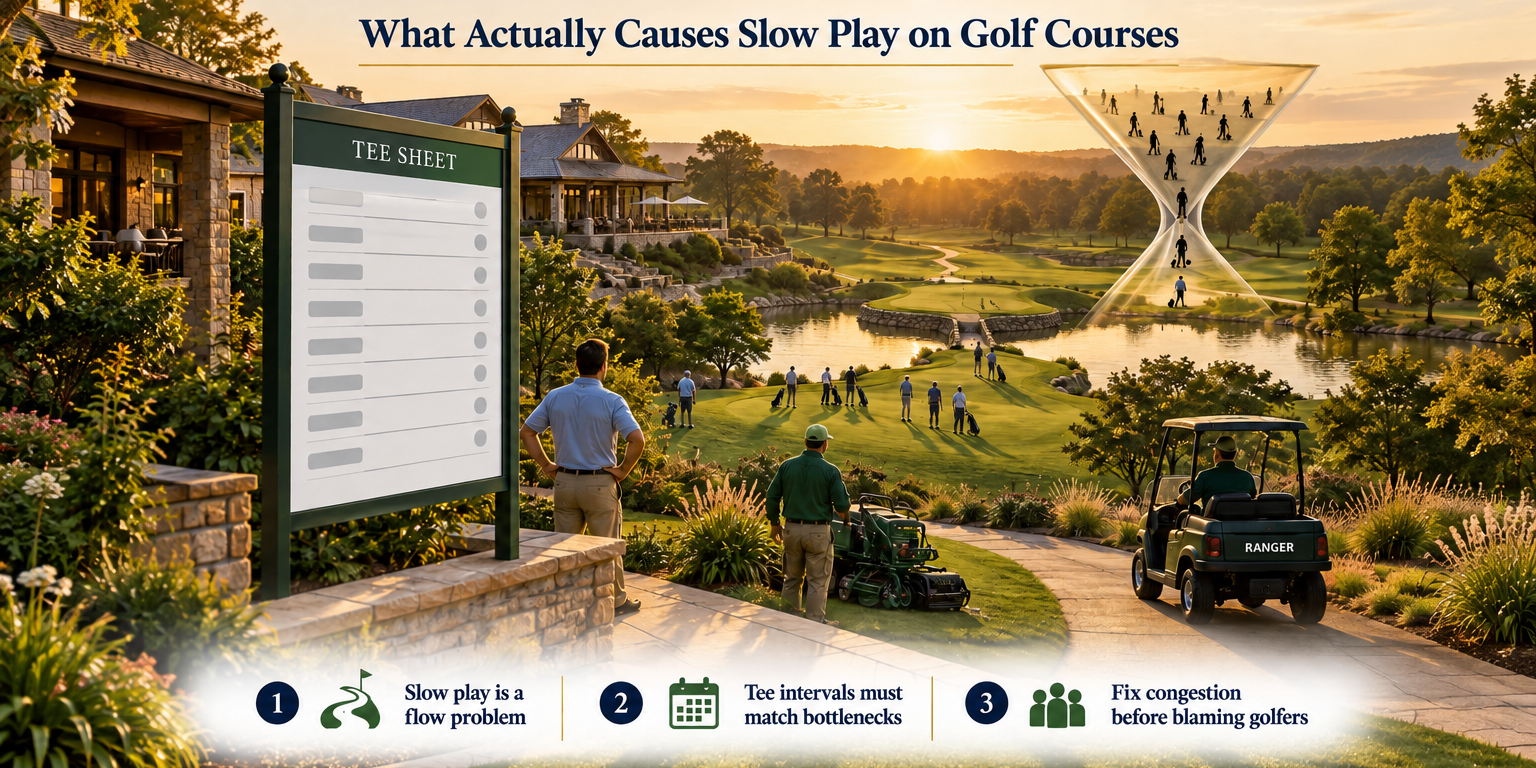
Slow play is rarely a behavior problem. It’s a flow problem. And once you understand where flow breaks down, the causes become predictable.
For a full systems overview, start here:
👉 https://www.fairwayiq.com/guides/pace-of-play-practical-science
The Myth: Slow Golfers Cause Slow Rounds
High handicaps, beginners, older players—these groups often get blamed.
But courses with the same player mix can produce wildly different round times. Why?
Because pace is governed by waiting, not swing speed.
If players are waiting before nearly every shot, the system is already overloaded.
The Real Causes of Slow Play
1. Tee Intervals That Exceed Course Capacity
When tee times are too tight for the course’s bottleneck capacity, congestion is guaranteed.
Small timing mismatches compound quickly.
(See:
👉 /guides/tee-interval-math-pace-of-play)
2. Bottlenecks That Control Throughput
Every course has one hole (often a par 3) that determines the round.
If that hole cannot clear groups at the rate they arrive, spacing collapses behind it.
(See:
👉 /guides/golf-pace-of-play-bottlenecks)
3. Reactive Ranger Enforcement
By the time a ranger is called in, compression has usually spread through multiple holes.
Enforcement becomes emotional instead of operational.
Revolutionize Your Golf Operations with FAIRWAYiQ
Unlock the power of data analytics to optimize your golf course management