
A Board-Ready Case for Cart Geofencing at Municipal Golf Courses
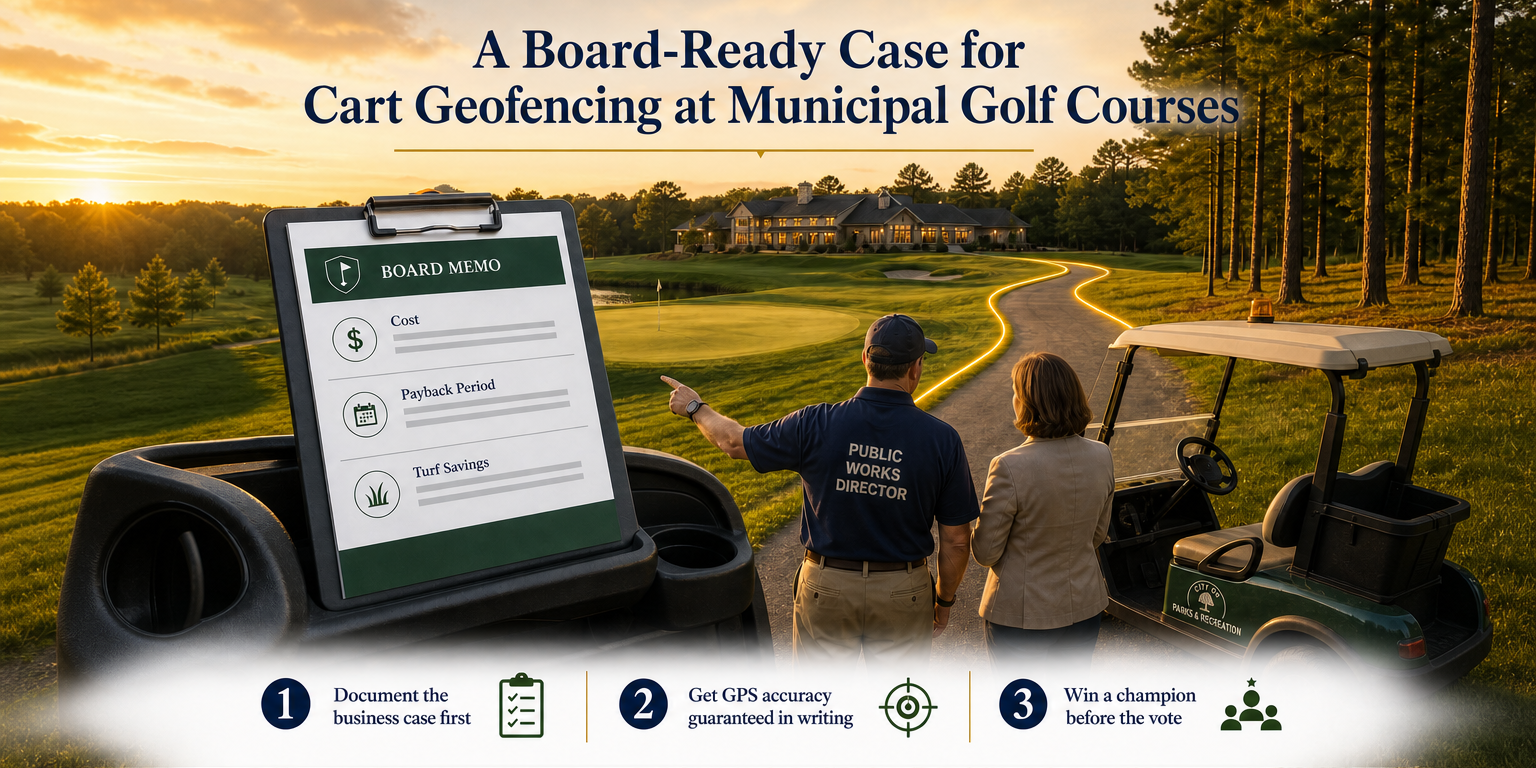
A city council in Mobile just voted to spend $68,115 on a golf cart geofencing system, plus roughly $13,000 every other year to keep it running. The vote and the reasoning behind it are public. This guide is written for municipal golf courses, where the buyer is a city council, a parks and recreation board, or a public works director, and the money comes out of a public budget with public scrutiny. If you run a private club or a golf community with resident-owned carts, your board is a member committee and the argument runs differently; we will cover that case in its own guide.
Geofencing is a capital decision, not a gadget purchase
Treat the request the way a council treats paving a cart path or replacing a mower fleet. It has a purchase price, a recurring cost, and a payback period. Mobile's public works director told Fox10 she expects the system to pay for itself in avoided turf repairs. That is the frame a finance committee understands: carts stop costing you money in a specific, countable way.
Document the operating problem before you ask for money
Councils and parks boards approve line items they can see, not feelings about golfer behavior. Pull repair records for the last two seasons. Count labor hours spent reseeding cart-entry points near bunkers and greens. The USGA's Green Section Record notes that as little as one pass of cart traffic during a frost event can produce noticeable damage, and that most damage concentrates where carts leave and reenter the path near the same points on every hole. Map those points. Attach a photo. Attach a repair invoice. That is your evidence file.
Add golfer complaints and any safety incidents. Mobile's mayor cited personal experience with wayward carts as part of his reasoning. Your board will respond the same way to specifics they recognize from their own rounds.
Build a conservative cost model
Line up the numbers so the reader does the math. Implementation cost. Recurring annual or biennial fee. Staff time to manage the system. Avoided turf repair cost per season. Cost of the alternative, usually ropes, stakes, and a ranger walking the same loop every hour. The 2026 NGCOA Golf Business Pulse Report surveyed over 200 facility owners and operators, and it is worth citing in a public memo because councils trust trade association data more than vendor data. A geofencing system that reduces manual patrol hours is a labor line, not just a turf line. Some courses also generate $12,000 to $20,000 a year in cart screen advertising once the hardware is in place, which offsets recurring cost further. Put that number in a footnote, because it is a bonus, not the justification.
Translate technical requirements into board language
Board members need four questions answered plainly.
- How accurate is the boundary, is that accuracy guaranteed in writing, and what happens when a cart is close to the line but not over it.
- What does the cart do before it locks, warning beep, slow-down, or immediate stop.
- How does an operator override a false lockout, and how fast.
- What does the reporting look like, and who answers the phone when something breaks.
Our guide on false alerts in golf cart geofencing covers why lockouts happen and how to reduce them, and it is worth attaching as an appendix so the board sees you have already thought through the failure modes, not just the sales pitch.
Why standard GPS drift is a physics problem, not a settings problem
Standard consumer GPS drifts 6 to 16 feet. A cart path is typically 8 to 10 feet wide. That means a standard GPS system can place a cart on the wrong side of the path before it has moved an inch. No settings menu fixes that. It is a measurement problem. Our guide on how to evaluate golf cart GPS accuracy claims walks through the questions to ask any vendor about their positioning method. Precision GPS built on RTK corrections is a different measurement category from standard GPS, and it is the reason a boundary can sit tight against a green without triggering false stops on the cart path next to it. If your board is approving a system that will beep or shut carts down automatically, as Mobile's will, accuracy claims deserve the same scrutiny as the price tag. See also our guide on why carts lock up in the wrong places for the operational consequences when accuracy is off.
Build a vendor-neutral scorecard
Score every vendor against the same list, regardless of who is presenting. Procurement rules usually require it, and it protects the staff member who has to defend the choice in public.
- Does it work with a mixed fleet, or does it lock you into one cart manufacturer.
- Who owns the location data, and can you export it.
- How long does installation take, and does it interrupt play.
- What training is included for staff and rangers.
- Will the vendor put its GPS accuracy in writing, as a contractual guarantee with a stated accuracy figure and an on-course acceptance test. A verbal assurance or a brochure claim does not count. If a vendor will not sign a number, that is your answer.
- What support response time is written into the contract.
- What are the contract terms if the system underperforms.
Our guide on OEM vs. independent GPS systems covers the lock-in question in detail, since some manufacturer-branded systems only work on that manufacturer's carts. That matters if your fleet is mixed, or if you want pricing power at renewal.
Build the ROI case before anyone votes
You already have the data to make this decision. What a council needs is payback math it can check itself, using the cost model above. Take two seasons of repair invoices, patrol labor hours, and the vendor's quoted implementation and recurring cost, and lay out the payback in plain numbers: total cost, avoided repair cost per season, ranger labor savings of roughly $14,000 a year where patrol time drops, and any cart screen advertising revenue as an offset. Show the year the system pays for itself. That is the business case, and it should hold up before anyone votes.
A vendor that has done this before can take your past repair invoices and labor records and organize them into the ROI model and the presentation for you. With the AI tools every vendor should be using today, that part is easy. Ask for it.
Win a champion before the vote
The work before the meeting is fast-tracking the council's understanding of the value so the decision can move quickly. Big public expenditures rarely pass when the committee sees them for the first time at the vote. Find one champion first, a council member, a parks board chair, or the finance director, and walk them through the ROI case privately. Once they are convinced, sell the benefit to the other members one by one before the meeting. By the time the item is on the agenda, the vote should ratify a decision the room has already made.
Let committee members hear from people outside your building. Ask the vendor for references at other municipal courses and connect council members directly to them, so they hear best practices and real experience firsthand. A peer at another municipality carries more weight than any slide you present.
What to do this week
- Pull two seasons of turf repair invoices and tag the ones caused by cart traffic.
- Log labor hours spent on manual cart patrol or rope-and-stake maintenance for one week.
- Photograph the three worst cart-damage zones on the course.
- Draft a one-page cost comparison: current spend on repairs and patrol versus estimated system cost and payback period.
- Identify your champion, the council member, parks board chair, or finance director most likely to back the request, and ask vendors for municipal references you can hand to committee members.
- Read our full pillar guide on golf cart geofencing and pull the sections your board will ask about.
Close with a one-page board memo
Structure it in five short sections: the problem (repair cost and labor hours this season), the ask (full system budget and the payback period), the model (implementation cost, recurring fee, avoided repair estimate, payback period), the requirements (accuracy guarantee, override, support response, contractual acceptance test), and the review date (a payback checkpoint after the first season). Keep it to one page. Boards approve what they can read in five minutes.
Where FAIRWAYiQ fits
We are an independent GPS provider, not tied to any single cart manufacturer, and we have worked with municipal, private and community golf operators for 11 years. Our system runs on precision GPS built on RTK corrections, which is why boundaries near greens and tees hold up on narrow cart paths. Onboarding typically takes one to two weeks, and support response is two hours.
If you're building a business case for your own council or parks board, book a call with Mike.
Revolutionize Your Golf Operations with FAIRWAYiQ
Unlock the power of data analytics to optimize your golf course management