
False Alerts in Golf Cart Geofencing: Why They Happen and How to Reduce Them
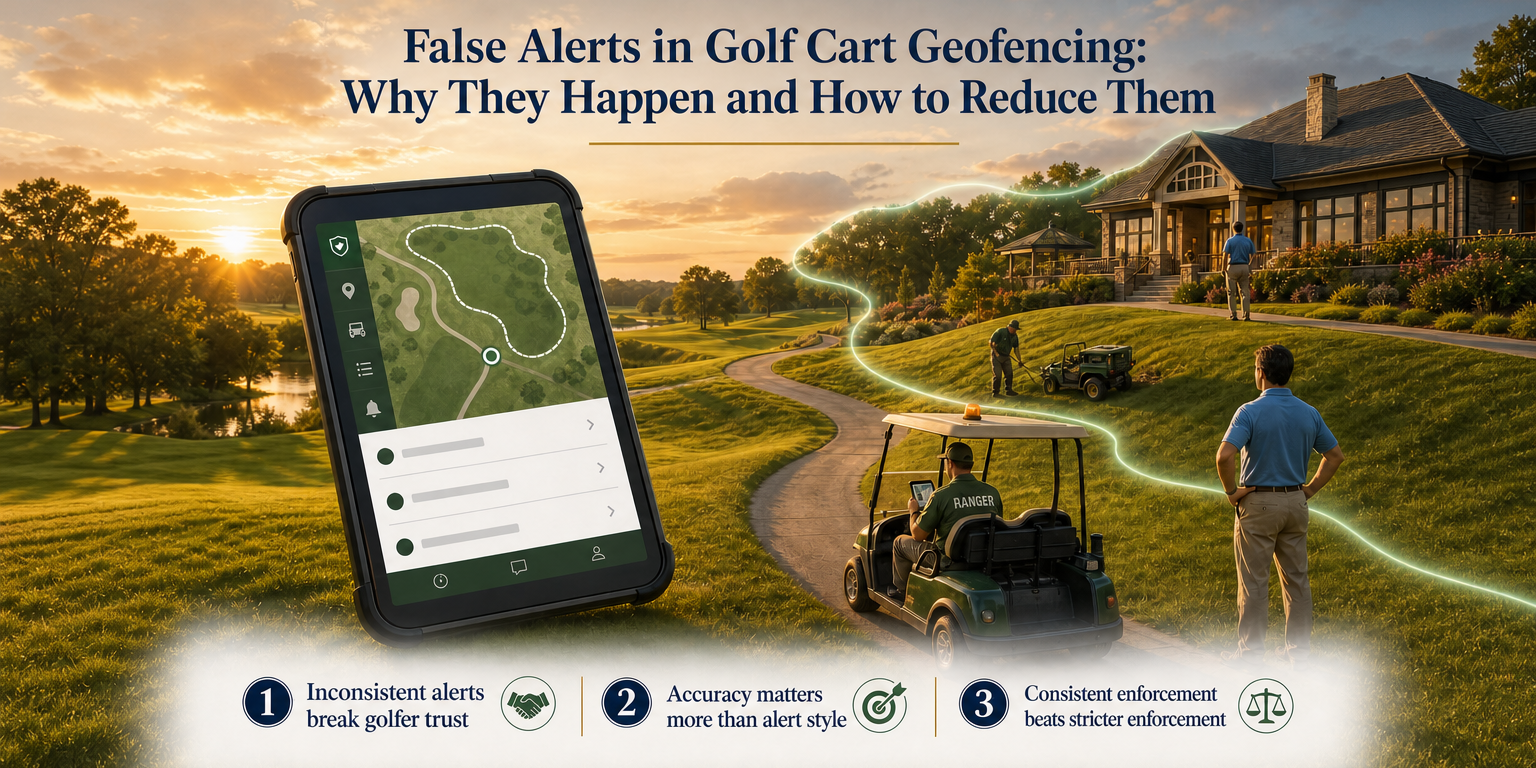
False Alerts in Golf Cart Geofencing: Why They Happen and How to Reduce Them
Intro
False alerts are where golf cart geofencing systems lose credibility.
When carts trigger warnings while clearly following the rules — or alerts fire inconsistently across the course — golfers stop trusting the system. Staff end up apologizing, overriding alerts, or turning enforcement off entirely.
False alerts are rarely caused by “bad behavior.”
They are almost always the result of accuracy limitations and enforcement design choices.
What Is a False Alert?
A false alert occurs when a system signals a violation even though the cart is operating within the intended rules.
Common examples:
- Alert triggers while cart is visibly on the path
- Alert fires intermittently in the same location
- Alert activates on one side of the path but not the other
To golfers, this feels arbitrary. To operators, it becomes noise.
The Three Root Causes of False Alerts
1. GPS Drift
Small positional shifts — often 5–15 feet — can cause carts to appear outside a boundary even when they are not.
This is especially common:
- under tree canopy
- near slopes or terrain changes
- near buildings or cart barns
For a deeper explanation, see:
👉 GPS Drift on Golf Courses
https://www.fairwayiq.com/guides/gps-drift-on-golf-courses
2. Buffer Design Tradeoffs
Most systems widen enforcement zones to avoid constant alerts.
This reduces alert frequency — but introduces edge ambiguity, where:
- some violations are missed
- others trigger late
- enforcement feels inconsistent
This tradeoff is central to cart path enforcement challenges.
3. Alert Timing and Thresholds
Alerts may require:
- a minimum time outside the boundary
- a minimum distance off the path
- repeated violations before triggering
These thresholds reduce noise — but also reduce immediacy and fairness.
Why False Alerts Hurt Compliance
Golfers respond to consistency, not severity.
When alerts feel random:
- compliance drops
- complaints increase
- ranger authority is undermined
- enforcement becomes optional
Over time, golfers learn which alerts “don’t matter.”
How Courses Reduce False Alerts in Practice
Short-term mitigations:
- expanding buffers
- disabling enforcement in problem areas
- switching to softer alerts
Long-term solutions:
- improving positional accuracy
- enforcing at true boundaries
- reducing reliance on artificial tolerance
This is why accuracy matters more than alert style.
For context on enforcement design, see:
👉 Cart Path Geofencing Explained
https://www.fairwayiq.com/guides/cart-path-geofencing-explained
FAQs
Are false alerts inevitable?
Some variability is unavoidable, but high false-alert rates usually indicate accuracy limits.
Can mapping fixes eliminate false alerts?
Only if the issue is mapping error, not drift.
Revolutionize Your Golf Operations with FAIRWAYiQ
Unlock the power of data analytics to optimize your golf course management