
OEM vs. Independent GPS: What Golf Courses Get Wrong
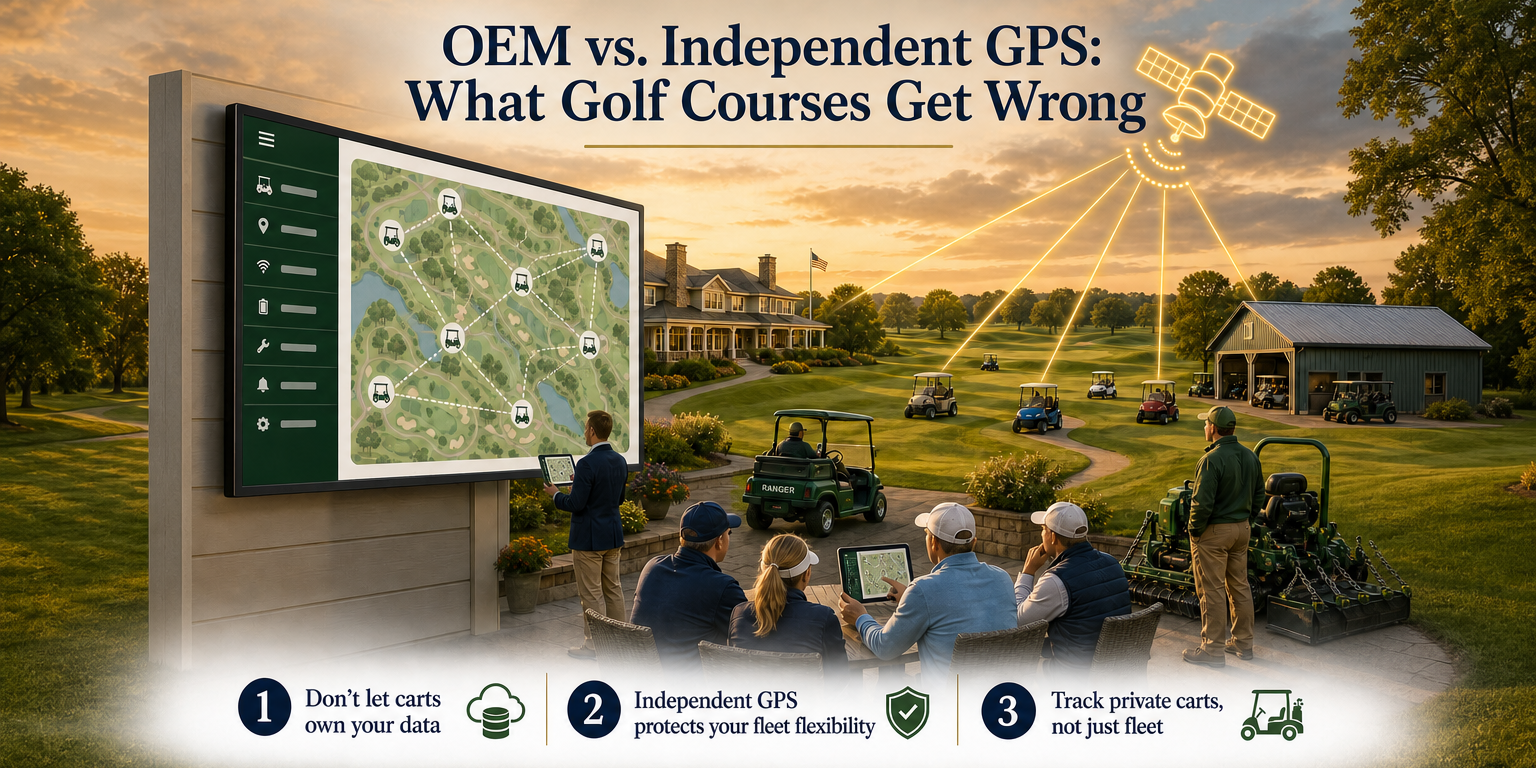
Most GPS Evaluations Miss the Most Important Question
Most golf course operators evaluate GPS systems the same way they evaluate any piece of equipment: features, price, support. That framework works fine for a sprayer or a mower. It does not work for cart GPS.
Cart GPS has a structural decision baked into it that most evaluations skip entirely. The question is whether the system is tied to a specific cart brand or operates independently of it. Getting this wrong means locking your technology strategy to your equipment vendor for the next five to ten years. No feature comparison chart tells you that.
What OEM-Bundled GPS Actually Means for Your Course
OEM-bundled GPS refers to systems sold or included by cart manufacturers that only operate on that manufacturer's fleet. Club Car Visage is installed at more than 2,300 courses. E-Z-GO Onyx follows a similar model. Both are real products with real functionality. The issue is not the features. The issue is the dependency.
The bundling model typically works through lease incentives or integrated pricing. The GPS feels like it comes with the carts because, in most cases, it does. That convenience has a cost that shows up later.
When your fleet lease ends or you switch cart brands, you do not take the platform with you. Your GPS data history, your pace-of-play baselines, your operational workflows built on that system, all of it is tied to the cart vendor relationship. The real cost of OEM-bundled GPS is not the hardware. It is the dependency the hardware creates.
The Private Cart Blind Spot
No OEM-bundled system covers member-owned or guest private carts on the same platform as fleet carts. That is not a minor gap. At courses with active private cart programs, it is a fundamental visibility problem.
Operationally, it means your pace-of-play software only sees part of the round. Private carts move through the course the same as fleet carts, but they are invisible to your tracking system. Revenue data has gaps. On-course communication tools cannot reach those players. Your ranger is working with an incomplete picture every single day.
Wycliffe Golf and Country Club tracks approximately 800 private carts on a single platform. That scale is possible only when the GPS platform treats private carts as a first-class data source, not an afterthought bolted onto the fleet solution.
Courses with 50 or more private cart members running OEM-bundled GPS are effectively operating two separate systems, or one system and a blind spot. Neither option gives you full operational visibility.
The Fleet Lock-In Problem
When you sign into an OEM GPS platform, your GPS strategy becomes contingent on staying with that cart brand. Fleet replacement cycles run five to seven years. GPS contracts often run the same window. The overlap is not a coincidence. It is a trap that is easy to walk into and difficult to walk out of.
Switching cart manufacturers means starting your GPS data history from zero. Pace-of-play trends you spent years building, gone. Hole-by-hole time data that informs your tee interval strategy, gone. Any operational baseline you built on that platform does not transfer to the next one.
Courses considering fleet changes need to factor GPS portability into the decision before signing anything. If your GPS contract and your fleet lease expire at the same time, and your next cart purchase is a different brand, you are not just replacing equipment. You are rebuilding your entire technology foundation from scratch.
Independent GPS platforms decouple your technology strategy from your equipment purchasing decisions. You can change cart brands without changing GPS providers. Your operational data stays intact regardless of what brand of cart comes off the truck next.
What Independent GPS Makes Possible
An independent GPS platform works across any cart manufacturer simultaneously. Club Car, E-Z-GO, Yamaha, private carts, all on the same dashboard, all contributing to the same data set. No mixed-fleet blind spots. No split operations.
Precision GPS built on RTK architecture delivers one to three centimeter accuracy. That level of precision is not available from most OEM-bundled offerings. The difference matters for geofencing, boundary enforcement, and pace-of-play measurement. Standard GPS operates at a different accuracy category. RTK correction technology is not a better version of standard GPS. It is a different measurement system entirely.
Private Cart Manager tracks member and guest private carts on the same platform as fleet carts. One platform. One pace-of-play data set. One dashboard covering everything in the barn and everything on the course.
Data continuity across fleet changes means your operational history stays intact regardless of what cart brand you buy next. You are not starting over. You are continuing.
Questions to Ask Before Signing a GPS Contract
Most GPS sales conversations are driven by feature demonstrations. Ask structural questions instead. The answers reveal what the demo does not show you.
- Does this system work if I add carts from a different manufacturer?
- What happens to my data and platform access if I switch cart brands?
- Can this system track private member carts on the same platform as fleet carts?
- What is the process for transferring historical data if I change providers?
- Who owns the data, the course or the vendor?
- Is precision RTK GPS available, and does it require a specific cart brand to access it?
If any of those answers are unclear, or if the sales rep redirects to a features conversation instead of answering directly, that tells you something important about what you are walking into.
The Comparison That Actually Matters
OEM-bundled GPS and independent GPS are not different grades of the same product. They are different structural bets.
OEM-bundled GPS bets that you will stay with one cart brand, that your fleet will never include private carts that need tracking, and that the features bundled into that system today will be sufficient for the next five to seven years. Some courses can make that bet comfortably. Most cannot.
Independent GPS bets that your fleet will change, that private carts are a real operational category that deserves first-class data treatment, and that your technology strategy should be yours to control regardless of who builds your carts.
The feature lists between these systems may look similar on a comparison chart. The structural implications are not similar at all.
Make the Vendor Dependency Decision Consciously
The cart GPS decision is not just a technology decision. It is a vendor dependency decision. OEM-bundled systems offer real convenience at the point of purchase. That convenience has terms attached to it.
Courses that evaluate GPS on features and price alone, without accounting for fleet lock-in and private cart coverage, tend to discover the gaps only after they have signed. The contract is in place. The fleet lease is running. The GPS platform is live. And then a member asks why their private cart is invisible to the pace-of-play system, or the GM starts looking at a different cart brand and realizes the GPS conversation just got a lot more complicated.
Ask the structural questions first. What brand of cart will I be running in seven years? What happens to my data if that answer changes? Can this platform see every cart on my course, not just the ones from one manufacturer?
The answers tell you more than any feature comparison chart.
Revolutionize Your Golf Operations with FAIRWAYiQ
Unlock the power of data analytics to optimize your golf course management