
What Is Precision GPS (RTK) and Why Golf Courses Care?
Intro
Most golf cart GPS systems provide location data within several feet of accuracy. That’s sufficient for navigation and general tracking.
But when enforcement depends on knowing whether a cart is on the path or off it by a few feet, standard GPS begins to show its limits.
Precision GPS — often powered by correction methods such as RTK (Real-Time Kinematic positioning) — reduces that positional uncertainty dramatically. For golf courses, that difference changes what enforcement systems are capable of doing.
What Is Standard GPS?
Standard GPS determines position using satellite signals. In open environments, it typically delivers accuracy within:
- 5–15 feet
- Sometimes worse under tree canopy
- Variable depending on terrain and signal reflection
For many consumer applications, that range is acceptable. For narrow cart paths and edge-based enforcement, it introduces drift and tolerance challenges.
For more on how drift shows up on courses, see:
👉 https://www.fairwayiq.com/guides/gps-drift-on-golf-courses
What Is Precision GPS?
Precision GPS improves standard positioning by applying correction signals that account for:
- Satellite timing errors
- Atmospheric interference
- Signal reflection
- Receiver variability
RTK is one common method used in industries where inches matter — agriculture, construction, surveying.
The result is:
- Reduced positional drift
- Greater repeatability
- More stable alignment to mapped boundaries
This isn’t about perfection. It’s about predictability.
Why Accuracy Matters on a Golf Course
Golf courses are uniquely sensitive to positioning error because:
- Cart paths are narrow
- Turf edges matter
- Restricted areas are irregular
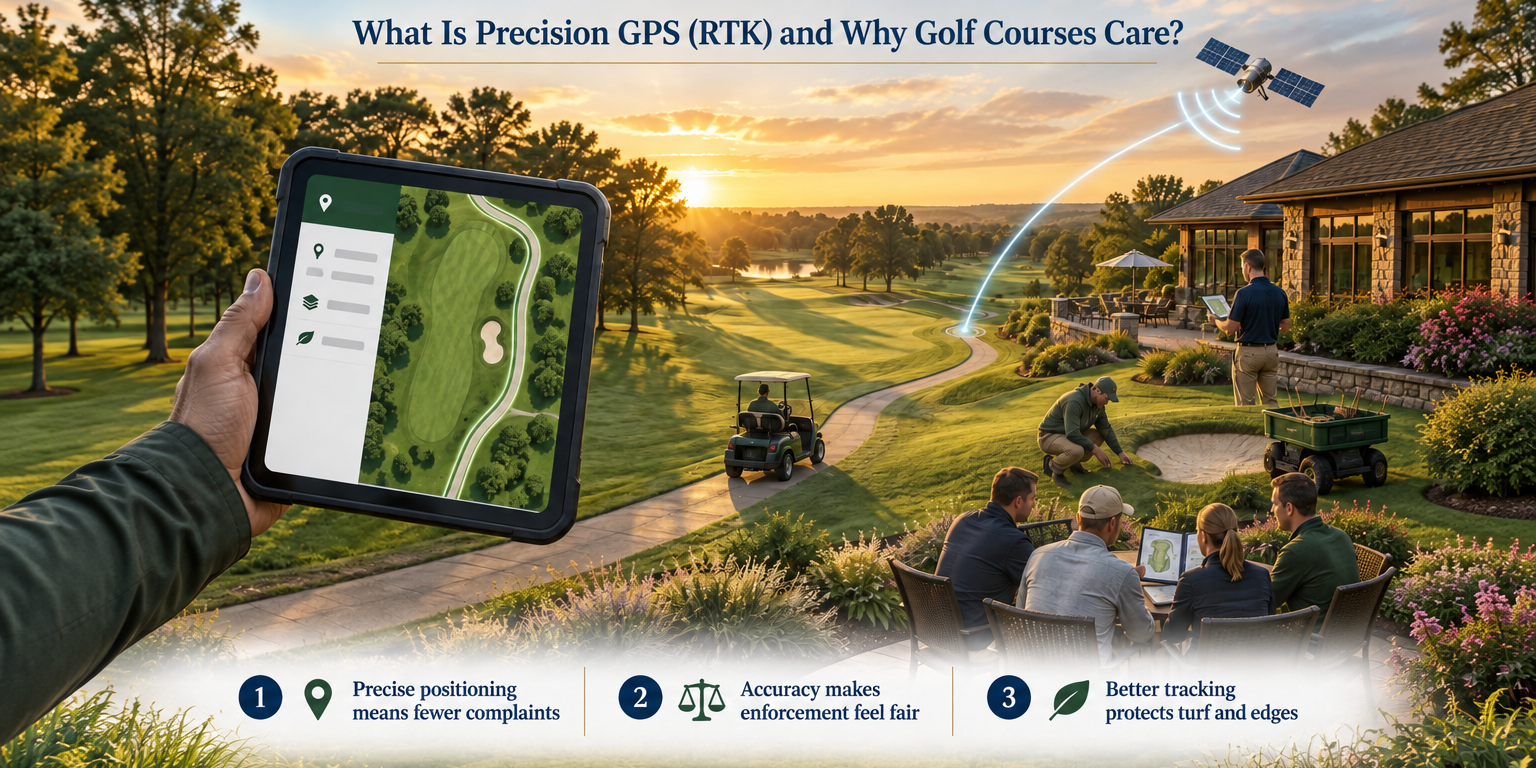
- Enforcement must feel fair
If a system must widen buffers to function, enforcement becomes inconsistent.
For context, see:
👉 Cart Path Geofencing Explained
https://www.fairwayiq.com/guides/cart-path-geofencing-explained
Where Precision GPS Makes the Biggest Difference
Precision GPS matters most when:
- Enforcing cart-path-only rules
- Protecting bunker edges and greenside turf
- Reducing false alerts
- Operating under heavy tree canopy
- Running zero-buffer enforcement
See:
👉 Zero-Buffer Cart Path Geofencing
https://www.fairwayiq.com/guides/zero-buffer-cart-path-geofencing
What Precision GPS Does Not Do
Precision GPS does not:
- Eliminate variability entirely
- Replace operational judgment
- Remove the need for mapping discipline
It reduces reliance on artificial tolerance and enforcement workarounds.
Operator Perspective
Most courses don’t initially seek “centimeter-level accuracy.”
They seek:
- Fewer complaints
- Fair enforcement
- Less ranger conflict
- Better turf protection
Accuracy becomes relevant because it enables those outcomes.
FAQs
Is RTK required for precision GPS?
RTK is one method of achieving high accuracy, but the outcome — stable, repeatable positioning — is what matters operationally.
Is precision GPS necessary for restricted-area enforcement?
Not always. Larger zones tolerate more variation. Narrow paths do not.
Does tree canopy affect precision GPS?
Yes — but correction systems significantly reduce the variability compared to standard GPS.
Is precision GPS more complex to manage?
It depends on implementation, but most modern systems automate correction processes.
Revolutionize Your Golf Operations with FAIRWAYiQ
Unlock the power of data analytics to optimize your golf course management