
Zero-Buffer Cart Path Geofencing
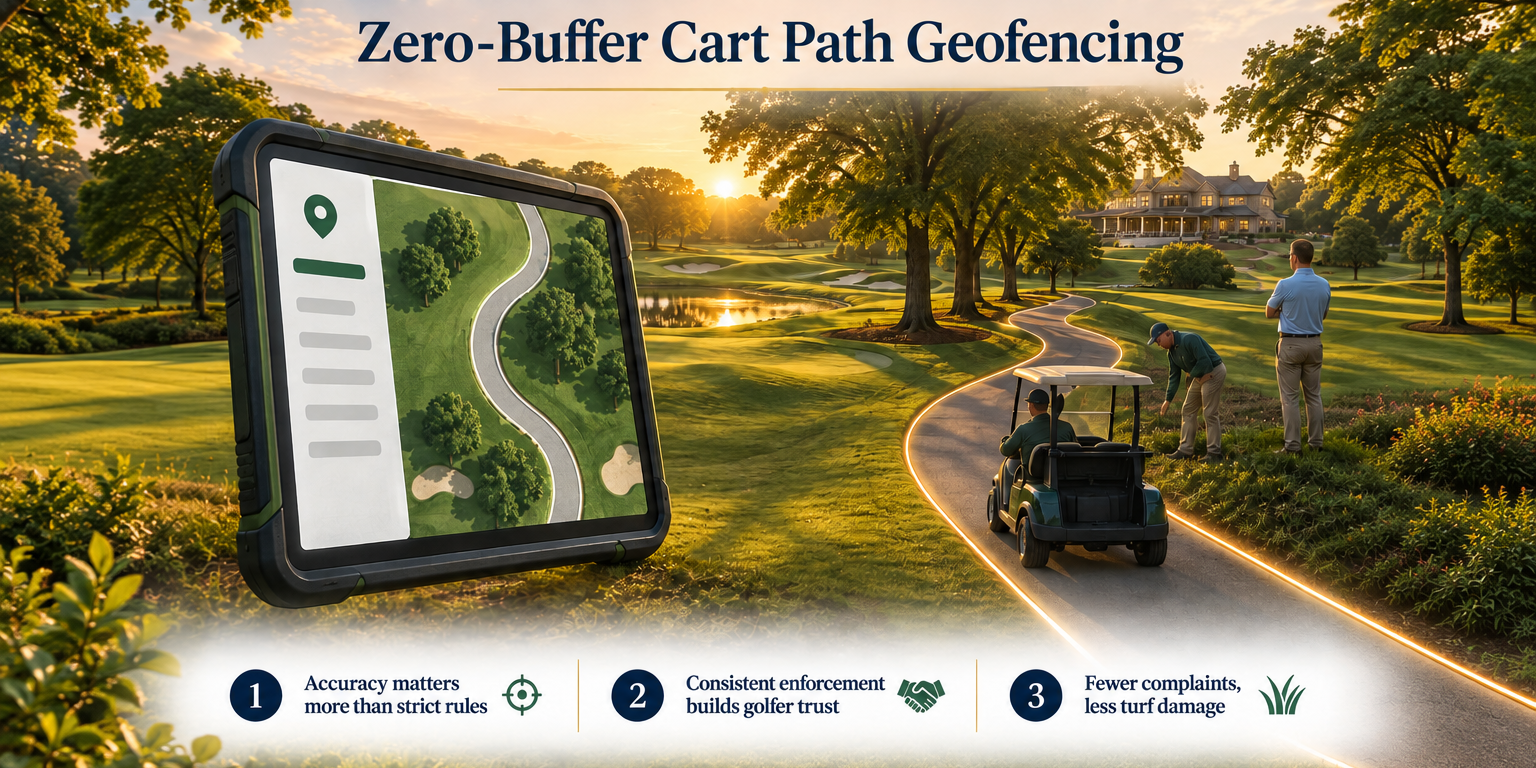
Zero-Buffer Cart Path Geofencing: Why Accuracy Changes Everything
Intro
Most cart path geofencing systems rely on buffer zones - invisible margins that allow carts to drift off the path before alerts trigger.
Zero-buffer geofencing removes that safety net.
This approach only works when positioning accuracy is high enough to enforce boundaries as mapped, without compensating for drift. For courses that want consistent enforcement and fewer golfer complaints, this distinction matters.
What Is Zero-Buffer Geofencing?
Zero-buffer geofencing means:
- Cart paths are enforced at their true physical edges
- Alerts trigger immediately when carts leave the path
- No artificial tolerance is added to mask GPS inaccuracies
It doesn’t mean “no forgiveness” - it means no technical workaround for poor accuracy.
Why Traditional Systems Can’t Do This Reliably
Standard GPS systems fluctuate several feet under real-world conditions.
Without buffers, that variability would:
- Trigger constant false alerts
- Frustrate golfers
- Undermine trust in the system
As a result, most platforms widen boundaries instead - sacrificing enforcement precision.
Why Golf Courses Feel the Difference Immediately
When zero-buffer enforcement is possible:
- Alerts feel fair and predictable
- Golfers trust the system
- Compliance improves without ranger intervention
- Turf damage decreases in high-risk areas
Behavior changes when rules are enforced consistently.
Accuracy Is the Enabler (Not the Feature)
Zero-buffer geofencing depends on:
- Stable, repeatable positioning
- Minimal drift under tree canopy
- Accurate alignment between mapped paths and real-world movement
This level of precision was originally developed for industries like agriculture and construction, where inches matter.
For background, see:
👉 Precision GPS for Golf Carts: Lessons from Agriculture
https://www.fairwayiq.com/guides/precision-gps-for-golf-carts-lessons-from-agriculture
How This Relates to Cart Path Enforcement
Zero-buffer enforcement solves the core cart path problem:
- Narrow paths
- High expectations of fairness
- Immediate feedback
Without it, operators are forced to compromise enforcement or accept complaints.
For the foundational explanation of cart path rules, see:
👉 Cart Path Geofencing Explained/guides/cart-path-geofencing-explained
Common Misconceptions
“Zero-buffer just means stricter rules.”
No — it means rules are enforced accurately, not aggressively.
“Golfers won’t tolerate it.”
Golfers tolerate consistency far more than randomness.
“Mapping must be perfect.”
Mapping must be good, but accuracy matters more.
FAQs
Is zero-buffer geofencing realistic on wooded courses?
Only with sufficiently accurate positioning. Otherwise buffers are unavoidable.
Does this eliminate the need for rangers?
No — it reduces manual intervention, but human judgment still matters.
Is this the same as restricted-area enforcement?
No. Restricted areas tolerate error; cart paths do not.
Revolutionize Your Golf Operations with FAIRWAYiQ
Unlock the power of data analytics to optimize your golf course management