
GPS Drift on Golf Courses
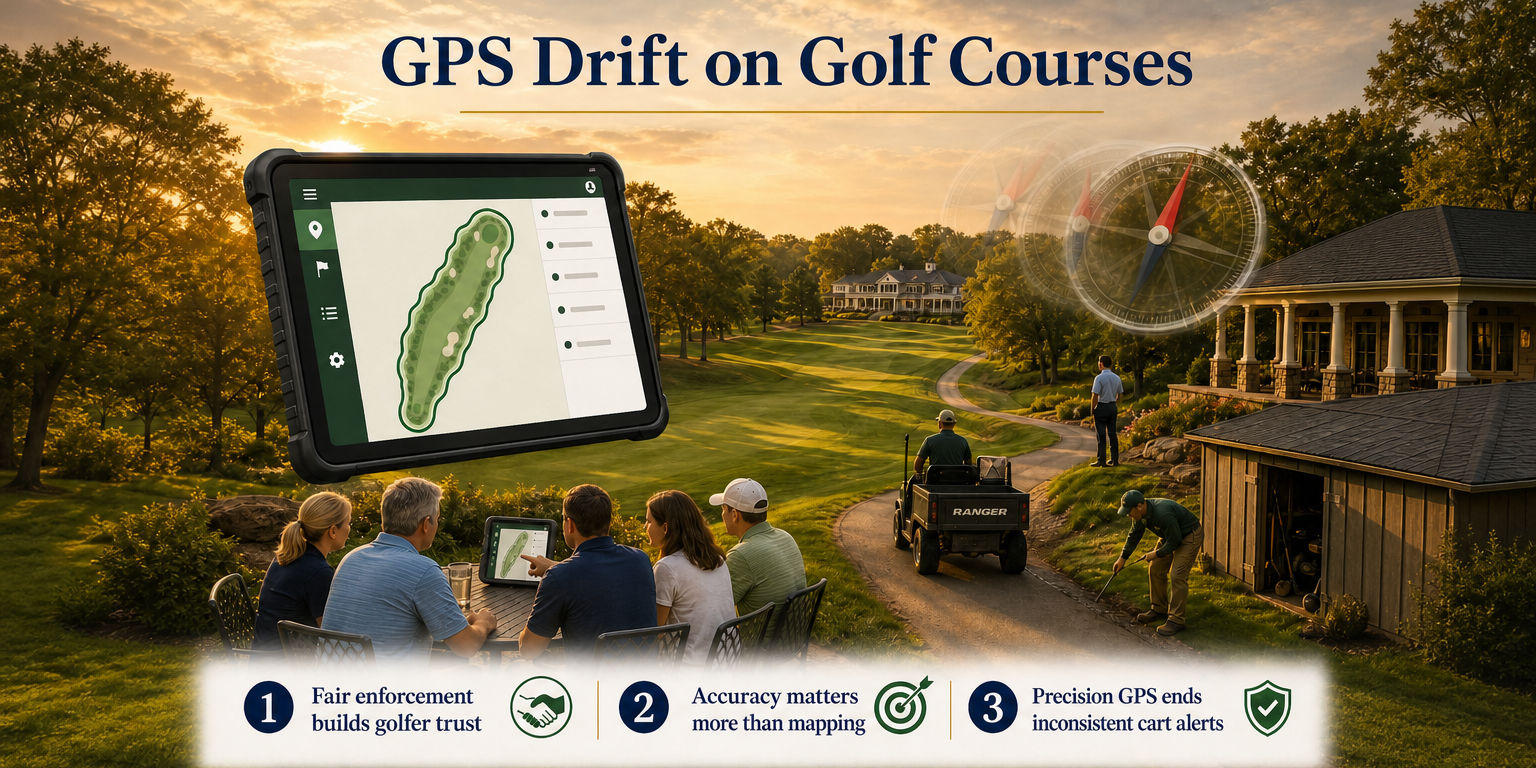
GPS Drift on Golf Courses: Why Cart Path Geofencing Fails (and What to Do About It)
Introduction
Golf courses rely on GPS to enforce cart paths, protect turf, and manage golfer behavior. But many operators eventually notice something that doesn’t make sense: carts triggering alerts while clearly on the path — or worse, not triggering alerts when they leave it.
This isn’t a mapping problem. It’s usually GPS drift.
Understanding why GPS drift happens — and how it affects cart path geofencing — is essential if you want fair enforcement, fewer complaints, and real turf protection.
What Is GPS Drift?
GPS drift is the natural variation in reported position that occurs even when a vehicle is stationary or moving predictably. On a golf course, this can mean a cart appears to move several feet side-to-side or forward-backward even though it hasn’t.
Standard GPS systems commonly experience 5–15 feet of positional variation. That may sound minor, but it’s enough to undermine geofencing entirely when cart paths are narrow or when restricted areas are close to play.
This is one of the most common reasons courses struggle with cart path enforcement — even when their maps look “correct.”
Why GPS Drift Is Worse on Golf Courses
Golf courses are uniquely difficult environments for GPS accuracy. Drift increases due to:
1. Tree Canopy
Dense tree cover interferes with satellite signals, causing inconsistent position fixes.
2. Terrain Changes
Elevation shifts, slopes, and valleys affect signal geometry and accuracy.
3. Reflections and Obstructions
Clubhouses, maintenance buildings, cart sheds, and even terrain edges can reflect GPS signals, confusing the receiver.
4. Consumer-Grade GPS Hardware
Many cart GPS systems rely on the same accuracy levels used for navigation apps — which were never designed for enforcing boundaries measured in feet.
The result: position “wander” that shows up as false violations or missed enforcement.
How GPS Drift Breaks Cart Path Geofencing
When drift exists, operators usually compensate by adding a buffer zone around cart paths.
That creates new problems:
- Alerts trigger late, after carts are already off the path
- Enforcement feels inconsistent to golfers
- Operators lose confidence in the system
- Staff end up manually overriding or disabling alerts
This is why many courses say, “Geofencing doesn’t really work” — when the real issue is accuracy, not intent.
For a deeper explanation of how geofencing is supposed to work, see:
👉 Golf Cart Geofencing: Complete Guide
https://www.fairwayiq.com/guides/golf-cart-geofencing-pillar
Drift vs Mapping Errors (A Critical Distinction)
Courses often assume enforcement issues come from bad maps. In practice:
- Mapping errors are consistent and repeatable
- GPS drift is intermittent and unpredictable
If alerts fire sometimes but not others — especially in wooded areas — drift is the likely cause.
No amount of remapping fixes an accuracy limitation.
Why Precision GPS Changes the Equation
Precision GPS systems (often adapted from agriculture and construction) reduce drift by:
- Using correction signals
- Improving satellite geometry
- Maintaining consistent position relative to physical boundaries
Instead of guessing within a wide tolerance, these systems can keep carts aligned closely with mapped paths — enabling true cart-path enforcement without oversized buffers.
To understand how this technology migrated from farming into golf operations, see:
👉 Precision GPS for Golf Carts: Lessons from Agriculture
https://www.fairwayiq.com/guides/precision-gps-for-golf-carts-lessons-from-agriculture
And for the full foundation:
👉 Precision GPS for Golf Carts (Pillar)
https://www.fairwayiq.com/guides/precision-gps-golf-carts-pillar
Operational Signs GPS Drift Is Hurting You
You’re likely dealing with drift if:
- Golfers complain about “unfair” alerts
- Alerts work on some holes but not others
- Staff disables enforcement in wooded areas
- Cart path rules are ignored over time
- Turf damage persists despite geofencing
These are behavioral signals — not technical ones — and they usually show up before operators diagnose the root cause.
What Courses Can Do About GPS Drift
Short of changing technology, options are limited:
- Increase buffer zones (reduces enforcement effectiveness)
- Turn enforcement on only in open areas
- Accept inconsistency and manage complaints
Courses that want consistent, fair enforcement eventually move toward higher-accuracy positioning rather than adjusting rules to fit technical limitations.
FAQs
How much GPS drift is normal on a golf course?
Standard GPS systems often vary by 5–15 feet, and sometimes more under trees or near buildings.
Is GPS drift the same as signal loss?
No. Drift occurs even when a signal is present; it’s a precision issue, not a connectivity issue.
Can remapping cart paths fix drift?
No. Mapping defines boundaries; drift affects where the cart is perceived relative to those boundaries.
Why do some holes work fine while others don’t?
Tree density, terrain, and nearby structures vary across the course, affecting accuracy.
Is GPS drift noticeable to golfers?
Yes — especially when alerts feel random or inconsistent.
Revolutionize Your Golf Operations with FAIRWAYiQ
Unlock the power of data analytics to optimize your golf course management