
Cart Path Geofencing Explained
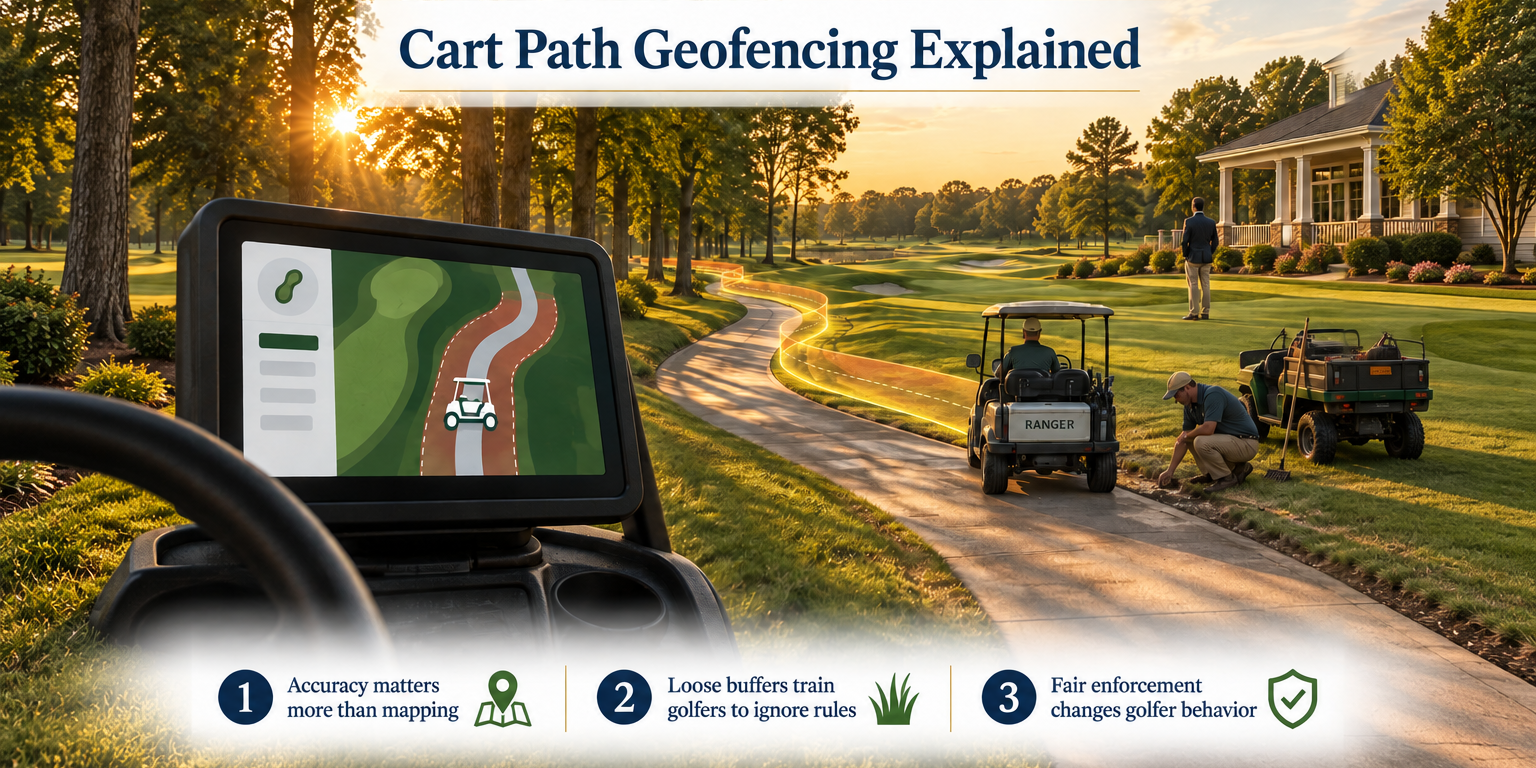
Cart Path Geofencing Explained: How It Works, Where It Breaks, and Why Accuracy Matters
Intro
Cart path geofencing sounds simple: define the cart path, alert golfers when they leave it, protect turf.
In practice, many courses find enforcement inconsistent, frustrating for golfers, and difficult to rely on operationally. The gap between expectation and reality usually comes down to how geofencing actually works — and its dependence on GPS accuracy.
This guide explains cart path geofencing from an operator’s perspective: what it is, how it’s typically implemented, and why so many systems struggle in real-world conditions.
What Is Cart Path Geofencing?
Cart path geofencing uses virtual boundaries mapped along cart paths to detect when a golf cart leaves the approved area. When a cart crosses the boundary, the system triggers an alert — typically on the in-cart screen or through another notification method.
Unlike restricted-area geofencing (which blocks access entirely), cart path geofencing is about continuous compliance over long distances and narrow corridors.
That distinction matters.
How Cart Path Geofencing Actually Works
Most systems follow this workflow:
- Cart paths are digitally mapped
- A virtual boundary is drawn around the path
- The cart’s GPS position is constantly checked against that boundary
- Alerts are triggered when the cart exits the zone
The challenge is that cart paths are narrow, often only a few feet wide — leaving little margin for positioning error.
Why Buffer Zones Exist (and Why They’re a Problem)
Because standard GPS systems experience position variation, most cart path geofencing relies on buffer zones — expanding the allowed area beyond the physical path.
Buffers are meant to prevent false alerts, but they introduce tradeoffs:
- Enforcement triggers late
- Golfers can drive several feet off-path before an alert occurs
- Repeated violations feel “allowed”
- Turf damage still happens
This is why cart path rules often feel optional, even when technology is present.
Cart Path Geofencing vs Restricted-Area Geofencing
These two are often lumped together — incorrectly.
Restricted areas tolerate buffers. Cart paths don’t.
This is why accuracy becomes non-negotiable for path enforcement.
The Role of GPS Drift
If cart path alerts feel random, inconsistent, or unfair, GPS drift is usually the cause.
Drift causes carts to:
- Appear off the path while clearly on it
- Miss violations entirely in certain areas
- Trigger alerts differently hole-to-hole
For a deeper explanation of why this happens on golf courses, see:
👉 GPS Drift on Golf Courses
https://www.fairwayiq.com/guides/gps-drift-on-golf-courses
Why Mapping Alone Doesn’t Solve the Problem
Courses often respond to enforcement issues by remapping paths.
That can help only if the issue is mapping error. But when drift is present:
- Better maps don’t improve position accuracy
- Operators end up widening buffers instead
- Enforcement quality declines over time
This is where many teams quietly give up on cart path geofencing altogether.
When Cart Path Geofencing Actually Works Well
Cart path geofencing performs best when:
- GPS accuracy is consistent within a few feet
- Tree canopy interference is minimal
- Enforcement rules are clear and visible to golfers
- Alerts are immediate and predictable
In these conditions, golfer behavior changes — because enforcement feels fair.
FAQs
Why does cart path geofencing work on some holes but not others?
Tree density, terrain, and nearby structures affect GPS accuracy differently across the course.
Can alerts be delayed intentionally?
Yes, but delays reduce effectiveness and make enforcement feel optional.
Are audible alerts better than on-screen alerts?
Audible alerts get attention faster but can frustrate golfers if accuracy is poor.
Is cart path geofencing worth it without precision GPS?
It can help, but expectations should be limited — especially in wooded or narrow areas.
Revolutionize Your Golf Operations with FAIRWAYiQ
Unlock the power of data analytics to optimize your golf course management