
Why Standard GPS Fails in Golf Communities - And What Precision Changes
Why Standard GPS Fails in Golf Communities - And What Precision Changes
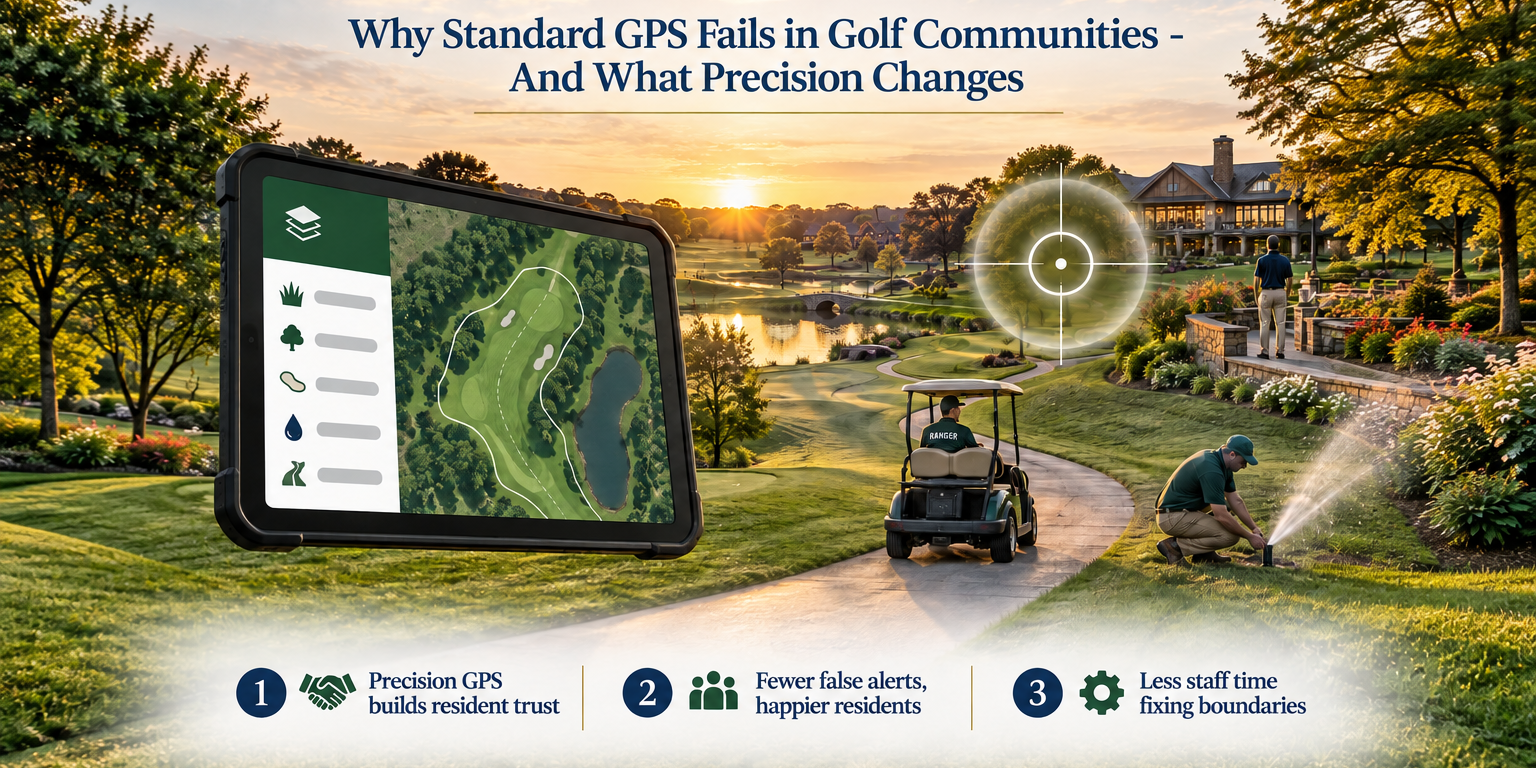
If your golf community has deployed cart GPS and the system still generates complaints about false alerts, inconsistent enforcement, and geofences that do not match reality — the problem is probably not the software, the mapping, or the configuration. It is the GPS accuracy.
What Standard GPS Actually Delivers
Under ideal conditions, standard GPS delivers 2 to 5 meters of horizontal accuracy. On a golf course, conditions are rarely ideal. Tree canopy adds 3 to 10 meters of error. Clubhouses and structures create multi path reflections adding 2 to 8 meters. Water features add 1 to 5 meters. Under real-world course conditions, accuracy degrades to 5 to 15 meters, and can spike to 20 to 30 meters.
A cart path is 8 to 10 feet wide. Standard GPS error routinely exceeds the dimensions of the features it is supposed to protect. The system cannot reliably tell whether a cart is on the path or on the fairway.
The Failure Cascade
Stage 1: Buffer Zones Replace Real Boundaries
To prevent constant false violations, operators add 15- to 50-foot buffer zones around every geofence. On a cart-path-only day, alerts fire when carts are still well within the legal riding area.
Stage 2: GPS Drift Creates Inconsistent Enforcement
Standard GPS positions drift throughout the day. The same cart driving the same path triggers an alert at 8 AM but not at 2 PM. For retired community residents who play daily, this inconsistency is maddening. They learn enforcement is random, and compliance erodes.
Stage 3: Staff Spends Hours Chasing the Problem
Operations teams spend 2 to 3 hours per week adjusting geofence boundaries to compensate for drift - 100 to 150 hours per year of maintenance that never resolves the underlying problem.
Stage 4: The System Gets Disabled
Staff reduces geofence sensitivity or disables enforcement in problem areas. The technology investment is wasted.
The root cause: most communities believe they have a software or mapping problem. They have a GPS accuracy problem. No amount of boundary adjustment fixes a position that is wrong by 5 to 30 meters.
Why Communities Are More Vulnerable Than Course Fleets
Resident tolerance is lower. Private cart owners live in the community, play daily, and have strong opinions about fairness. A resident who receives false alerts three times a week will call the pro shop, the committee chair, and the board.
The fleet is larger and more diverse. 500 unique cart-sensor combinations across a larger geographic area means more opportunities for accuracy failures.
Governance depends on trust. If the system alerts some carts but not others on the same path, residents challenge the governance framework itself.
What Precision GPS Does Differently
Precision GPS uses Real-Time Kinematic (RTK) correction to achieve centimeter-level precision - a 100x to 500x improvement. Standard GPS measures a signal’s code, changing at about 1 million cycles per second. RTK measures the carrier wave at over 1.5 billion cycles per second - 1,500 times finer resolution.
RTK also uses a network of reference base stations to cancel out ionospheric delay, atmospheric interference, satellite clock drift, and orbital errors. The result: positioning accurate to the centimeter, consistent across hours and seasons, and stable under tree canopy.
Head-to-Head on a Golf Course
Cart on an 8-foot cart path: Standard GPS cannot reliably detect position. Precision GPS is accurate to the inch.
Cart approaching green surround: Standard triggers 15–49 feet early or late. Precision fires at the mapped boundary.
Geofence around maintenance area: Standard requires 50+ foot buffer. Precision enables zero-buffer enforcement.
Cart-path-only day: Standard enforcement is inconsistent. Precision is consistent every round.
Under tree canopy: Standard degrades to 10–30m error. Precision maintains sub-meter accuracy.
Position over 8 hours: Standard drifts within a circle 30–100 feet wide. Precision keeps all positions within a circle smaller than a golf ball.
The Agriculture Analogy: Proven at Scale
Farmers using standard GPS for auto-steering experienced 10–20 inch overlaps between passes, wasting seed, fertilizer, and fuel. RTK reduced error to under 2 inches. Golf courses face the identical challenge: standard GPS error is larger than the features being managed. Precision GPS delivers the same accuracy that transformed agriculture, applied to golf course geometry.
[Learn more about precision GPS fundamentals → /guides/guides-what-is-precision-gps-golf-courses]
The Competitive Reality
FAIRWAYiQ is the only GPS provider serving private cart communities that offers precision GPS positioning. Every other vendor operates on standard GPS. This is not a feature comparison - it is a technology generation gap.
Communities evaluating GPS should ask: what is your system’s horizontal positioning accuracy under real-world course conditions? If the answer is measured in meters, the system will require buffers, tolerate drift, and generate false alerts. If measured in centimeters, it can enforce boundaries as mapped and earn resident trust.
Use the ROI Calculator → https://www.fairwayiq.com/fairwayiq-roi-calculator
Book a Discovery Call → https://calendly.com/d/3bz-wp5-rrp/fairwayiq-product-discovery-call
Revolutionize Your Golf Operations with FAIRWAYiQ
Unlock the power of data analytics to optimize your golf course management