
Golf Cart Rules Golf Communities Should Put in Writing This Fall
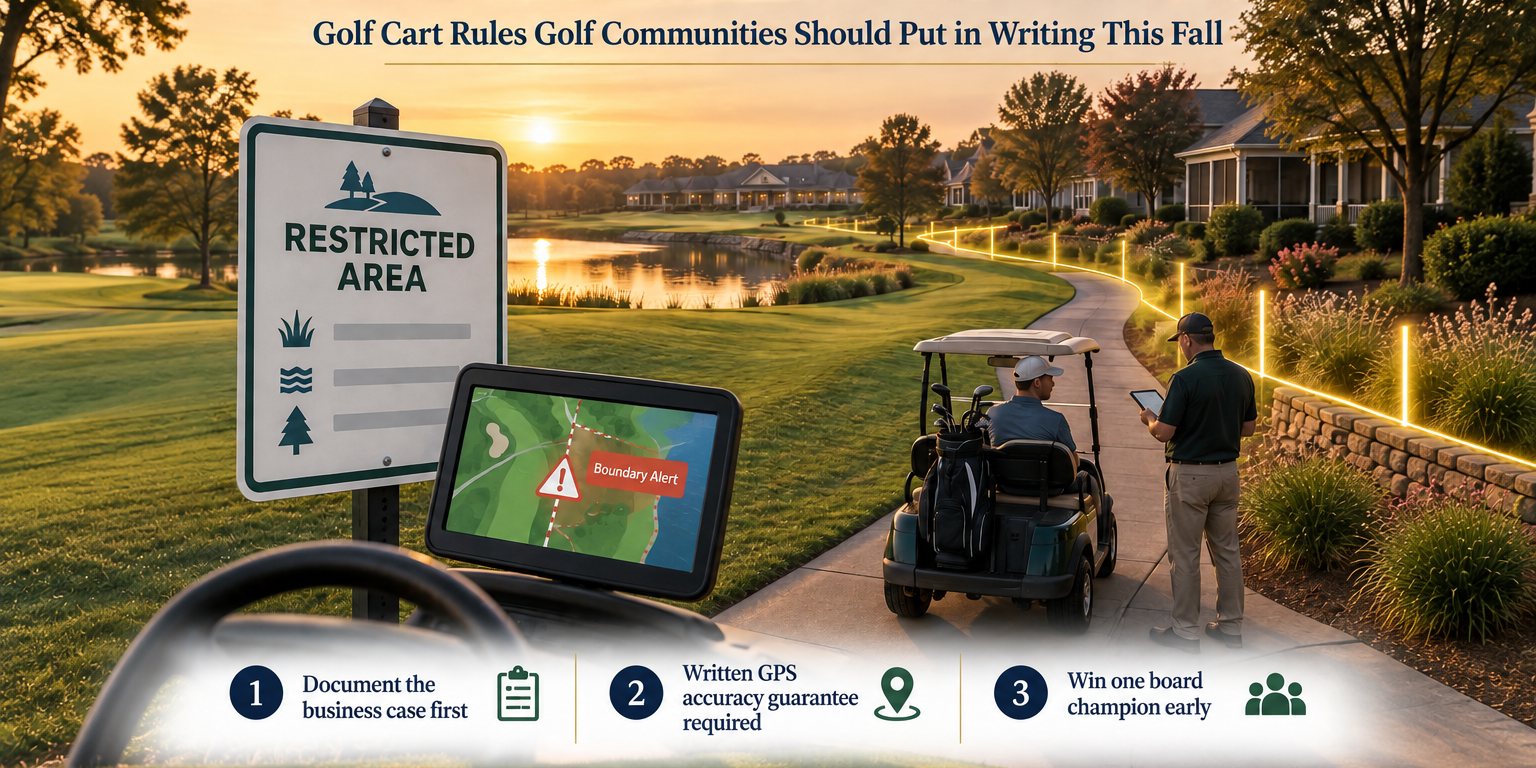
Two golf community associations this year posted the same kind of notice for residents: here is where a golf cart may not go. San Diego Country Estates Association posted its reminder in August and warned that repeated violations may bring citations, fines or suspension of association privileges. Evergreen Property Owners Association posted its own in June. Neither notice changes anything about how the rule gets enforced tomorrow morning.
This guide is written for golf communities with resident-owned carts, where the board is a homeowner committee, not a golf course operations team. If you sit on that board, or manage the community day to day, the reminder letter is familiar. What comes after it usually is not.
Two community associations just re-issued cart rule reminders
SDCEA's August notice covers e-bikes, e-motorcycles, scooters and golf carts. The association says it has seen an increase in minors operating these vehicles in restricted areas, including the golf course, horse trails, the Administration Building grounds, and the pool and snack bar area. Vehicles that are not registered with SDCEA and lack the required trail pass are prohibited in those areas. The notice states that staff will continue monitoring and that repeated violations may result in citations, fines, or suspension of association privileges.
Evergreen POA's June notice sets a minimum operating age of 16 on private roads and reminds residents that Crane Watch Golf Course is private property, not common area, and is off limits without express permission. Both associations are doing the same basic thing: publishing the rule again and asking residents to comply.
Why posted signage breaks down as private cart ownership grows
A sign at a trailhead or a clause in the covenants tells a resident what the rule is. It does nothing to tell the board when the rule is broken. That gap is not new, but it gets harder to manage as more households in a community own their own carts instead of renting from a single operator.
More owners means more carts, more routes, and more opportunities for a resident, guest, or service provider to cross a line nobody is watching in real time. A board can post the rule twice a year. It cannot station a person at every restricted boundary.
The gap between a written policy and an enforceable one
A written policy says where carts may not go. An enforceable policy knows the moment a cart crosses that line, records it, and gives the board a factual basis for a conversation, a fine, or a suspension. Most communities have the first. Few have the second.
Our guide on how GPS bylaws transform golf community private cart management walks through what changes when a community adopts a bylaw that references GPS boundaries directly, rather than relying on posted signage alone.
How GPS-backed bylaws turn restricted areas into enforced boundaries
Geofencing takes the same restricted areas named in a notice like SDCEA's, the golf course, the horse trails, the pool grounds, and turns them into boundaries a cart cannot cross without the board knowing. The cart's own GPS unit reports the crossing. No one has to see it happen.
Standard consumer GPS drifts 6 to 16 feet. A community cart path is often 8 to 10 feet wide. That means standard GPS cannot reliably tell a board whether a cart stayed on the path or drifted onto a green, a horse trail, or a resident's lawn. Precision GPS built on RTK corrections closes that gap and is the difference explained in why standard GPS fails in golf communities and what precision changes.
Privacy and member-relations considerations before adopting GPS enforcement
Residents who own their carts will ask what is tracked and who sees it. The honest answer: location and boundary events, not conversations or personal data. Boards should decide in advance who reviews violation data, how long it is kept, and what triggers a fine versus a warning.
Communities that have gone through this already report that residents come around once they understand the system protects them too, by keeping unregistered or reckless operators out of shared spaces. Why private cart owners in golf communities love FAIRWAYiQ covers that shift in more detail.
What to do this week
- Pull the exact language from your current covenants or rules on restricted areas and compare it against what a GPS boundary can actually enforce.
- List every area named in your last resident notice, golf course, trails, pool, administration grounds, and check whether each has a clear geographic boundary that could become a geofence.
- Ask your management company or board treasurer for the last two years of cart-related incident reports, fines issued, and staff time spent on manual patrols.
- Find one board member who already wants this and let them raise it first at the next meeting, rather than presenting it cold to the full board.
- Request a written GPS accuracy guarantee from any vendor you talk to, with a specific number and a stated test method. A verbal assurance that the system is accurate is not a guarantee.
Why precision matters more in mixed communities
A municipal golf course has room for error most golf communities do not. Homes sit next to fairways. Pools sit next to cart paths. Horse trails cross walking paths. A boundary that is off by even a few feet in a community like this can put a cart in someone's yard.
That is why the same standard-versus-precision distinction that matters on a golf course matters more in a residential setting, and why our guide on GPS for private golf cart communities treats narrow paths near homes as the central design problem, not an edge case.
Building the business case before the vote
Boards do not adopt new enforcement technology on a hunch. They adopt it on a business case: current fine and incident costs, current staff or security hours spent on manual patrols, and the cost of the alternative. That case is easier to build than most board members expect, because a vendor can take your community's past incident and maintenance records and organize them into an ROI picture with the AI tools available today.
The practical path starts with one champion on the board who understands the value. That person pre-sells a few other members individually before the meeting and connects skeptical members with peer references at other communities who have already made the change. Presenting it cold to the full board rarely works.
Where FAIRWAYiQ fits
We work with golf communities on GPS bylaws and private cart management, using RTK precision built for narrow paths near homes and shared amenities. Moving enforcement from signage to geofencing takes manual patrol time off your staff and security team without adding headcount. We are an independent GPS provider, we work with any cart brand, and onboarding typically takes one to two weeks.
If your board is putting cart rules in writing again this fall, book a call with Mike to talk through what enforceable looks like.
Revolutionize Your Golf Operations with FAIRWAYiQ
Unlock the power of data analytics to optimize your golf course management