
GPS for Private Golf Cart Communities: The Complete Guide
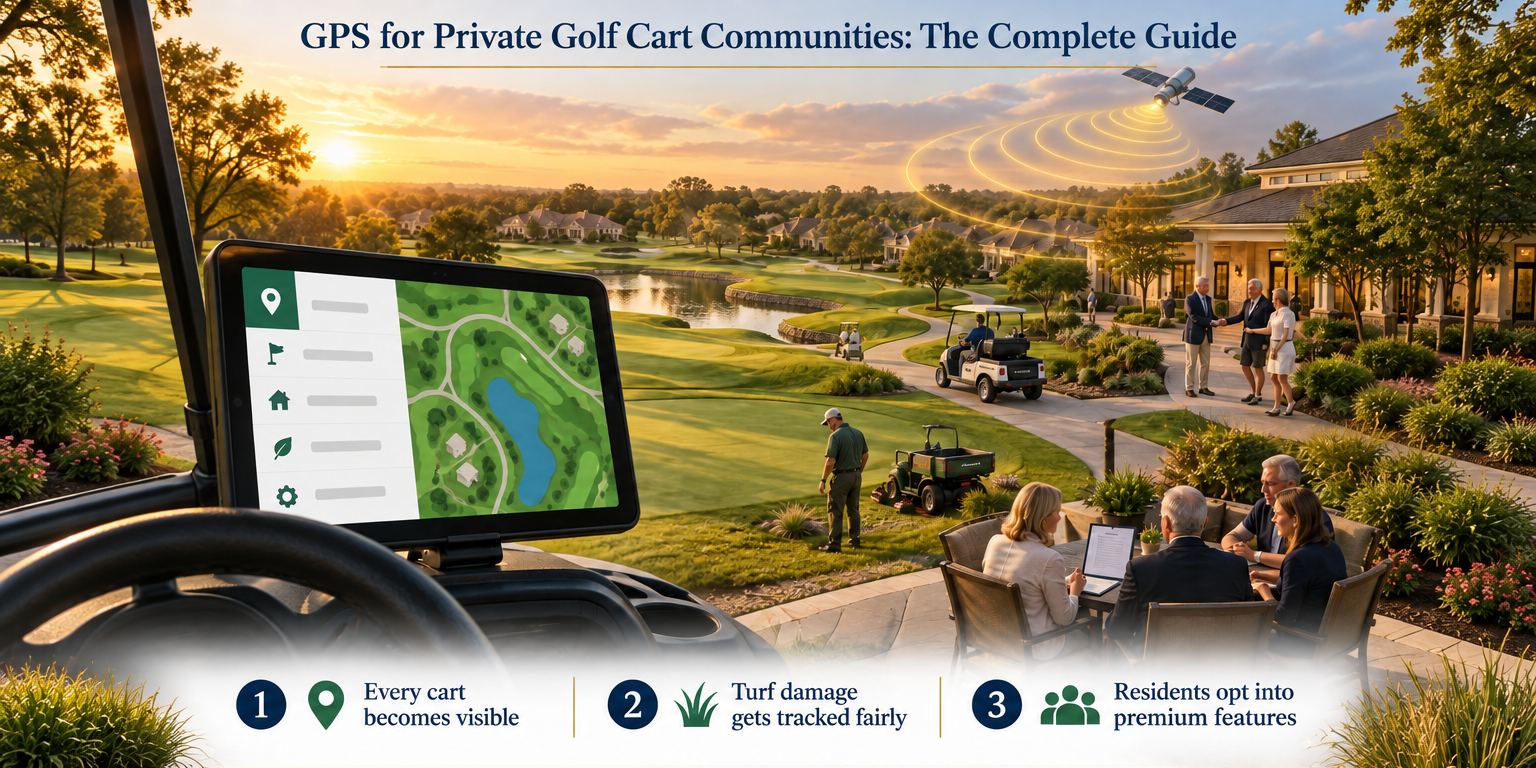
GPS for Private Golf Cart Communities: The Complete Guide
Managing a golf community with hundreds - or thousands - of privately owned golf carts is a fundamentally different challenge than running a course with a fleet of 70 club-owned vehicles. The carts belong to the residents. They come in every brand, model, and condition imaginable. They travel roads, paths, and sometimes fairways atall hours. And until every one of them is visible to your operations team, you are managing blind.
This guide covers everything a golf community needs to know about deploying GPS technology across a private cart fleet: how the technology works, why precision matters, how to fund and govern a deployment, what the ROI looks like with real numbers, and how to rollout GPS across 500 or more carts without disrupting your membership.
Why Private Cart Communities Need GPS
Turf damage without accountability. Private cart owners cut across fairways to visit neighbors, drive through restricted areas, and access parts of the course that fleet carts would never reach. Without tracking data, the superintendent sees the damage but cannot identify who caused it or when. Communities with GPS tracking on private carts have documented up to $50,000 in annual turf repair savings through boundary enforcement alone.
Unauthorized golf starts. In many communities, residents drive their personal cart onto the course near their home and begin playing - bypassing the pro shop, the tee sheet, and the pace management system entirely. This undermines the Director of Golf’s ability to manage all starts, creates pace problems for groups who checked in properly, and represents lost revenue the club never recovers.
After-hours course access. Whether it is a teenager joyriding at midnight or a resident taking a shortcut through the course after dark, unauthorized after-hours access is a safety issue, a liability issue, and a turf management issue. GPS provides real-time alerts to security when any cart enters the course outside designated hours.
Pace of play is unmanageable. If your course has 200 fleet carts with GPS and 500 private carts without it, you are managing pace on fewer than 30% of the carts on your property.Accurate pace-of-play management requires 100% cart coverage.
Speed and safety on community roads. Golf carts sharing roads with pedestrians, cyclists, and vehicles create safety exposure. GPS enables speed monitoring and zone-based speed limits that protect residents, particularly in communities with an older demographic.
How Golf Cart GPS Works in a Community Setting
The Base Layer: GPS Sensor + Beeper
Every privately owned cart - regardless of brand, age, or model - receives a cellular GPS sensor connected to the cart’s battery system. This sensor communicates over CAT-M1 networks and provides real-time location, speed, and zone data to the club’s operations dashboard.
An optional audible beeper pairs with the sensor to deliver real-time alerts to the golfer when they enter a restricted area or violate a geofence boundary. Together, the sensor and beeper form the compliance layer: the club can track all carts, enforce cart-path-only rules, protect sensitive turf areas, manage pace, and monitor after-hours access.
The Premium Layer: Cart Screen Upgrade
Private cart owners have the option to upgrade from the base GPS sensor to a full cart screen — a landscape-mounted display that provides hole flyovers and distances, two-way messaging with the clubhouse, pace-of-play information, food and beverage ordering, tournament management / scoring, and real-time alerts. At communities that have launched this program, approximately half of all private cart owners choose to upgrade at launch, with more following over time.
This tiered model ensures 100% fleet coverage for governance and operations while creating a premium experience layer that residents opt into voluntarily.
[Learn more about the screen upgrade and deployment process →/guides/golf-communities/implementing-gps-500-private-carts]
Why GPS Accuracy Matters — The Precision GPS Advantage
Not all GPS is created equal. Standard GPS receivers deliver accuracy of 2 to 5 meters under ideal conditions. On a golf course, with tree canopy, elevation changes, and signal reflections, that error can balloon to 10 to 30 meters. A typical cart path is8 to 10 feet wide. Standard GPS error routinely exceeds the width of the path it is supposed to protect.
The result is a predictable failure cascade. Systems add 15- to 50-foot buffer zones around geofences.Those buffers trigger alerts when golfers are well within legal areas. Golfers - especially retired residents who play daily - lose trust. Staff disables enforcement. The technology investment is wasted.
Precision GPS changes this equation entirely. Using Real-Time Kinematic (RTK) correction technology, precision GPS achieves 1 to 3 centimeters of accuracy - a 100x to 500x improvement over standard GPS. Boundaries are enforced at their true physical edges. Alerts fire exactly where they should. And the system earns the trust of residents because it behaves predictably and fairly.
FAIRWAYiQ is the only GPS provider serving private cart communities that offers precision GPS positioning.
[Read the full precision GPS comparison →/guides/golf-communities/standard-vs-precision-gps-golf-communities]
Governance: Bylaws and the Legal Framework
Deploying GPS across hundreds of private carts requires a governance framework. The most effective approach is aboard resolution that establishes GPS as a mandatory requirement for any golf cart operating on common property or club facilities. This resolution cites the board’s existing authority under the CC&Rs to regulate use of common property, regulate traffic, and establish rules for golf cart operation.
Key provisions include mandatoryGPS on all carts, no tampering or disabling, consent-by-use (operating a carton community property constitutes consent to monitoring), and privacy protection ensuring location data is only transmitted within designated zones.
FAIRWAYiQ provides a board-ready bylaws template that has been developed with legal counsel and adopted by communities in Florida.
[Download the bylaws guide →/guides/golf-communities/gps-bylaws-golf-community-fleet-management]
Funding: The Trail Fee Model
The GPS subscription cost is embedded into the annual trail fee that every private cart owner already pays. This avoids special assessments, distributes cost evenly, and ensures every cart owner contributes equally. Cart owners who choose a screen upgrade pay a one-time fee in addition to their trail fee. Contract terms run four to six years, with volume discounts scaling with fleet size.
ROI: Real Numbers from Real Communities
Pace of play and revenue: 30–50%reduction in slow play incidents; ~$125K annually from optimized pacing at one Florida community.
Turf protection: Up to $50K saved yearly through reduced unauthorized turf access.
Staffing reallocation: ~$40K+saved by shifting rangers from reactive patrol to GPS-directed intervention.
Revenue protection: DeBary Golf & CC eliminated lost revenue from unauthorized golf starts by residents bypassing the pro shop.
Experience consistency: Higher member satisfaction and retention from faster rounds, protected conditions, and fair enforcement.
[See the full ROI analysis →/guides/golf-communities/roi-gps-private-golf-carts]
Deploying GPS Across 500+ Carts
Large-scale deployments follow a proven process refined at communities including Wycliffe Golf and Country Club(700+ carts). The process: cart inventory survey, scheduling application for member appointments, in-house technician installation (~20 sensors/day or 10–12screens/day with 2 techs), 6–8 week equipment lead time, and ongoing support from a dedicated Customer Success Manager.
Carts 15 years or older receive a health check before installation to confirm battery condition, assess power draw from accessories, and ensure general safety. These carts receive GPS trackers only — screen installations are limited to carts in good condition.
[Read the deployment step-by-step guide →/guides/golf-communities/implementing-gps-500-private-carts]
Choosing the Right Technology Partner
Brand-agnostic hardware is non-negotiable — private fleets include every manufacturer. Precision GPS separates leaders from commodity vendors. In-house installation delivers consistent quality. A tiered sensor-to-screen model protects the business case.And a dedicated CSM ensures value over the full contract term.
FAIRWAYiQ is the North American leader in golf cart GPS, trusted by over 350 courses for more than a decade, and the only provider in the private cart community space with precision GPS, brand-agnostic hardware, in-house installation, and a tiered business model.
Use the ROI Calculator →https://www.fairwayiq.com/fairwayiq-roi-calculator
Book a Discovery Call →https://calendly.com/d/3bz-wp5-rrp/fairwayiq-product-discovery-call
Revolutionize Your Golf Operations with FAIRWAYiQ
Unlock the power of data analytics to optimize your golf course management