
A Frost Delay Recovery Plan for Municipal and Daily-Fee Courses
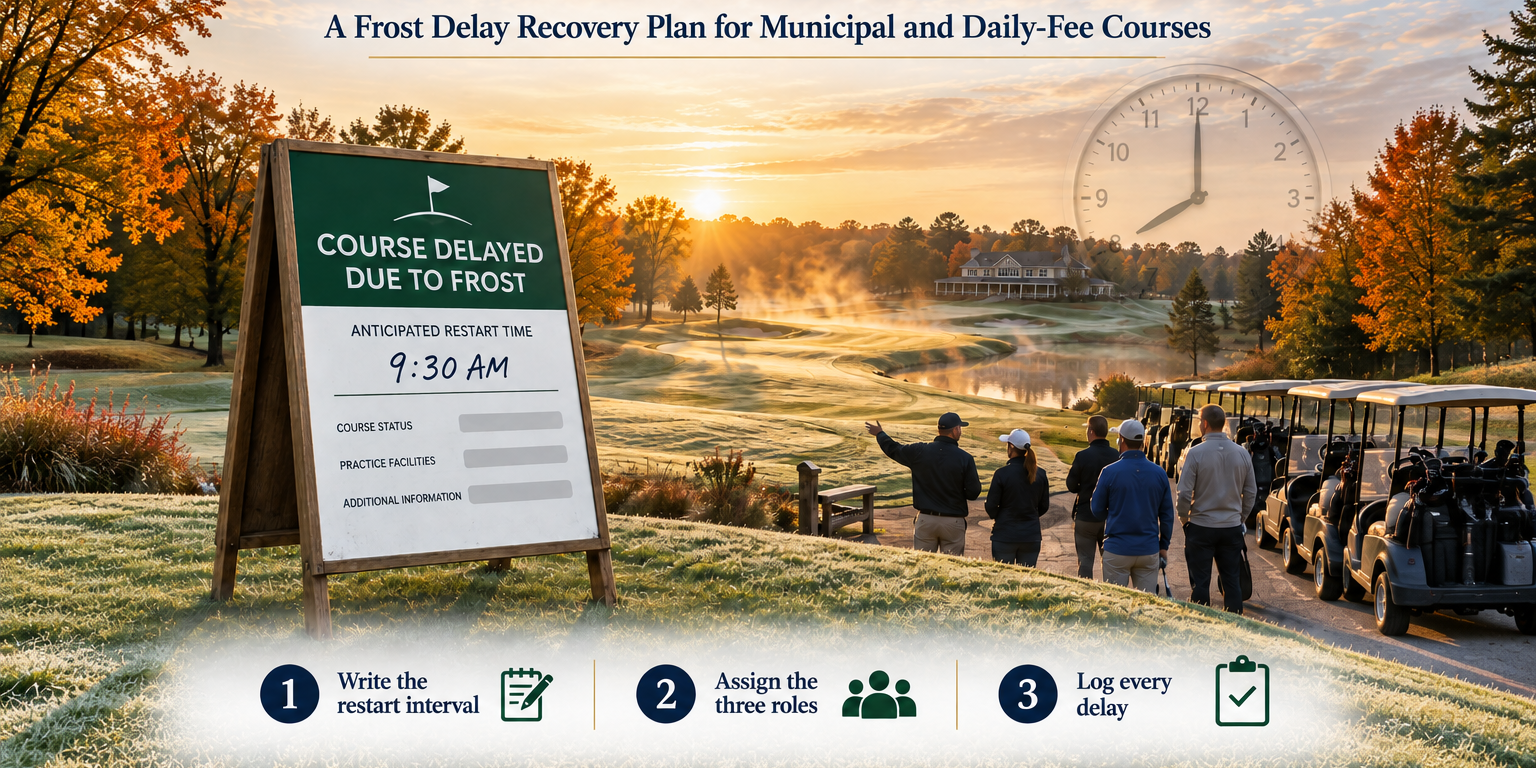
Frost season starts the same way at most municipal and daily-fee courses. The starter walks the first tee, checks the grass, and makes a call by feel. No one has written down what the restart interval should be, who decides it, or how the backed-up field gets resequenced, so every frosty morning becomes a fresh negotiation.
What a frost delay actually costs on the tee sheet
A frost delay costs tee times before it costs anything else.
Every minute the first tee sits idle is a minute the whole field slides back. A course that normally releases groups on a fixed interval loses that interval the moment the delay starts, and it does not get it back automatically when play resumes. That gap has to be managed on purpose or it stays open all day.
Operators who have read The Tee Interval Formula Operators Don't Know already know how sensitive total tee sheet capacity is to interval spacing on a normal day. A frost delay is that same math under worse conditions.
Decide the restart interval before the morning of, and write it down
The restart interval should not be invented at 7:40 a.m. with three groups already staged on the range.
Decide it in the off-season, or at the start of frost season, and put it in writing. Base it on your course's normal pace data, not on how fast the starter feels like moving people. A written interval is something a starter can follow under pressure. A verbal habit is not.
This is the same discipline behind a hidden-capacity audit. Courses that have run The Hidden Capacity Audit for Your Tee Sheet already have the baseline interval data to build a frost restart plan on top of.
Sequencing the backed-up field
The instinct on a frost morning is to get everyone moving at once. That instinct is wrong.
A shotgun-style restart, where multiple groups are sent to multiple holes at the same time to clear the backup fast, breaks the interval spacing the rest of the day depends on. Groups that started apart end up converging later on the same hole, because a shotgun start resets position but does not preserve pace. The backup simply moves downstream and shows up on a par 5 or a long par 4 later in the round.
Sequential restart off the first tee, on the interval you wrote down in advance, protects the spacing. It takes longer to clear the queue. It does not create a second bottleneck an hour later.
Roles: who calls the delay, who calls the restart, who talks to golfers on the lot
Three decisions, three owners. Write down who holds each one before frost season starts, not during it.
- Who calls the delay: usually the GM or head professional, based on turf condition, not guesswork.
- Who calls the restart: the same person, using the written interval and the field data, not the first cart that looks ready to go.
- Who talks to golfers on the lot: a staff member with the communication script in hand, not whoever happens to be standing near the pro shop door.
When one person owns all three jobs at once, on a morning with forty golfers waiting, something gets skipped.
Using on-cart position data to see when interval spacing has recovered
The hardest part of a frost delay is knowing when the field has actually recovered its spacing, not just when the first few groups look fine.
FAIRWAYiQ Precision GPS shows real interval spacing across the entire field on a recovery morning. A GM can see the gap between group four and group five the same way as the gap between group fourteen and group fifteen. That is the difference between restarting on data and restarting on a guess based on the front nine.
A written plan only protects the tee times a GM can actually verify were recovered. Position data closes that loop. It also gives a GM something concrete to log: which tee times were delayed, which were saved, which were lost. That log is the record that makes next year's plan better than this year's.
Courses working on a predictable pace as a marketing asset, not just an operations fix, may also want Why a Predictable Four-Hour Round Is Worth Marketing (and How to Sell It on Your Website), since a course that recovers from frost delays reliably has a stronger claim to make to golfers booking online.
Communication scripts for the lot, the phone and the booking confirmation
Golfers on the lot need one sentence, not an explanation of turf science: the expected restart time, and a promise to update if it changes.
Phone calls need the same sentence, delivered by whoever answers, so a golfer calling at 7:15 hears the same information as the one standing on the range at 7:15.
The booking confirmation, sent the night before during frost season, should set the expectation early: a possible delay, and where to check for updates. A golfer who expects a delay is not upset by one. A golfer who was not warned is.
What to do this week
- Write the restart interval down, based on your course's normal pace data.
- Assign the three roles: who calls the delay, who calls the restart, who talks to golfers on the lot.
- Draft the three communication scripts: lot, phone, booking confirmation.
- Brief the crew on the sequencing rule before the first frost morning, not during it.
- Log every delay this fall: cause, length, tee times affected, tee times recovered.
Courses that have replaced roaming pace checks with cart-based data, as described in The End of the Driving-Around-Looking-for-Slow-Play Ranger, already have staff freed up to run the lot and phone scripts instead of chasing pace on the course.
Where FAIRWAYiQ fits
FAIRWAYiQ is an independent GPS provider that has worked with golf courses for 11 years, on any cart brand. Precision GPS gives a GM real interval spacing across the field on a recovery morning, so the restart call is based on data rather than a guess from the front nine. If a municipal course wants to bring this to council or a budget committee, we can help organize the tee-sheet and labor numbers into a business case before that meeting, not after.
If you want to talk through what a frost-delay recovery plan looks like for your course, book a call with Mike.
Revolutionize Your Golf Operations with FAIRWAYiQ
Unlock the power of data analytics to optimize your golf course management