
Building the 2027 Case for Cart GPS at Your Daily-Fee Course
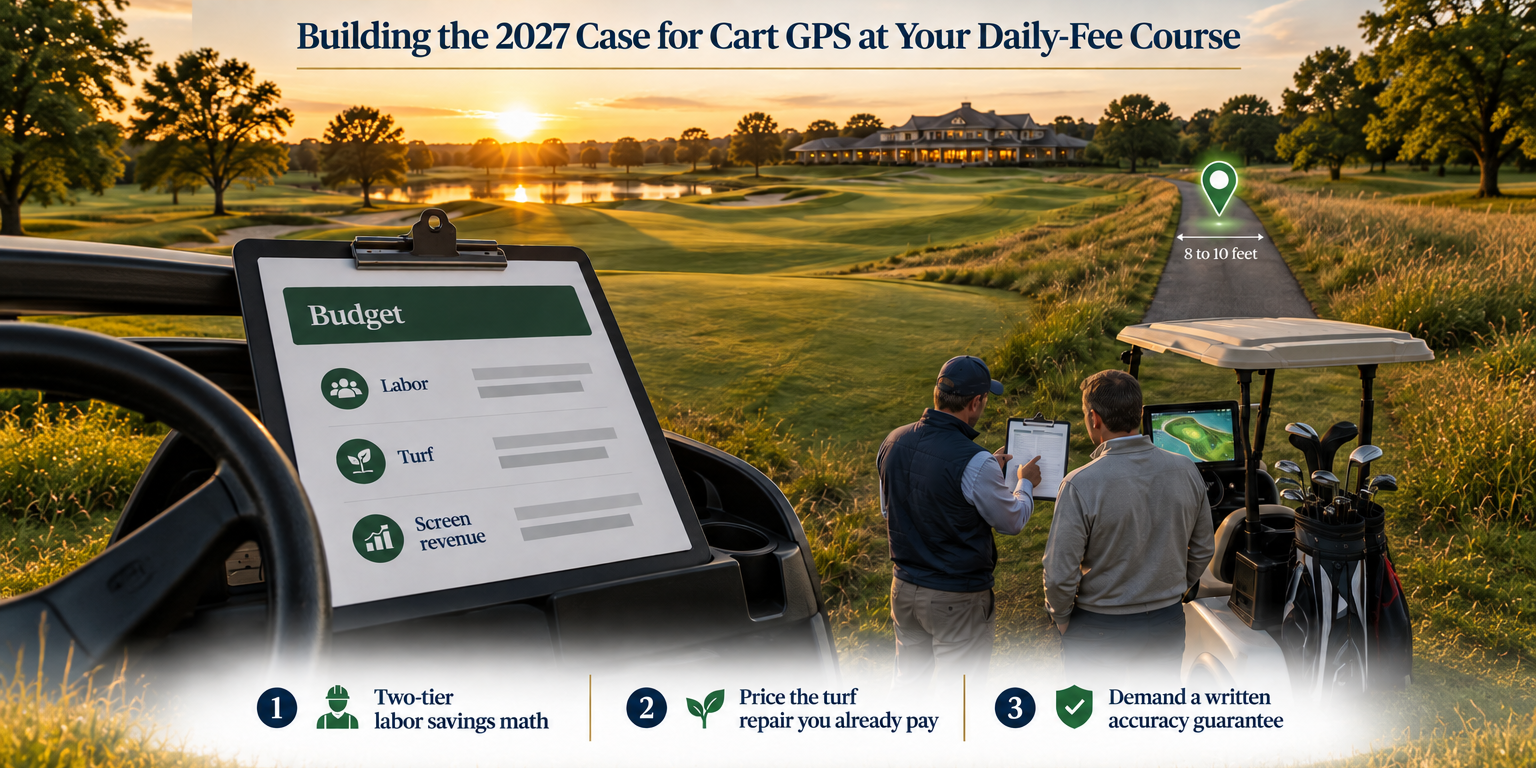
September and October is when owner-operated daily-fee courses lock the 2027 budget. Payroll is the line item nobody can stop staring at, and technology keeps showing up as a question mark instead of a number. This guide is written for owners and GMs who write the budget themselves. Private clubs with a member committee and municipal courses answering to a council face a longer approval path, and we have covered those separately.
The goal is simple. By the time the budget closes, cart GPS should sit on the page as three savings and revenue lines next to one recurring cost line, with your own numbers in each cell.
Two findings from the Pulse Report that belong on the budget page
NGCOA's 2026 Golf Business Pulse Report came out July 1. Two of its high-level takeaways matter for this budget cycle. Owners are worried the game is getting too pricey for the average golfer. Operators are finding new challenges managing payroll costs and figuring out where technology fits in.
Those two findings, listed in NGCOA's release announcing the report, are what a September budget spreadsheet looks like at most daily-fee courses we talk to. Payroll and technology sit next to each other. The report also notes that owners are pouring profits back into upgrading their courses, so the money is moving; the question is whether a technology line comes with a return attached.
This guide treats cart GPS as a budget line with a return, not a wish-list add.
Line item one: ranger and player-services labor
There are two tiers of labor savings, and they depend on how far you take it. Pick the tier that matches how you actually plan to staff next season and budget that one.
Courses that keep their current staffing but use GPS data to route rangers only where slow play is actually happening save an average of $14,000 a year. No one loses a job. The savings come from fewer wasted loops and faster response to real pace problems.
Courses that go further, eliminating a dedicated ranger role and repurposing junior golf professional staff onto member and guest interactions, save $40,000 or more a year. The idea is simple: computers track pace and position, people handle the sensitive conversations a screen never should. We wrote more about that shift in The End of the Driving-Around-Looking-for-Slow-Play Ranger.
Line item two: turf repair you already pay for
Cart traffic is one of the quietest line items on a maintenance budget. Every course pays for turf repair from carts cutting corners, parking off path, or crossing wet ground when a starter can't see every hole at once.
GPS geofencing keeps carts on the path and off vulnerable turf without a staff member watching every fairway. We covered the mechanics of that damage and the fix in How Golf Course Turf Gets Damaged, and How FAIRWAYiQ Helps Prevent It. Put a number next to your own repair line before you build the case; every course's cart-path wear cost is different.
Line item three: cart screen sponsorship revenue
Cart screens are a revenue line, not just a display. Local businesses, restaurants and your own pro shop can buy placement on a screen that sits in front of every golfer for the length of the round.
The advertising potential on a fleet of cart screens runs $12,000 to $20,000 a year. That is the ceiling the inventory supports, not a guaranteed number for every course; a course's actual revenue depends on how it sells and fills that inventory. We built a full playbook for selling and filling that inventory in The Cart Screen Ad Playbook: Turning Your Fleet Into a Local Sponsorship Channel.
The recurring costs to budget honestly, and the guarantee to demand
A GPS system is not a one-time purchase. Budget the subscription, the connectivity, and hardware replacement as ongoing lines, not sunk capital cost. Our broader breakdown of where course costs actually sit is in Your Guide to Understanding Golf Course Costs.
Before you sign anything, get a written GPS accuracy guarantee. A number and a test method, in the contract. Standard GPS drifts 6 to 16 feet. A cart path is 8 to 10 feet wide. That gap is the difference between a system that keeps carts on path and one that can't. Verbal assurances do not count. We laid out how to evaluate any vendor's accuracy claim, including the test methods to ask for, in How to Evaluate Any Golf Cart GPS Accuracy Claim (And How to Fix It).
What to do this week
Build the one-page case before October. Here is the order:
- Pull last year's ranger and starter payroll hours and mark which ones are truly needed versus routine patrol.
- Pull your turf repair and cart-path maintenance spend for the last two seasons.
- Call three local businesses that might sponsor a cart screen and get a real number, not a guess.
- List the recurring costs: subscription, connectivity, hardware replacement, as separate lines, not one bundled estimate.
- Ask any vendor you're considering for a written, contractual accuracy guarantee with a test method attached.
- Put the payroll savings, turf savings and screen revenue on one page next to the recurring cost.
Vendors can take your past repair and payroll records and organize them into an ROI case. With the AI tools every vendor should be using today, that part is fast. Ask for the help before you build the page yourself from scratch.
One more thing an owner controls that a committee does not: timing. You can decide in October and have the system running before the spring opener, which means the labor line changes in the same season you budgeted it. Onboarding runs 1 to 2 weeks.
Where FAIRWAYiQ fits
FAIRWAYiQ is precision GPS built on RTK corrections, works with any cart brand, and we've been doing this for 11 years. We give owners the labor, turf and screen-revenue data to put a real number on each line of this budget case, and our team can help you build the one-page case before your budget is locked.
If you want help putting the numbers together before October, book a call with Mike.
Revolutionize Your Golf Operations with FAIRWAYiQ
Unlock the power of data analytics to optimize your golf course management