
The Cart Screen Ad Playbook: Turning Your Fleet Into a Local Sponsorship Channel
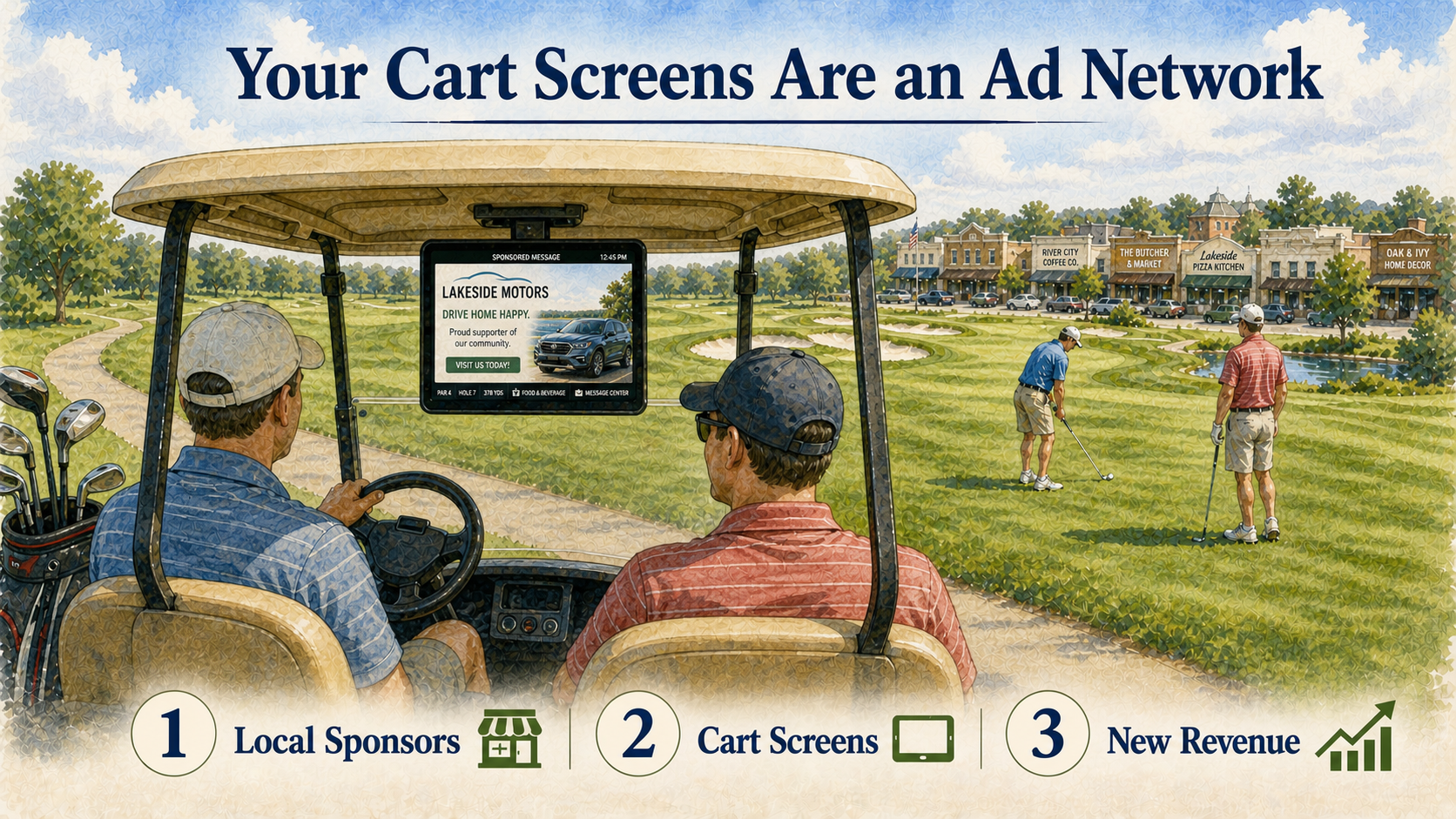
Most public and municipal courses are sitting on a four-hour attentive ad surface in front of a household-income local audience and not selling it. The cart screen, when used as a sponsorship channel, is the most attractive small-business ad inventory in your market.
This guide is the playbook to turn the screen into a revenue line. The floor is $10,000 in your first season. That is a soft number, set deliberately low, because public course ad sales programs ramp through year one and the second season is where the math gets interesting.
The bigger point is that the cart screen ad revenue, when you build it, often offsets a meaningful share of your GPS subscription. The course pays for itself in inventory the course already owns. That math works the same whether your decision maker is a city manager or an ownership group.
Who is sitting in your cart for four hours
The audience math at a typical public course:
- 30,000 to 40,000 rounds per year
- Two to four players per cart
- A four-hour round of attention, with the screen visible at every shot
- Households with discretionary recreation spend (golf is a paid hobby)
- 80% inside a 20-mile radius of the course
There is no other ad surface in the market with that combination of attention, dwell time, and local audience. A billboard is glanced at. A mailer goes in the trash. A radio spot competes with the road. A cart screen ad shows up between every shot for four hours.
Why a cart screen outperforms a tee sign or a scorecard ad
Tee signs are static. Players walk by once and ignore them. Scorecard ads sit in a pocket and are seen only when the player is doing math. The cart screen, by contrast, runs a rotation across every hole, with location-triggered placements that match the message to the moment. A beverage sponsor on the par-3 with the long forced carry. The auto dealer on the home hole as the round wraps. The bank ad on the front nine, when the player is fresh.
The format is more flexible, the impressions are real, and the attribution is trackable through QR codes on the screen.
The inventory math
The model is rounds times carts times rotations.
A 30,000-round public course with 70 carts running at peak fills approximately 12,000 cart-rounds of screen time per year. With a 15-minute ad rotation across an 18-hole round, each cart-round serves 16 to 18 ad impressions. Total annual impressions: 200,000 to 220,000.
That is the total inventory. Five to twelve sponsors fit into that inventory at typical industry rates without crowding any one slot.
Pricing tiers
Three tiers that work for a public course:
Single-hole sponsor. $1,000 per season. The sponsor's ad fires on a specific hole. Common buyers: local restaurants, the auto dealer, the neighborhood bank.
Banner-rotation sponsor. $1,500 per season. The sponsor appears in a rotating banner across multiple holes. Common buyers: insurance, healthcare, real estate.
Tournament sponsor. $2,500 per tournament. The sponsor takes over the screen during a member-guest, a city championship, or a charity event. Common buyer: the title sponsor of the tournament.
A typical first-season ad year: five to ten sponsors, mixed across tiers, totaling $10,000 to $15,000.
Who buys these ads in your market
The buyer list is local and specific. A public course in Texas or Florida pulls from:
- The auto dealer cluster near the course
- The regional bank or credit union with a branch nearby
- The real estate brokerage that handles weekend listings
- The local restaurant or steakhouse that wants the Saturday-night reservation
- The home-services category (HVAC, pest, roofing) where the household income is right
- The insurance agent with a long history of golf-course advertising
- The pharmacy or medical practice in the same demographic
Most public course ad programs sell through one or two relationships first, then fill through referral. The pro shop manager already knows the buyers. The hardest part is starting.
How to sell ads yourself with the FAIRWAYiQ Ad Finder application
FAIRWAYiQ has built a free ad sales application called Ad Finder that handles the sales workflow public course operators do not have time for. The app:
- Generates a sponsorship deck for each prospect
- Tracks the prospect through the pipeline
- Manages the creative upload and approval
- Schedules the rotation on the cart screens
- Reports ad performance back to the sponsor
It is free for one full year for non-customers. FAIRWAYiQ customers get unlimited access. You can try it on your real prospect list right now.
Try the FAIRWAYiQ Ad Finder application
The app does the work. The course keeps the relationship and the revenue.
Ad rotation guardrails to keep the player experience clean
Three rules protect the player.
One. Maximum 30% of screen time on ads. The screen is primarily a player experience tool. Yardage, course map, hole graphics, and pace data come first. Ads fit in the gaps.
Two. No interruptive formats. No takeovers between shots. No video with sound. The player is hitting a 7-iron, not watching TV.
Three. Local sponsors only at the start. A national chain ad on the screen feels like spam. A local sponsor with the manager's name on it feels like community. Lean local for the first season.
Reporting back to the sponsor
The sponsor wants two numbers at the end of the season: impressions and clicks. The QR code on the ad gives you both. A one-page PDF report at season end ("Your ad ran for 18,000 impressions, generated 240 QR scans, and your offer was redeemed 12 times") earns the renewal in year two.
How public course operators are running the model
The Bandit Golf Club in Texas operates with FAIRWAYiQ screens. The Bandit uses the screen as a player experience and revenue surface, with ad inventory and F&B ordering both running through the same hardware.
Quail Heights in Florida runs FAIRWAYiQ screens with geofencing as the primary value point. The platform is in place to support a sponsorship program as the local sales pipeline matures.
Both courses have the hardware in place. The work is in the local relationships, and the FAIRWAYiQ Ad Finder application handles the workflow.
Next step
Try the FAIRWAYiQ Ad Finder application free for one year and see whether the local sponsor list in your market lines up with the pricing model.
Revolutionize Your Golf Operations with FAIRWAYiQ
Unlock the power of data analytics to optimize your golf course management