
A Weather Plan Your Cart Fleet Already Knows
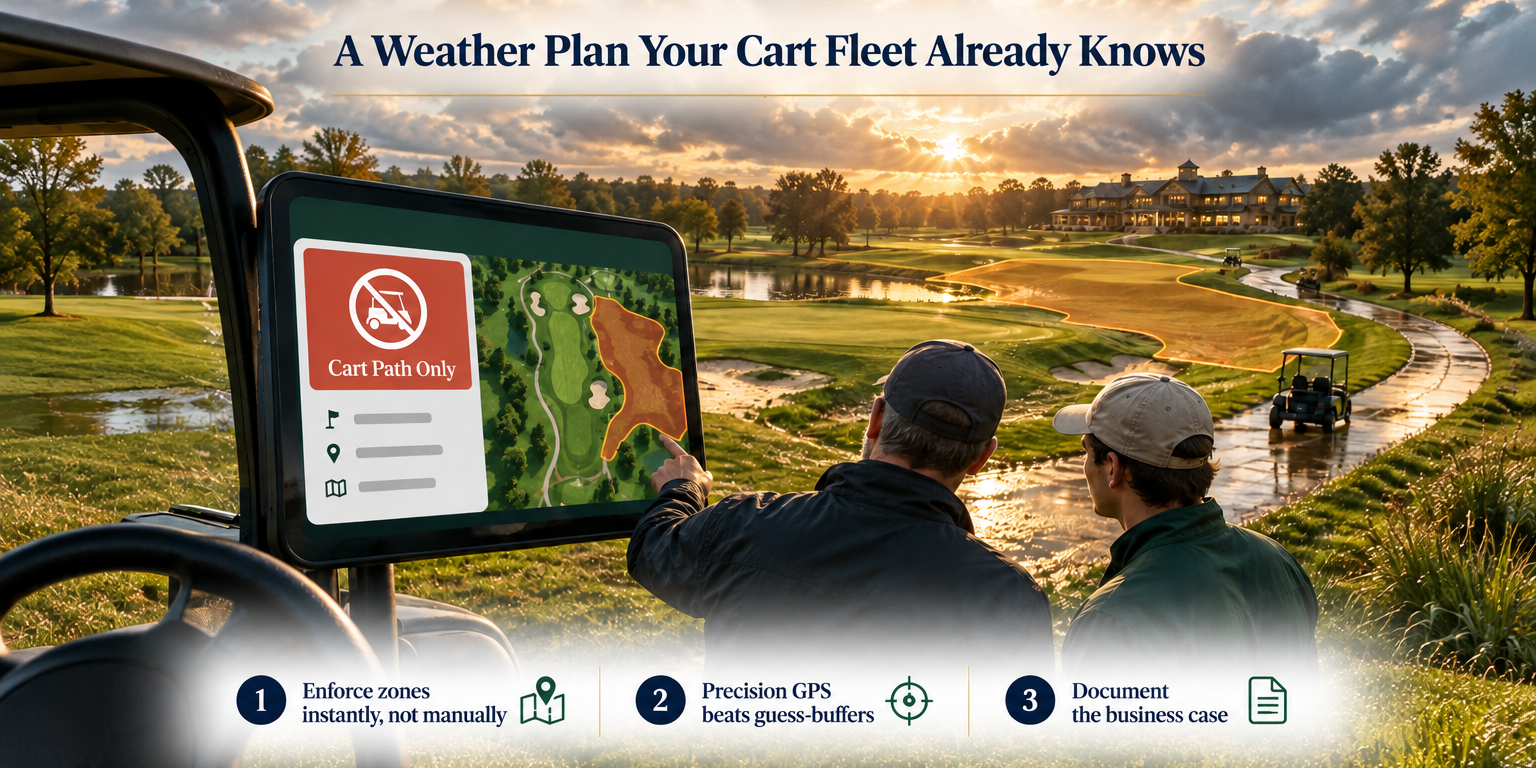
A hailstorm does not call ahead. When it hits, a superintendent has minutes to decide which holes close, and an operator has to get that decision to every cart on the property before someone drives across bruised turf. This guide is for daily-fee and resort operators who run their own carts and need restrictions enforced the moment weather turns, not an hour later.
The hail story: two courses, two responses to the same weather event
A piece titled A tale of two courses and hail describes two courses on different sides of the nation sharing their strategies for tackling hail.
Hail is worth writing protocols for because the storm is not the unusual part. Two courses in different parts of the country are both working out how to handle it, and either way the decision has to reach carts that are already out on the property.
That plan usually lives on paper. A hailstorm does not wait for paper to get read.
Why sudden weather events expose gaps in manual cart restriction enforcement
Most courses restrict carts by memory and word of mouth. A starter tells the next group. A sign goes up at the clubhouse. A ranger drives out to flag anyone who missed it.
None of that scales when the restriction has to happen in the next five minutes, not the next tee time.
Carts already on the course keep driving the same lines they were driving before the call came in. That is the gap.
Picture a Saturday at a busy public course. Carts are spread across all 18 holes when the sky turns. A starter can warn the groups still waiting on the first tee, but the groups on 12 and 14 hear nothing until somebody drives out to them. By the time the last cart has been reached, wet and bruised turf has already absorbed traffic it should never have taken.
What real-time geofencing changes: instant zone updates, automated golfer alerts, no chasing carts
With golf cart geofencing, a superintendent's cart-path-only call becomes a zone update pushed to every cart screen at once. No staff member has to physically reach a cart to enforce it.
The zone change and the golfer alert happen at the same moment. That is the difference between a rule that exists and a rule that gets followed.
Accuracy matters here as much as speed. Standard GPS drifts 6 to 16 feet. A cart path is 8 to 10 feet wide. A wide guess-buffer either lets carts through a restricted area or locks out golfers who are still on the path. Precision GPS built on RTK corrections draws the line where the line actually is, so the zone enforces exactly, not approximately. We cover the enforcement side in more detail in our guide on cart-path-only days, enforcement, messaging, and what actually works, and the underlying accuracy question in GPS drift on golf courses.
Turf recovery windows after hail or storm damage
Hail bruises turf. Cart traffic on that same turf while it is still wet compounds the damage. That much is basic agronomy every superintendent already knows.
Superintendents pay for that in recovery weeks and in line items for seed, sod and the labor to put it down.
The operational failure point is not the storm. It is the hours right after it, when carts are still moving and nobody has updated where they are allowed to go.
A geofenced zone closes that window immediately instead of relying on every golfer having seen the sign.
What to do this week
Build the weather-response plan once, before the next storm, not during it.
- Write down which zones get restricted for hail, heavy rain, and frost, and save them so they can be activated with one call, not redrawn each time.
- Confirm who has authority to trigger a restriction and how fast the change reaches every cart on the course.
- Check whether your current cart system can push a zone change and a golfer message in the same action, or whether it still relies on staff driving out to flag carts.
- If you are comparing systems, require a written, contractual GPS accuracy guarantee with a stated number and a stated test method. A verbal assurance from a sales rep does not count.
- Log turf incidents by date and hole so the pattern, and the cost of not having instant enforcement, is documented for next year's budget conversation.
A simple weather-response checklist operators can build once and reuse
Municipal courses answering to a council, private clubs with a member committee, and golf communities with resident-owned carts all face the same storm. The decision maker is different, but the checklist is the same: pre-set zones, one trigger, automated messaging.
For council and committee approval, the strongest move is winning one champion first, then pre-selling other members individually before the vote. Connecting committee members to peer references at other municipal courses or clubs who already run geofencing lets them hear the operational case firsthand rather than take it secondhand.
Building that ROI case from past turf repair records and labor logs is straightforward work, and it is something a vendor can help with as part of the presentation. We cover how turf damage adds up over a season, and how enforcement prevents it, in How Golf Course Turf Gets Damaged, and How FAIRWAYiQ Helps Prevent It.
Where FAIRWAYiQ fits
We are an independent GPS provider for golf carts, built on RTK corrections rather than standard GPS, and we work with any cart brand. Zones can be updated remotely the moment a superintendent calls a weather closure, with golfer alerts sent automatically. Onboarding takes 1 to 2 weeks, and support responds within 2 hours if something needs attention during a storm.
If you want to work through what a weather-response plan and the ROI case would look like for your course, book a call with Mike.
Revolutionize Your Golf Operations with FAIRWAYiQ
Unlock the power of data analytics to optimize your golf course management