
What Management Companies Owe Every New Course on GPS
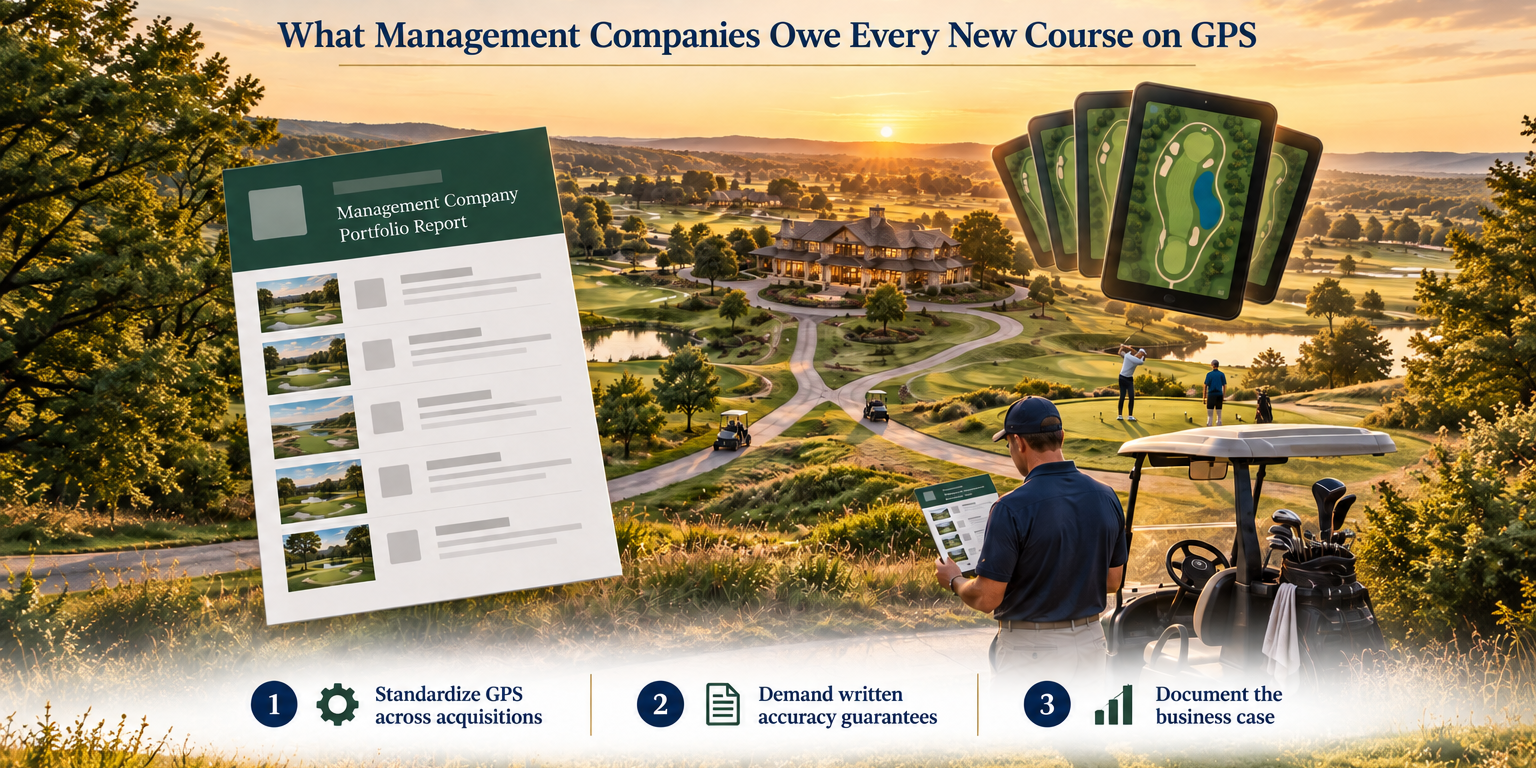
Heritage Golf Group just added Independence Golf Club, a 27-hole facility, as its 50th property. Fifty courses means fifty separate histories of cart purchases, GPS vendors, and IT decisions made by people who no longer run those courses. This guide is for management companies and multi-course operators who inherit that mess every time they close a deal.
Why portfolio growth forces a technology decision most operators don't expect
A management company doesn't buy one course. It buys whatever that course already has running on its carts.
Heritage Golf Group's move to 50 properties is a useful marker. Fifty courses is fifty prior ownership groups' worth of cart brand choices, GPS contracts, and screen hardware.
Nobody budgets for this at the deal stage. It shows up three months later when the ops team tries to run one pace report across the portfolio and finds five different systems reporting five different ways.
The problem with inheriting mismatched cart brands and GPS systems across properties
Cart fleets don't get replaced on acquisition day. A newly acquired course might run Club Car, another E-Z-GO, another Yamaha, each with its own OEM screen and its own GPS backend.
That means the portfolio has no single view of pace of play, no shared geofencing rules, and no consistent reporting format for ownership or lenders.
We wrote about how this plays out course by course in Why Cart Brand-Locked GPS Systems Are Holding Your Course Back. At the portfolio level, the same problem multiplies by every acquisition.
What OEM lock-in costs a management company at scale
OEM GPS is sold with the cart. That sounds convenient until the fleet turns over or the acquired course wants to switch cart brands.
Standard GPS drifts 6 to 16 feet. A cart path is 8 to 10 feet wide. That gap is the difference between a system that can enforce pace and geofencing rules and one that just draws a dot on a map.
We laid out the mechanics of this trap in OEM Lock-In: The Hidden Cost of Buying GPS From Your Cart Brand. Multiply it across fifty properties and one course's annoyance becomes a portfolio-wide reporting gap.
The case for an independent GPS layer that works across any cart brand
An independent GPS system is not tied to a cart manufacturer. It runs on whatever fleet a course has, whether that fleet is Club Car, E-Z-GO, or Yamaha.
That matters for a management company because it decouples the technology decision from the cart-buying decision. Ownership can standardize on one GPS system now and let each course's cart replacement cycle run on its own timeline.
We compared the two models directly in OEM vs. Independent GPS: What Golf Courses Get Wrong. Independent GPS works as a standardization tool. OEM GPS works as a fleet accessory.
How to evaluate switching costs when a newly acquired course is stuck on legacy GPS
Every acquired course stuck on legacy OEM GPS needs the same math run before a decision gets made.
Start with the existing contract term, the remaining screen hardware value, and the labor hours currently spent chasing pace manually. Those three numbers, side by side, tell you what switching actually costs versus what staying costs.
We built a walkthrough for exactly this scenario in How to Switch GPS Providers Without the Sunk Cost. It's the same document a private club committee or a municipal council would want before approving a switch.
If the property answers to a board or council rather than a single owner, the path is different. Win one champion on the committee first. That person pre-sells the rest of the members one on one before any formal vote, and connects skeptical members to peer references at other clubs or municipal courses already running the system. A vendor can help assemble that business case, including pulling together a course's own repair and cost records into a clean ROI summary, but the champion still has to carry it internally.
A checklist for standardizing pace, geofencing, and reporting across a multi-course portfolio
Use this list when a new acquisition closes and the GPS question lands on your desk:
- Confirm what cart brand and GPS system the acquired course currently runs, and when that contract expires.
- Request a written, contractual GPS accuracy guarantee with a specific number in feet and a named test method. Verbal assurances from any vendor, incumbent or new, do not count.
- Compare that number against the standard GPS drift range of 6 to 16 feet on an 8 to 10 foot cart path.
- Pull the course's existing repair and labor records and build a one-page ROI comparing current cost to a standardized system across the portfolio.
- If the course answers to a board or council, identify one champion and start the one-on-one conversations before scheduling a vote.
- Set a target date to bring the new course's reporting format in line with the rest of the portfolio.
What to do this week
Pull the cart brand and GPS contract details for the most recently acquired course in your portfolio.
Check the contract's remaining term and the accuracy language, if any exists at all. Most OEM contracts have none.
Ask the incumbent GPS vendor, in writing, for its accuracy number and test method. If they won't give you one, treat that as an answer.
Run the three-number comparison, contract cost, hardware value, and labor hours, before your next portfolio review meeting.
Where FAIRWAYiQ fits
We're an independent GPS provider that works with any cart brand, built on RTK-corrected precision rather than standard GPS. We've supported courses for 11 years, and our buyout program can offset the cost of moving a newly acquired course off legacy GPS. That lets a management company standardize pace, geofencing, and reporting across a growing portfolio without waiting for every cart fleet to turn over on its own.
If you're evaluating GPS across a multi-course portfolio, book a call with Mike.
Revolutionize Your Golf Operations with FAIRWAYiQ
Unlock the power of data analytics to optimize your golf course management