
Rolling Out Cart GPS Rules to Private Club Members
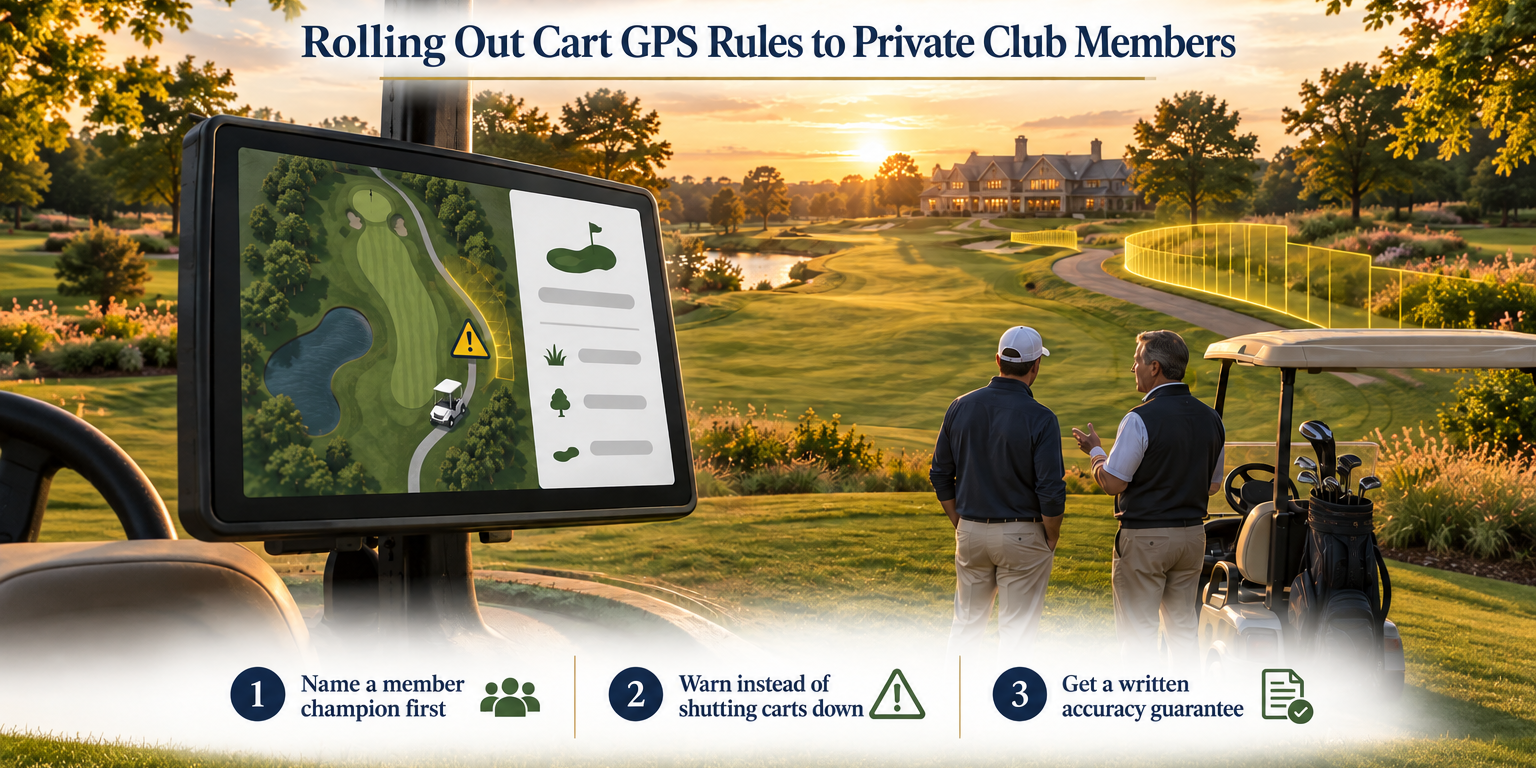
The committee approved cart GPS. Now the general manager has to explain geofencing and pace alerts to the membership, and members own the club, so they will ask questions the board did not. This guide is written for private clubs, where the board is a member committee, not a municipal council or a resort ownership group.
Approval is the easy part; member trust decides whether the system works
A committee vote is one meeting. Member trust is built over the first few rounds after the carts go out.
If members feel policed, they will find the override, blame the technology, and ask the board to pull it. If members understand the why, the same zones and the same alerts become normal course conditions, no different than a wet-weather cart path restriction.
The system does not change in either case. Only the member's read of it changes.
Name a champion and explain the why before the first cart goes out
Pick the committee chair, or a respected member who plays often, to carry the message. Members hear this better from one of their own than from staff.
The why is short: protect turf, keep pace consistent, and take the marshal out of confrontations with other members. That last point matters more at a private club than anywhere else, because the marshal and the member often know each other by name.
Say this before carts go out.
Say plainly what the data is for and what it is not for
The data is for pace and turf. It is not for tracking an individual member's round or reporting who drove where.
Members will ask this directly. Answer it directly, the same way every time, from the champion and from staff.
Zone rules exist because a cart path is 8 to 10 feet wide. Standard GPS drifts 6 to 16 feet, which is wider than the path itself. That is a physics problem, not a policing decision, and it is worth saying so.
Warnings, not shutoffs, are the right model for a private club
We do not believe private club members need cart shutoff, and we built our position around that. Forcing a member to throw a cart into reverse to back out of a zone is the kind of parochial rule that draws pushback at a club, not compliance. Members remember the moment their cart lost power in front of other members far longer than they remember why the zone existed.
Warnings do the job better. A member approaching a zone boundary gets an on-screen warning before they reach it. If they cross anyway, the system logs a zone-violation alert instead of cutting power. The committee and staff can follow up on repeat violations the way they would any other course-conduct matter, with a conversation.
That model works because it pairs the alert with governance. Every zone should have a plain-language reason attached to it: this zone protects a green surround, this one protects a wet fairway, this one keeps carts off a drainage line. When members understand why a zone exists, an alert reads as information. When they do not, it reads as a rule imposed on them. Either way, the cart keeps moving.
Our guide on why carts lock up in the wrong places walks through the mapping and timing issues that cause a zone to trigger where it should not, and why warnings catch those problems before they ever reach a member as a dispute.
Tune zones with the superintendent and get a written accuracy guarantee
A false alert on the 9th fairway during a member-guest costs more in trust than it saves in turf. Tune every zone boundary with the superintendent, who knows where carts actually need to go this week and where they never should.
Ask any vendor for a written, contractual GPS accuracy guarantee with a specific number and a stated test method. A verbal assurance that "it's accurate enough" does not count, and it will not hold up when a member disputes an alert in front of the committee.
Our guide on how to evaluate any golf cart GPS accuracy claim covers what that number and test method should look like before you sign anything. Our related guide on false alerts in golf cart geofencing explains why they happen and how tuning reduces them.
What staff do differently
Computers crunch the pace and turf data. Staff handle the sensitive conversations, the member relationships, and the exceptions the data cannot judge on its own.
Rangers and marshals spend less time chasing slow groups and more time on service, the same shift covered in our guide on the end of the driving-around-looking-for-slow-play ranger. That frees staff for the interactions that actually need a person. For most courses the labor math lands at an average of $14,000 a year without cutting staff, and the member experience improves at the same time.
Close the loop with the committee and the board
Set up a feedback channel to the committee for the first weeks after zones go live. Members should know exactly who to tell if a zone feels wrong.
Report back to the board on what changed: which zones were tuned, what members raised, and what staff time moved to service instead of enforcement. That report is what turns a committee decision into a member-trusted system.
What to do this week
- Confirm who the champion is and get their message ready before carts go out.
- Write the one-paragraph explanation of what the data is for, and is not for, and hand it to every staff member who will field questions.
- Write the plain-language reason behind each zone so staff and the champion can explain it the same way every time.
- Walk the course with the superintendent and mark zones that need tuning before members see them.
- Ask any vendor under consideration for their written accuracy guarantee, the number, and the test method, in writing.
- Open a short feedback channel to the committee for the first weeks and put a report-back on the next board agenda.
Where FAIRWAYiQ fits
FAIRWAYiQ works with any cart brand, so the rollout does not depend on a fleet swap. Our on-cart Precision GPS, built on RTK corrections rather than standard GPS, keeps zone warnings and violation alerts tied to the actual cart path instead of the wider drift zone around it, which is what keeps members from getting flagged in the wrong places.
By design, FAIRWAYiQ does not lock carts or shut them down. At a private club, warnings paired with governance work better than a stalled cart in front of other members, and that is the differentiator we are built around. Onboarding takes 1 to 2 weeks with a 2 hour support response, and we help the club prepare the member communication and the committee report before and after launch.
Next step is a conversation about your specific layout and committee timeline. You can book a call with Mike to talk it through.
Revolutionize Your Golf Operations with FAIRWAYiQ
Unlock the power of data analytics to optimize your golf course management