
Off-Season Checklist for Municipal Cart GPS Fleets
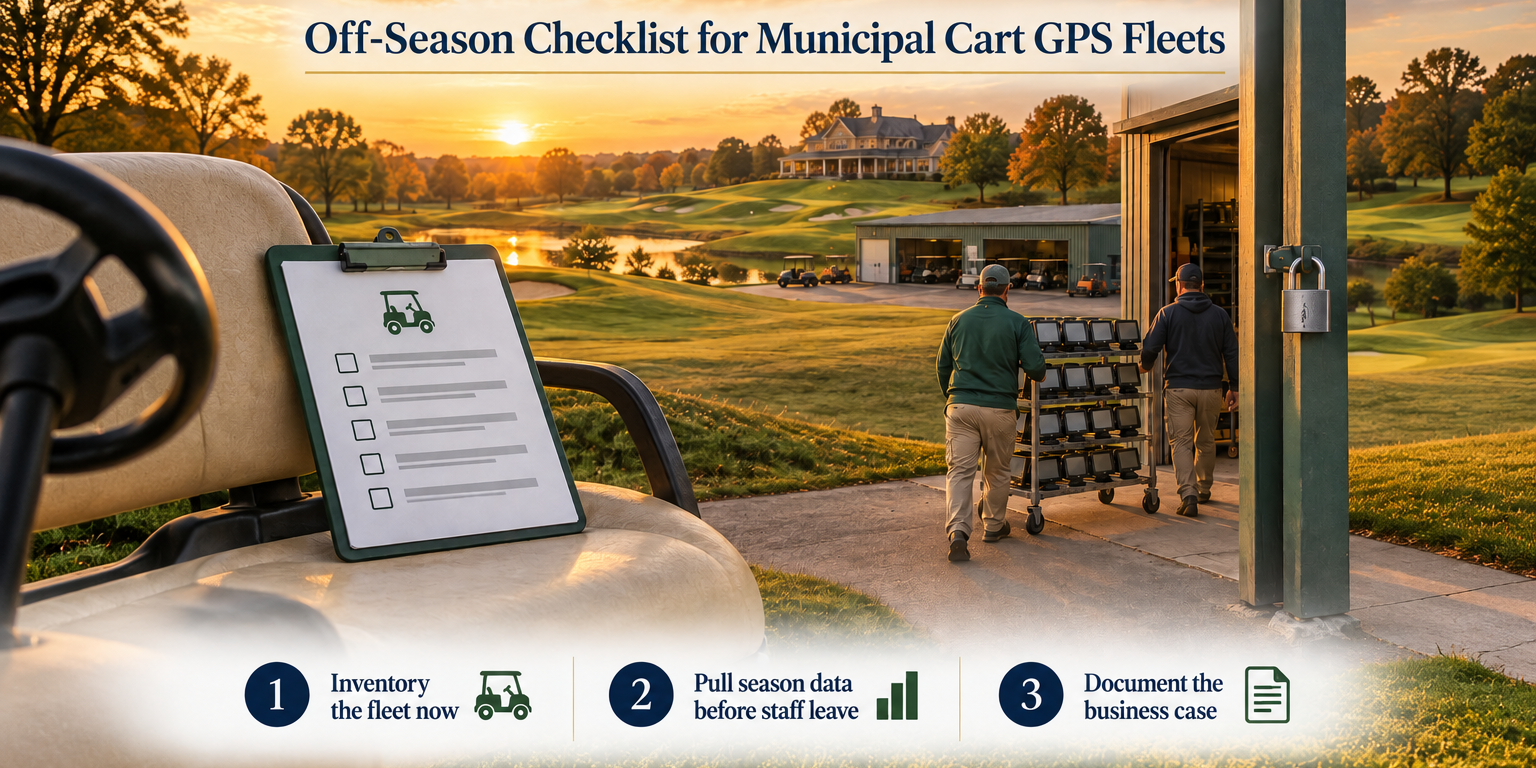
For municipal and daily-fee courses in northern markets, the end of the season decides a lot more than the last tee time. What happens to the cart GPS fleet, the vendor contract and next season's budget all gets settled during close-out, and most of that work gets rushed after the course shuts instead of planned before it.
This checklist is written for the GM at a municipal or daily-fee course that closes or slows down for winter. It covers the fleet, the data, the contract and the spring restart, in the order a GM can actually work through them.
Why the off-season matters for a GPS fleet
A cart fleet that sat idle without a plan last spring tells the story every time. Units get powered on for opening day with nobody sure which ones worked in October.
The off-season is the one window a GM has to document the fleet, make the renewal decision and prepare for spring before carts go back out. Treat it as working time for the fleet and the spring restart gets a lot quieter.
Inventory and damage log while the season is fresh
Walk the fleet before staff scatter for winter. Count every screen, note cracked mounts, dead units, and any that dropped connection during the season.
Write it down while the details are still accurate. A GM who does this in October has a real record. A GM who waits has a guess.
Pull the season's data before staff leave
Before the last ranger clocks out, pull what the system has: pace by tee time, ranger coverage, restricted-zone alerts. Keep it to one page.
This is the record that supports next year's decisions, whether that's renewal, replacement, or asking for budget. Our on-cart Precision GPS data on pace by hole, turn time, and restricted-zone alerts gives a GM this season review without clipboard work.
Read the contract: off-season months, support, renewal date
Find the renewal date now. Confirm what the contract says about off-season months: does support continue, does the fee pause, is there a storage or reactivation clause.
If the current system has been drifting or unreliable and switching is on the table, switching GPS providers without the sunk cost is worth reading before the renewal deadline forces a decision.
Winterize the carts and the equipment on them
Start with the cart itself. Follow the cart manufacturer's winterization instructions and anything your cart distributor sends out. That is the baseline. The steps below are a good start on top of it.
Electric carts should go into tow or maintenance mode before storage. Tow mode stops the cart and its accessories from drawing on the batteries all winter, which is how a fleet ends up with drained packs in the spring.
Accessories wired to the cart battery, including GPS units and cart screens, should be disconnected for the off-season. Remove one ring connector from the battery post and leave it off until spring. This matters most for carts left outdoors, where a small constant draw and months of cold add up. If a cart stays plugged in to a charger all winter, the connector can stay on, because the cart will charge back up as normal.
Power the screens off rather than leaving them in standby, and confirm there is no indicator light still on. A light that stays on after the cart is in tow mode means the unit is still drawing power, and that is worth a call to your vendor's support team before the course closes.
Plan the spring side at the same time. Recharging a fleet takes time, so start well before opening day. When carts come out, do a hands-on check of every nut and bolt on the mounts, since hardware can loosen over the winter. Label everything before it goes into storage. The person doing spring reactivation may not be the person who did the fall shutdown.
Done this way, opening day starts with carts and screens that power up on the first try instead of a morning of troubleshooting.
Renewal or replacement: build the ROI case, demand a written accuracy guarantee
Whatever the vendor pitch sounds like, the decision should rest on a business case built from the season's numbers: labor, repairs, ranger coverage and, if the screens carry ads, advertising revenue.
Labor is usually the biggest line. Courses using FAIRWAYiQ save an average of $14,000 a year without cutting staff, and $40,000+ a year when a course eliminates rangers and repurposes junior golf professional staff onto the interactions technology can't handle. The system crunches the data; people handle the sensitive conversations and the relationships with golfers. Cart screen advertising adds a second line, with $12,000 to $20,000 a year in potential depending on the course.
Vendors can take a course's past repair and financial records and organize them into an ROI case. With the AI tools every vendor should be using today, that part is fast.
For a council or parks department vote, the approach is the same every time. Win one champion first. Sell council members one by one before the meeting. Connect them to the vendor's peer references at other municipal courses so they hear it firsthand.
Any vendor comparison needs one non-negotiable line item: a written, contractual GPS accuracy guarantee with a number and a test method. Verbal assurances do not count. Standard GPS drifts 6 to 16 feet. A cart path is 8 to 10 feet wide. That gap is the reason to ask, and how to evaluate any golf cart GPS accuracy claim walks through exactly what to ask for and how to check it.
If accuracy is the deciding factor, understanding the underlying technology helps frame the conversation. What is Precision GPS (RTK) and why golf courses care covers the difference between standard GPS and RTK corrections, which is the physics behind the accuracy number a vendor should be willing to put in writing.
What the season review should show
Keep the one-page review simple enough that a council member can read it in a minute. Four things matter most: where pace slowed and at what times of day, how often rangers were covering gaps by driving the course, where carts entered restricted or wet areas, and which units needed repairs or swaps.
Those four lines answer the questions that come up at budget time. They show whether the current system paid for itself, where staff hours went, and what the course should expect from any system next year. If the current system cannot produce that page without hours of manual work, note that too. It belongs in the business case.
Spring reactivation plan
Write the reactivation plan now while the fall shutdown is fresh. Note the order units come out of storage, who tests them, and what "ready" looks like before opening day.
A plan written in October is something a new hire can follow in April. A plan that only lives in someone's head is not.
What to do this week
- Walk the fleet and log every unit's condition before staff leave for the season.
- Pull pace, ranger coverage, and restricted-zone alert data into a one-page season review.
- Find the contract's renewal date and off-season support terms.
- Winterize the carts per the manufacturer and distributor, put electric carts in tow mode, and disconnect the ring connector on battery-wired accessories, especially on carts stored outdoors.
- Draft the spring reactivation checklist while shutdown details are fresh.
- If renewal or replacement is on the table, start the ROI case now.
Where FAIRWAYiQ fits
We work with any cart brand, so a switch does not mean replacing the fleet. Onboarding takes 1 to 2 weeks, which fits comfortably inside a winter closure, and our support team responds within 2 hours once carts are back out. Our on-cart Precision GPS data gives a GM the season review, pace by hole, turn time, restricted-zone alerts, without pulling it together by hand. We also help build the ROI case and the presentation for the council or parks department.
If you want to talk through your fleet's off-season checklist, book a call with Mike.
Revolutionize Your Golf Operations with FAIRWAYiQ
Unlock the power of data analytics to optimize your golf course management