
Building Staffing Plans for Daily-Fee Courses Under New Leave Rules
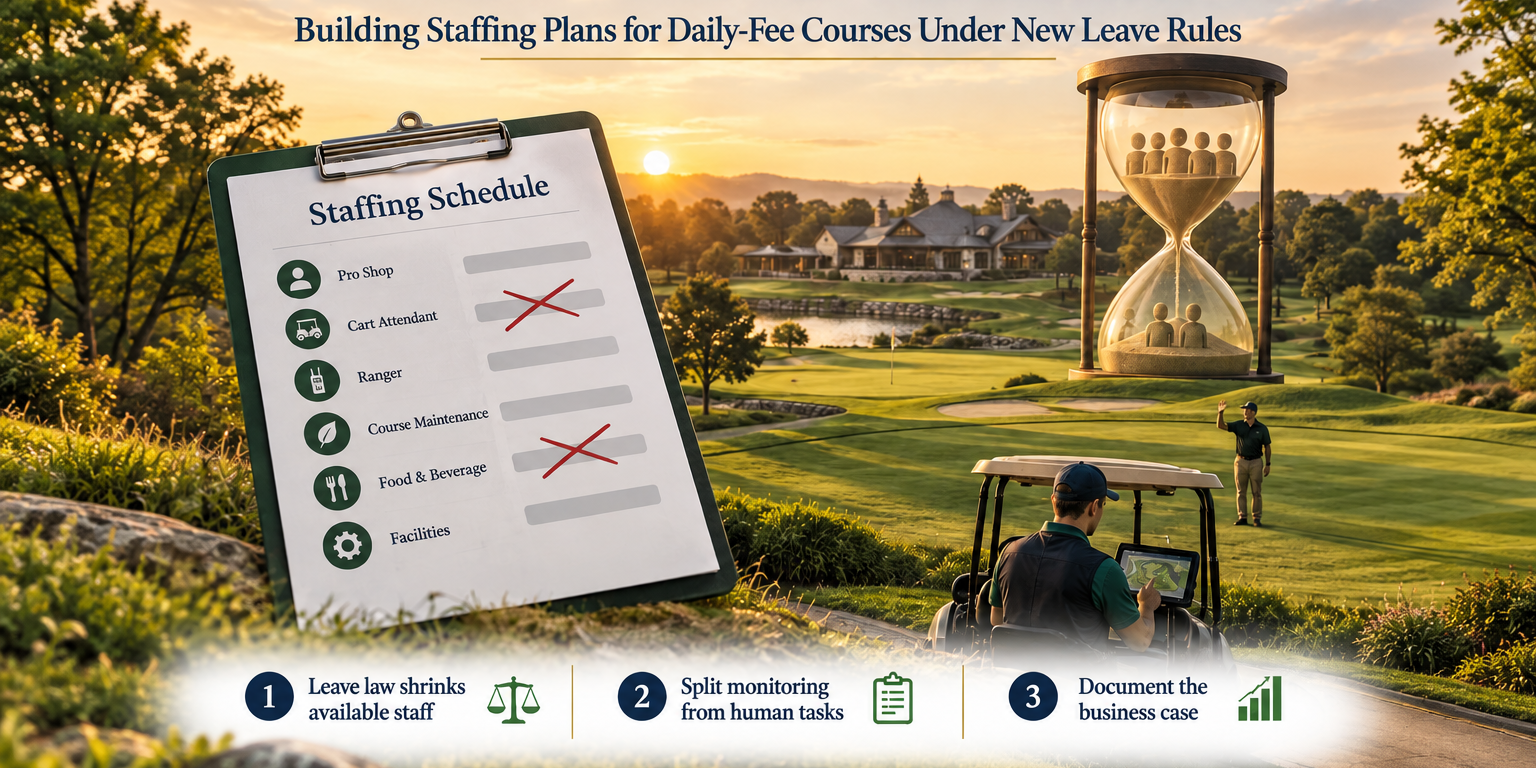
Leave-law compliance is quietly shrinking the labor pool golf operators can schedule against. NGCOA has put out an FMLA and paid leave advisory that lays out how federal and state leave rules are getting more complex for course owners. That complexity lands directly on the roles courses depend on for pace enforcement and course monitoring: rangers and player assistants.
This guide is written for daily-fee and resort operators building staffing plans for the year ahead. Municipal courses face a parallel problem through council-approved headcount, and private clubs and golf communities route the same staffing math through a committee, but the budgeting mechanics differ enough that we'll treat those separately elsewhere.
FMLA and paid leave rules are tightening the labor pool operators can schedule against
Ronnie Miles, NGCOA's Senior Director of Advocacy, writes that a note from a Minnesota course owner surfaced a concern showing up across the industry: navigating employee leave laws that are becoming more complex at both the federal and state level. Miles states plainly that golf course owners and operators need to understand how these rules work.
That is a compliance issue first, and a scheduling issue second. Every hour of protected leave is an hour a GM cannot count on when building a tee sheet, and pace coverage is built out of those hours.
Why ranger and player-assistant coverage is the first place this pain shows up
Rangers and player assistants are the roles that cover pace enforcement, cart returns, and course monitoring in real time. They're also hourly, seasonal, and often the first positions affected when leave requests land on a schedule already built tight.
When one of those roles goes on leave, the result is a gap on a specific shift, on a specific day, that someone has to fill or the course has to absorb. Coverage does not thin out evenly across the week, which is why a roster that looks adequate on paper still leaves Saturday mornings exposed. Our guide to the golf course labor shortage covers how thin that margin already is before leave law enters the picture.
The task split: what GPS and geofencing data can do without a person present
Position data doesn't need a shift, doesn't take leave, and doesn't call in sick. Cart GPS tracks where every group is on the course. Geofence alerts flag a group that's fallen behind pace, a cart that's left the path, or a cart parked somewhere it shouldn't be.
None of that requires a ranger driving the course looking for slow play. We wrote about that shift directly in The End of the Driving-Around-Looking-for-Slow-Play Ranger. The monitoring work, the repetitive part, is the part a system can carry on its own.
What still needs a human: leave conversations, sensitive on-course issues, relationship management
A leave request, a return-to-work conversation, a schedule accommodation, none of that gets automated. A guest complaint on the 14th tee, a dispute between two groups, a member who's upset about pace, those need a person with judgment and a relationship to the customer.
A smaller compliant staff still has to deliver the same round. What changes is how the hours get spent: the monitoring moves to the system, and the people take the parts that need judgment, a conversation, and a relationship with the customer.
Building a staffing plan that survives a smaller, compliant labor pool
Start with the headcount you can legally schedule against rather than the headcount on paper. Ten scheduled positions with two people on intermittent leave means nine or eight people showing up on a given week, and the plan has to work at that number, not the higher one.
Redeploy the hours that used to go toward driving around looking for slow play. Put them into the conversations that need a person. Our post on running a golf course while short-staffed walks through how to keep control of pace and service when the roster shrinks. Minimum wage pressure compounds this; our cost-benefit analysis of the minimum wage increase shows why every remaining hour on the schedule needs to earn its cost.
What to do this week
Before the next budget cycle, walk through this list:
- Pull your current ranger and player-assistant schedule and mark every position that could be affected by intermittent leave.
- Ask HR or your leave administrator how many hours of protected leave are currently in use or pending across those roles.
- List which tasks on that schedule are pure monitoring (pace, cart location, course checks) versus which require a person and a relationship.
- If you're evaluating a GPS or pace-tracking vendor, require a written, contractual GPS accuracy guarantee with a stated number and test method. A verbal assurance from a sales rep does not count.
- Build the ROI case now, not after the budget is set. A vendor can help organize your past payroll and repair records into that case; the AI tools every vendor should be using today make that part fast.
- If you answer to a council or a committee, find one champion first. Sell the members individually before the vote, and ask the vendor to connect you with peer references at other municipal courses or clubs so members hear it firsthand.
Where FAIRWAYiQ fits
We're an independent GPS provider for golf carts, built on RTK corrections rather than standard GPS, and we've worked with courses for 11 years across any cart brand. Position tracking and geofence alerts handle the repetitive monitoring, so a smaller compliant staff can spend its hours on the interactions that need a person. Courses using this approach see average labor savings around $14,000 a year without cutting headcount.
If you want help building the business case before your next budget cycle, book a call with Mike.
Revolutionize Your Golf Operations with FAIRWAYiQ
Unlock the power of data analytics to optimize your golf course management