
A Fall Cart Policy Built on Turf Condition, Not Dates
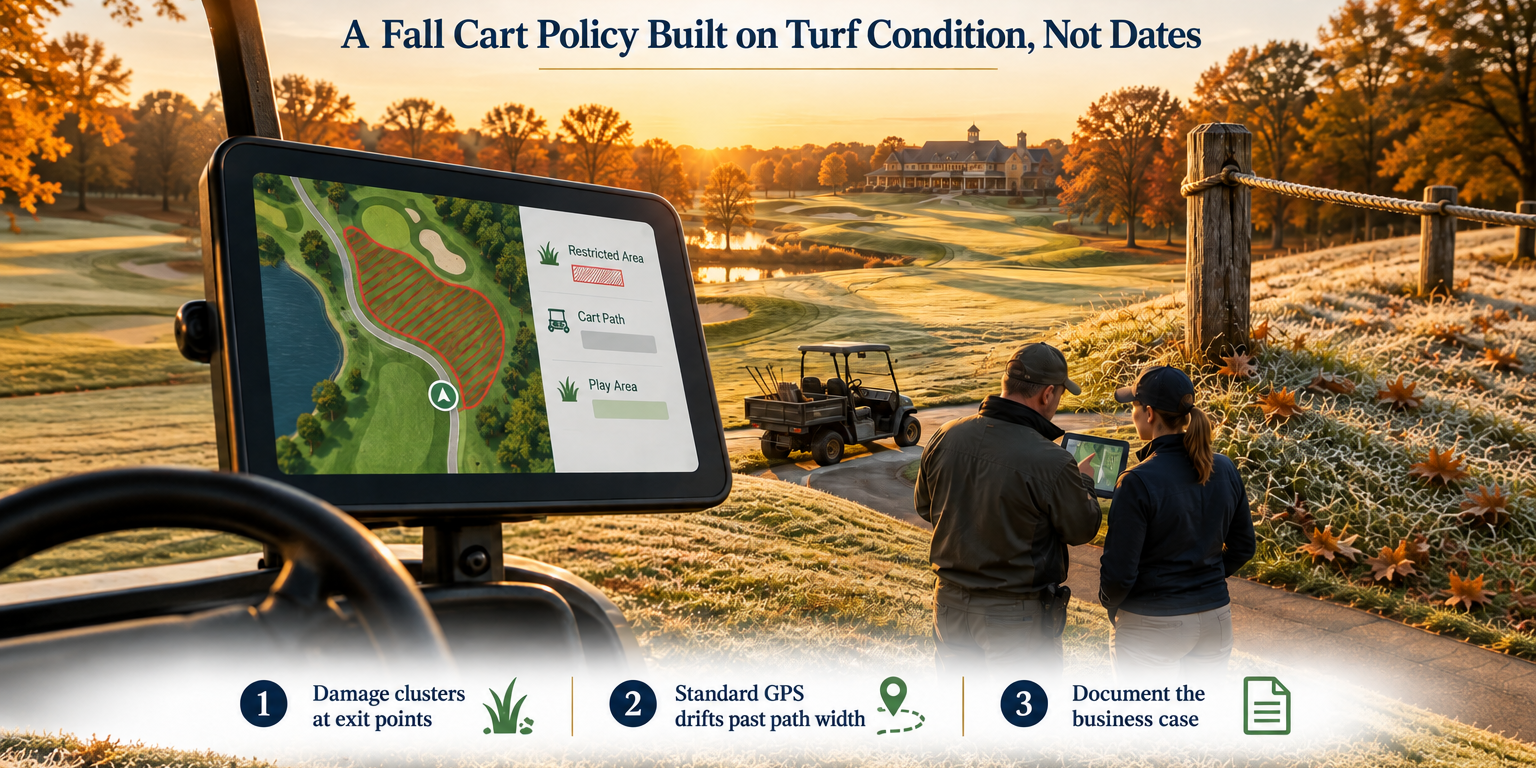
Fall dormancy is starting on turf across the country while shoulder-season play at daily-fee and municipal courses often holds carts on the ground at the same rate as September. That mismatch, steady or heavier cart traffic against slowing or dormant turf, is where fall damage begins. A cart policy tied only to a date on the calendar misses it every time.
Why dormancy makes cart damage worse even when traffic looks steady
Turf that is dormant or slowly growing cannot recover the way it does in June. The USGA's Green Section has documented this directly: golf cart traffic on grass causes damage, and that damage is worse when turf is dormant, under drought stress, shaded, or exposed to frost, and it gets worse as cart volume increases.
Rounds don't need to spike for the damage to spike. If cart traffic in October matches cart traffic in August, the turf underneath it is in a weaker state to absorb that traffic. The same 90 carts a day that a course handled fine all summer can leave a different mark in October.
What the USGA research says about frost, stress, and repeated traffic
The USGA Green Section's research on golf cart damage cites a finding worth repeating to any pro shop or grounds crew: as little as one pass of cart traffic during a frost event produced noticeable damage on a creeping bentgrass fairway. The same research found that repeated traffic without frost also produced turf injury, and that turf thinning showed up with only four passes per week in one study, not 100 passes per day.
The USGA also notes that cart damage concentrates in the same places: where carts leave the path to enter the fairway, near fairway bunkers, and where carts reenter the path near the green. Not every foot of turf takes the same beating. A narrow band of it does, over and over.
Our own look at this problem covers the mechanics in more depth, including how compaction and wear stack on top of each other through a season. See How Golf Course Turf Gets Damaged, and How FAIRWAYiQ Helps Prevent It.
Why fixed cart-path-only rules fail without accurate enforcement
A cart-path-only rule is easy to write and hard to enforce. Standard GPS drifts 6 to 16 feet. A cart path is 8 to 10 feet wide. That gap is the whole problem: a system built on standard GPS cannot reliably tell a cart that is on the path from one that has drifted off it.
Signage and ranger patrols try to fill that gap, but they depend on staff being in the right place at the right time, which on a short-staffed fall morning is not guaranteed. We've written about what actually works in cart-path-only enforcement in Cart-Path-Only Days: Enforcement, Messaging, and What Actually Works.
How dynamic geofencing adjusts to agronomic conditions week to week
Turf conditions in October are not static, and a cart policy shouldn't be either. A restricted zone that made sense during a wet week in early October may need to shrink or move by the third week as a fairway dries and recovers, or expand around a green that stayed frosted late into the morning.
Precision GPS built on RTK corrections is a different measurement category from standard GPS, and it's what makes a zero-buffer restriction possible instead of a rough approximation. We cover the distinction in Zero-Buffer Cart Path Geofencing. A superintendent can redraw a restricted zone this week to match this week's turf, not last month's assumptions.
Building a fall policy your superintendent and pro shop can both enforce
The best fall policy is one where the superintendent sets the agronomic boundary and the pro shop doesn't have to argue about it with a member or a guest. That means the zones need to be visible on the cart screen, not just printed on a sign at the first tee. It also means updating those zones has to be fast enough to happen on a Tuesday morning when frost delayed the first group by 45 minutes.
Good turf practices extend past cart restrictions into mowing height, traffic patterns, and bunker maintenance, all of which affect how much stress the turf can take before it shows damage. Our guide on this is Mastering Golf Course Turf: Tips for Pristine Green Maintenance.
What to do this week
- Walk the course with the superintendent and mark the three or four zones where fall dormancy or frost risk is highest right now.
- Compare those zones against current cart-path-only signage and note where the two don't match.
- Ask whether current enforcement, whether signage, rangers, or GPS, can actually hold a zone accurately to within 10 feet.
- If evaluating a GPS enforcement vendor, require a written, contractual accuracy guarantee with a specific number and a stated test method. A verbal assurance from a sales rep does not count.
- Document current cart-related repair costs and rounds volume so the case for tighter enforcement is built on numbers, not impressions.
Golf Course Industry has been making a related point about staffing this fall: investing time, effort, and money in the people already on a maintenance team pays off more reliably than chasing new hires. That same logic applies to giving your existing superintendent and pro shop staff a tool that actually holds a boundary, instead of asking them to enforce one with a sign and hope. See the Golf Course Industry piece on investing in existing staff.
At a municipal course, this policy change usually needs a champion on staff who can walk council or the parks department through the repair-cost numbers before a vote. At a private club or golf community, that means finding one board or committee member willing to pre-sell the idea to the rest before it's formally raised, and connecting other members to peer references at clubs or communities running the same kind of enforcement. A vendor can help organize your past repair and cost records into that case, since the analysis that used to take weeks is now something any serious vendor should be able to turn around quickly with the AI tools available today.
Where FAIRWAYiQ fits
We provide precision GPS enforcement built on RTK corrections, which lets a superintendent redraw restricted zones as turf conditions change through the fall instead of relying on fixed signage. We're an independent provider that works with any cart brand, not tied to OEM screens, and we've been doing this for 11 years. Onboarding takes 1 to 2 weeks, and support responds within 2 hours when a zone needs to change fast.
If you want help putting together the business case for your council, board, or committee, book a call with Mike.
Revolutionize Your Golf Operations with FAIRWAYiQ
Unlock the power of data analytics to optimize your golf course management