
Making the Cart GPS Budget Case for Golf Communities
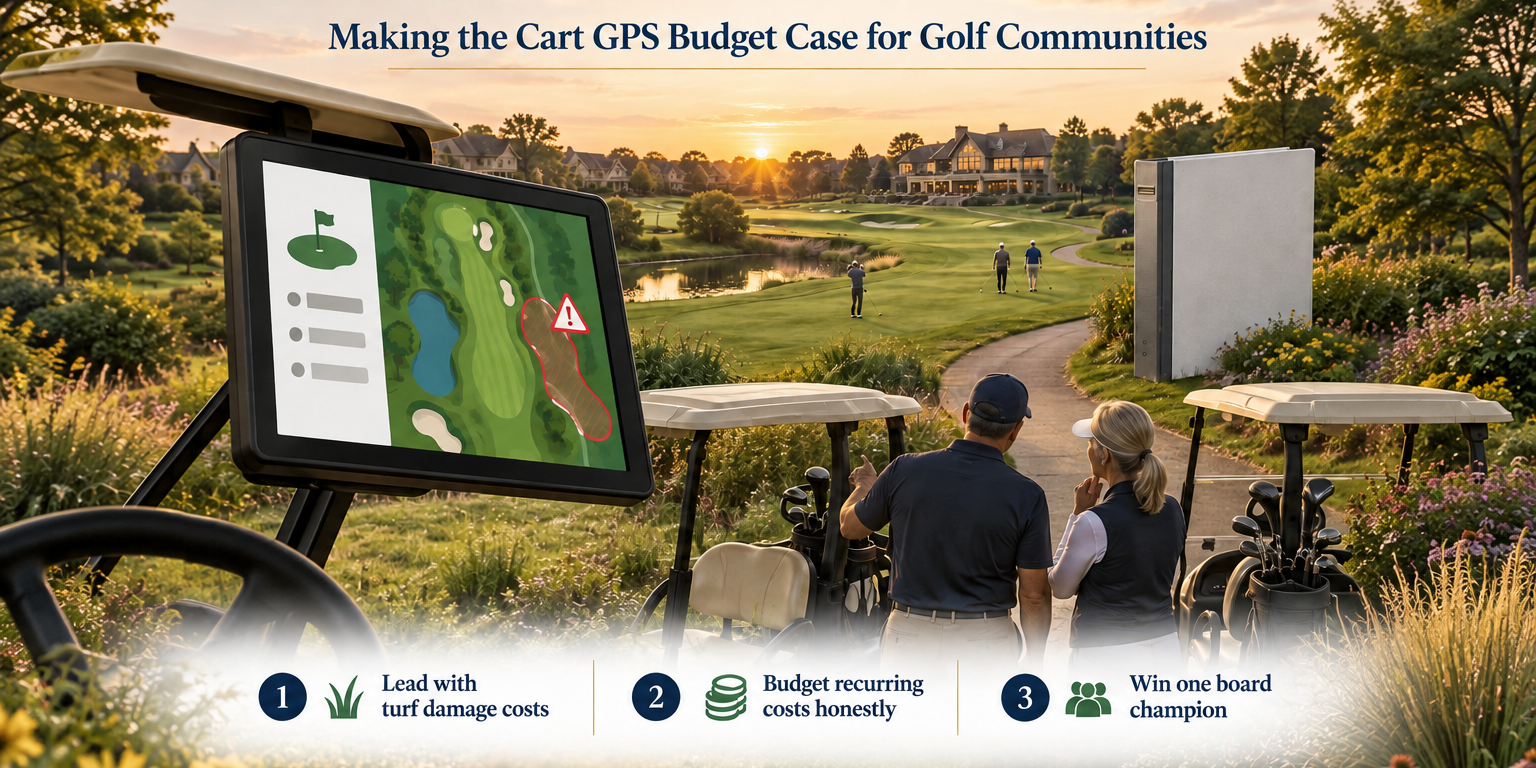
For golf communities with resident-owned carts, fall budget planning is where turf damage, patrol time and stale cart registration records either become a funded operating issue or remain a recurring complaint. The golf operations manager or community manager needs more than photos of worn turf and stories about a cart in a restricted area. By the board meeting, those details need to be a written business case.
Why the budget meeting is where cart problems get decided
Private-cart issues reach the board through different channels. The superintendent sees repair work. Golf staff handles resident complaints. The community office maintains registrations. A golf or cart committee hears about damage without always having a clear record of the cart involved.
The budget process puts those issues in one place. A strong case shows what the community already spends, what remains difficult to document, how better records change accountability and what the recurring system will cost.
Frame it as a governance and operating-cost case. A daily-fee operator usually owns the fleet and builds a different approval case, covered in Building the 2027 Case for Cart GPS at Your Daily-Fee Course; a resident-governed community must also address private-cart registration and committee accountability.
What private carts already cost the community
Start with records the community already has. Do not assign a value to general frustration. Put documented work, payroll and administrative records next to the proposed recurring cost so board members can see the operating case directly.
- Turf repair: Work orders, materials and outside invoices tied to carts leaving paths or entering restricted areas.
- Staff coverage: Payroll records for patrolling, checking problem areas and responding to cart-related incidents.
- Complaint handling: Staff correspondence, committee review and follow-up with residents.
- Registration administration: Time spent reconciling resident details, cart identities and records that have gone stale.
- Unclear accountability: Damage reports where staff could not establish which registered cart was involved.
Turn each category into an auditable line item. Keep the source record beside it. If a cost is known but not separated in the accounting system, label that limitation rather than creating an estimate the board cannot defend.
Written policy belongs in the same packet. Golf Cart Rules Golf Communities Should Put in Writing This Fall explains how to define restricted areas, registration duties and follow-up before technology is introduced.
Lead with turf. For a golf community, the biggest savings come from avoiding turf damage: fewer repair work orders, less material, fewer outside invoices and less disruption to playing conditions residents pay to enjoy. Staff time belongs in the case as a supporting line, since it is a small number at a community's budget level. Computers handle location data and alerts. People handle resident relationships and sensitive conversations.
Governance without confrontation
On-cart GPS should support the community's rules without creating a confrontation on the course. As a resident-owned cart approaches a restricted zone, the cart screen gives a warning and the plain-language reason for the restriction. If the cart crosses the boundary, staff receives a violation alert for committee follow-up.
The same screen can provide pace warnings. Registration records connect the cart to current community records, giving the committee a documented event to review instead of a disagreement based on memory.
We discourage heavy-handed cart control in a residential community. The cart keeps moving. The resident receives useful information, and the board retains governance through written policy, accurate records and consistent committee follow-up.
Cart screens for community events and resident communication
In a golf community, the cart screen works best as a resident communication channel. Use it for community events, clubhouse happenings, course notices, maintenance schedules and reminders about cart rules. Residents see timely information where they already spend their time, and the board gains one more way to reach the membership.
Advertising for businesses outside the community calls for caution. Many residents paid for the carts and devices themselves, and outside ads on a screen they own can feel disruptive. Some communities selectively allow local services such as attorneys, insurance agents or home-service providers. Make that a membership decision, set standards in writing, and keep the volume modest.
Cart screen advertising can generate $12,000 to $20,000 per year for a course. A community should treat any outside-business revenue as optional and leave it out of the core case. The Cart Screen Ad Playbook: Turning Your Fleet Into a Local Sponsorship Channel covers the operating work if the membership chooses to proceed.
Recurring costs to budget honestly
Separate one-time implementation items from recurring costs. Ask the vendor's written quote to identify the software subscription, connectivity, support, mapping changes, replacement responsibility and installation on newly registered carts.
Include internal administration as well. Registration maintenance, committee review and screen content still require ownership. Better data reduces searching and patrolling. People still handle resident communication.
Build the case on operating savings and governance. If the membership later approves selective local advertising, report that income separately so the board can evaluate it on its own.
What to require from a GPS vendor
Accuracy is non-negotiable. Standard GPS drifts 6 to 16 feet. A cart path is 8 to 10 feet wide. If the system cannot consistently distinguish the path from adjacent turf, alerts will lose trust.
Require a written, contractual GPS accuracy guarantee with a number and a test method. Verbal assurances do not count. The test should define where measurements occur, the reference points used, the conditions covered, the sample procedure and what happens if the stated accuracy is not met.
Ask vendors to demonstrate the test on the community's mapped cart paths and restricted boundaries, including areas affected by trees or terrain. Require the result in writing before the recommendation goes to the board.
Also confirm that the system works with resident-owned carts of any brand, maintains usable registration records, provides approaching-zone and pace warnings, sends violation alerts and supports exportable reporting. Ask for peer references from other golf communities with private carts so board and committee members can hear how governance works after installation.
What to do this week
The next step is to build the ROI-based case before the vote. Keep it short enough for a board packet and detailed enough that every statement points back to a community record or a written vendor commitment.
- Collect the records. Pull turf repair work orders, materials, payroll records, resident complaints, incident notes and the current private-cart registration list.
- Organize the current cost. Group the records under turf repair, patrol, complaint handling, registration and accountability, with turf repair first. Mark gaps plainly rather than filling them with assumptions.
- Get a complete vendor response. Request recurring costs, implementation responsibilities, the contractual accuracy guarantee and peer references from comparable communities. The vendor can organize the community's past repair and payroll records into the business case and presentation.
- Win one champion first. Find one board or committee member who understands the operating problem. Brief the remaining members one by one before the vote, and connect them directly with the vendor's peer references.
- Prepare the recommendation. Put the current records, governance model, expected operating changes, resident communication plan, recurring costs and vendor commitments in one document. Match the board's established submission process.
The goal is to fast-track the committee's understanding of the value. Board members should see the current operating issue, the evidence behind it and the responsibilities that remain after approval.
Where FAIRWAYiQ fits
FAIRWAYiQ is an independent GPS provider with 11 years serving golf courses. Our on-cart precision GPS uses RTK corrections and works with resident-owned carts of any brand, providing zone and pace warnings on the cart screen, violation alerts, registration records and a cart screen channel for community events and resident notices.
For help reviewing the business case, book a call with Mike.
Revolutionize Your Golf Operations with FAIRWAYiQ
Unlock the power of data analytics to optimize your golf course management