
Welcoming New Golfers at Daily-Fee Courses Without Slowing Down
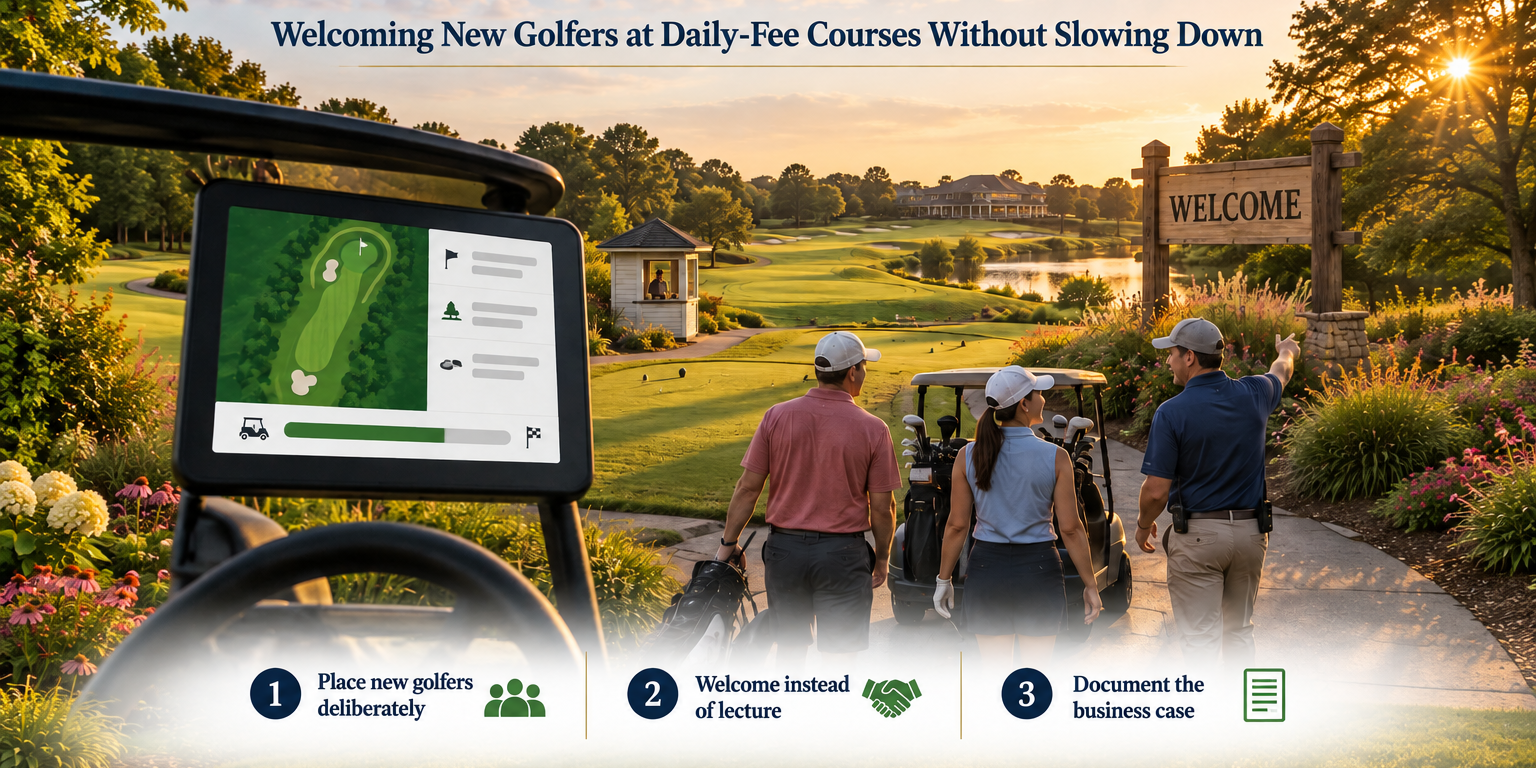
Every municipal and daily-fee course sees newer and occasional golfers on the tee sheet, and many of them don't know pace expectations, course etiquette, or where the forward tees are. The usual response is nothing, or a ranger scolding a group that just wanted to enjoy a Saturday. Either way, the course loses a customer who might have become a regular.
Why new golfers are a pace problem and a revenue opportunity at the same time
Most new golfers care about pace. They lose time because nobody told them where to stand, which tee to play, or how to keep moving. That's a coaching gap, and coaching is something a course can plan for.
Municipal and daily-fee courses depend on repeat play from exactly this group. A first round that ends in embarrassment doesn't come back. A first round that ends in a plan for the next visit does.
Place newer players on the tee sheet deliberately
Newer and occasional players belong in visible, deliberate blocks on the tee sheet, not hidden in the last slots of the day and not scattered randomly among low-handicap groups expecting a quick round. Mid-morning and early-afternoon windows, grouped together, give staff a predictable block to support and give faster groups a predictable lane to play through.
This is a tee sheet decision the starter and the pro shop make together before the day begins, while there is still time to shape it.
A starter briefing that welcomes instead of lectures
A short briefing at the first tee works when it sounds like a welcome. Two or three sentences: which tees to play, where to find the restrooms and the turn, and a reminder that pace matters for everyone's enjoyment, including theirs.
The same information delivered as a warning drives people away. Delivered as a welcome, it sets expectations without making anyone feel singled out.
Let the cart screen teach the course and warn gently on pace
On-cart screens can carry hole information, forward tee markers, and a reminder to play ready golf and pick up when a hole is out of reach. That's teaching, and it happens automatically for every group, every hole, without a staff member driving over to say it.
When a group falls behind, the same screen can show a gentle on-screen pace notice. FAIRWAYiQ never locks or shuts down carts. The model is a warning as a group falls behind, followed by a conversation with staff if the gap keeps growing. We think that's the right approach for daily-fee play, where the goal is to keep a new golfer coming back. If your early tee times set the tone for the rest of the day, The First-Hour Pace Audit for Public and Resort Courses shows how to check them.
Player assistants who coach with facts, not impressions
A player assistant who arrives with a guess about how far behind a group is starts the conversation on the wrong foot. A player assistant who arrives knowing the group's actual position, gained from the cart's own data rather than a clipboard estimate, can open with something useful: here's where you are, here's a tip for the next few holes.
That's coaching. It replaces the old ranger model built around driving the course looking for slow play and guessing at who's behind. We've written about that shift in more detail in The End of the Driving-Around-Looking-for-Slow-Play Ranger.
Turn the first round into a second visit
The round itself is only half the job. What happens after is what brings the golfer back. A clinic invitation, a nine-hole rate for their next visit, or a simple note from the pro shop staff turns a first-timer into someone with a reason to return.
These offers work best coming from staff who know the group played that day, rather than as a generic mailer weeks later. The turn is also where a lot of daily-fee courses lose time and goodwill; our guide on Fixing the Turn on Municipal and Daily-Fee Courses covers that separately.
What to do this week
- Review the tee sheet and identify time-of-day blocks for newer and occasional players, rather than defaulting to the last slots of the day.
- Write a two- or three-sentence starter script that welcomes rather than lectures, covering tees, the turn, and ready golf.
- Confirm what hole information and forward tee guidance the cart screens currently show, and add what's missing.
- Brief player assistants on using position data instead of impressions when they approach a group.
- Set a follow-up offer, a clinic slot or a nine-hole rate, that pro shop staff can extend to first-time and occasional players before they leave.
Where FAIRWAYiQ fits
FAIRWAYiQ's on-cart Precision GPS screens show hole information automatically and track each group's position against pace, with a gentle on-screen notice as a group falls behind. Staff arrive with facts instead of a guess, and nobody works from a clipboard. Courses save an average of $14,000 a year without cutting staff, and $40,000+ for courses that eliminate rangers and repurpose junior golf professional staff onto the interactions technology can't handle, like welcoming a first-time group at the tee. Computers crunch the data. People handle the welcome and the relationship.
The same screens that teach the course also carry local sponsor messages. Cart screen advertising can bring in $12,000 to $20,000 a year, which helps the business case when a council, parks department or owner asks how the system pays for itself. That revenue line and the labor line are both numbers a GM can audit from payroll and the ad contracts.
If you're comparing systems, ask any vendor for a written, contractual GPS accuracy guarantee with a number and a test method. Pace warnings are only fair to a new golfer if the position behind them is right, and a group that gets a warning it didn't earn is a group that stops trusting the screen. A verbal assurance doesn't count. Most vendors can also help you turn last season's records into the ROI case and the presentation for whoever signs off.
To talk through what this looks like for your tee sheet, book a call with Mike.
Revolutionize Your Golf Operations with FAIRWAYiQ
Unlock the power of data analytics to optimize your golf course management