
What Private Clubs Should Put on Cart Screens for Members
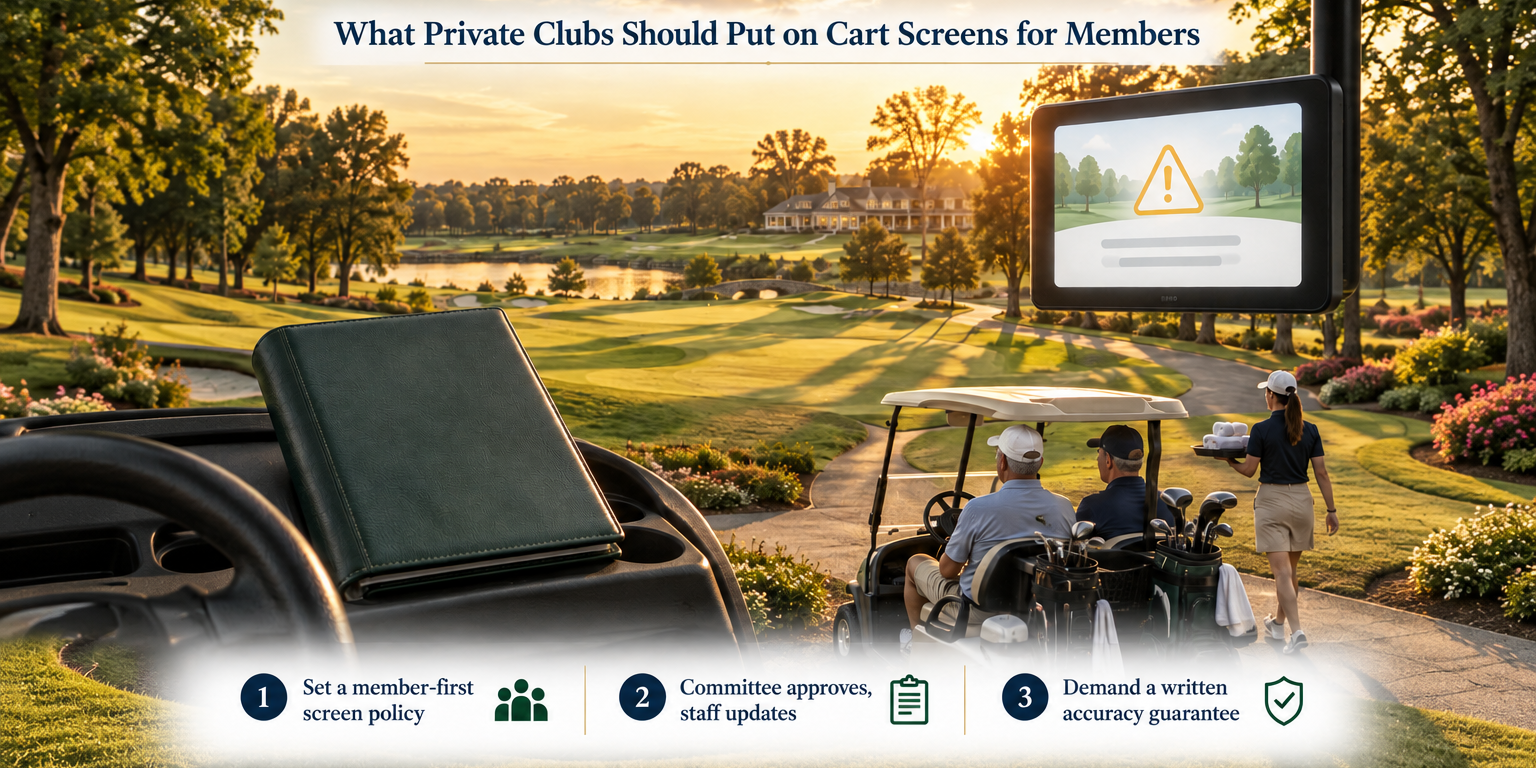
Every private club installs cart screens for yardage and pace. Almost none of them decide what else belongs there, so the screen drifts toward clutter or members learn to ignore it. As the season winds down and the green or golf committee reviews the year, the cart screen is one member touchpoint that has never had a real policy behind it.
Why the cart screen is the club's best member channel
The cart screen reaches every member, in every cart, every round. No newsletter, no email blast, no clubhouse sign does that. At a private club, that reach belongs to the membership, and the committee should decide how it gets used before the golf staff fill it in by default.
Screen content should start from what a member needs during the round, then move to club communication. Advertising comes last, and only with committee and member approval.
Start from what members need during a round
Yardage and hole layout are the baseline. From there, the committee should ask what else helps a member play the round they are already on. Promotion can wait.
That list is short at most clubs: course conditions, zone guidance, pace notes tied to the club's own policy, and the ability to order food and beverage from the cart. Our guide on rolling out cart GPS at a private club covers the sequencing questions that come up once the committee starts this conversation.
Course condition notices from the superintendent
Cart path only areas and wet zones change week to week, sometimes day to day. The superintendent already knows this information before the first group tees off. Putting it on the cart screen means members get it in real time instead of from a sign they drove past, or not at all.
Zone warnings members understand
A zone warning should say in plain language what the zone protects and why. FAIRWAYiQ issues a warning as a cart approaches a protected area, and a violation alert to staff if the cart crosses in. The club decides what happens next.
We never lock or shut down carts. A warning as a cart nears a zone, paired with a quiet alert to staff if it crosses, does the job without forcing anyone to stop or reverse out in front of other members. That matters more at a private club than anywhere else. Members talk to each other, and a system that embarrasses someone in front of their group creates a bigger problem than the one it was meant to solve.
Pace notes that match the club's own policy
Pace messages on the screen should repeat the pace policy the club already has, in the club's own words. Our guide on how private clubs handle slow play goes into how to phrase these so they read as a gentle nudge and never as a scold. The same logic that applies to zone guidance applies here: a system that irritates members gets switched off, mentally if not literally.
Ordering at the turn from the cart
Letting members order food and beverage from the cart on the front nine removes the ordering queue at the turn. It does not touch bathroom breaks or a group that wants to linger at the halfway house. Those stay member choices.
FAIRWAYiQ measures turn time automatically, so the staff do not have to track it with a clipboard. Courses that have looked closely at their own turn operations, using the steps in Fixing the Turn on Municipal and Daily-Fee Courses know how much of the wait comes from people standing in line to order. Cart ordering takes that line away.
Club news and events, kept short
Member events, tournament sign-ups, dining notes, course closures and maintenance schedules all belong on the screen. They belong there in small doses. A screen with five messages competing for attention trains members to stop reading any of them. The committee should set a limit on how many items appear at once and let the golf staff rotate within that limit.
Be careful with outside advertising
Outside advertising on a member-owned screen is disruptive, and it should never appear without committee and member approval. This is different from a resident-owned golf community, where cart screens mostly carry community events and resident news, and any local service listing goes up only after the membership signs off. At a private club, the bar is the same or higher, because members pay dues for a quiet round.
Who approves and who updates
The committee should approve the categories of content once and leave individual messages to staff. Day to day, the golf staff own the updates within those categories. That split keeps the committee out of daily operations while still giving them control over what kind of content ever appears.
Ask the vendor for a written GPS accuracy guarantee
A zone warning that fires at the wrong spot on the cart path teaches members to ignore the screen faster than any other mistake a club can make. Standard GPS drifts 6 to 16 feet. A cart path is 8 to 10 feet wide. That gap is the whole problem.
Any vendor the committee considers should put a GPS accuracy figure and a test method in writing. A verbal assurance that "the system is accurate" counts for nothing in a committee meeting. Ask for the number, and ask how it was tested, before anything goes on a member's screen.
What to do this week
- Pull together the GM, the superintendent, and one committee member for a short working session.
- Draft a short list of approved content categories, in the order members need them: conditions, zones, pace, ordering, then club news.
- Decide who owns daily updates within those categories, and confirm that the golf staff own them.
- Write one sentence on advertising: no outside ads without committee and member approval.
- Bring the draft to the next committee meeting as a short decision item.
Winning committee approval goes faster with one champion. Find the committee member who already sees the problem, walk them through the draft policy first, and let them help bring the rest of the committee along. Connecting that champion, and any skeptical committee members, with peers at other private clubs who have already set a similar policy does more than any slide deck. A vendor can help build that presentation and the business case behind it, including pulling together a club's own repair and tee-sheet records into something the committee can read in a few minutes.
Where FAIRWAYiQ fits
FAIRWAYiQ cart screens carry yardage, zone warnings, course notices, club messages, and front-nine ordering on one screen, and they work with any cart brand already in the fleet. Turn time is measured automatically, so there is no clipboard work for staff. We back our Precision GPS accuracy in writing.
On labor, FAIRWAYiQ courses save an average of $14,000 a year without cutting staff, and $40,000+ for courses that eliminate rangers and repurpose junior golf professional staff onto the interactions technology can't handle.
If your committee is ready to put a content policy on the agenda, book a call with Mike.
Revolutionize Your Golf Operations with FAIRWAYiQ
Unlock the power of data analytics to optimize your golf course management