
What Should a Private Club Committee Review Before Renewing Cart GPS?
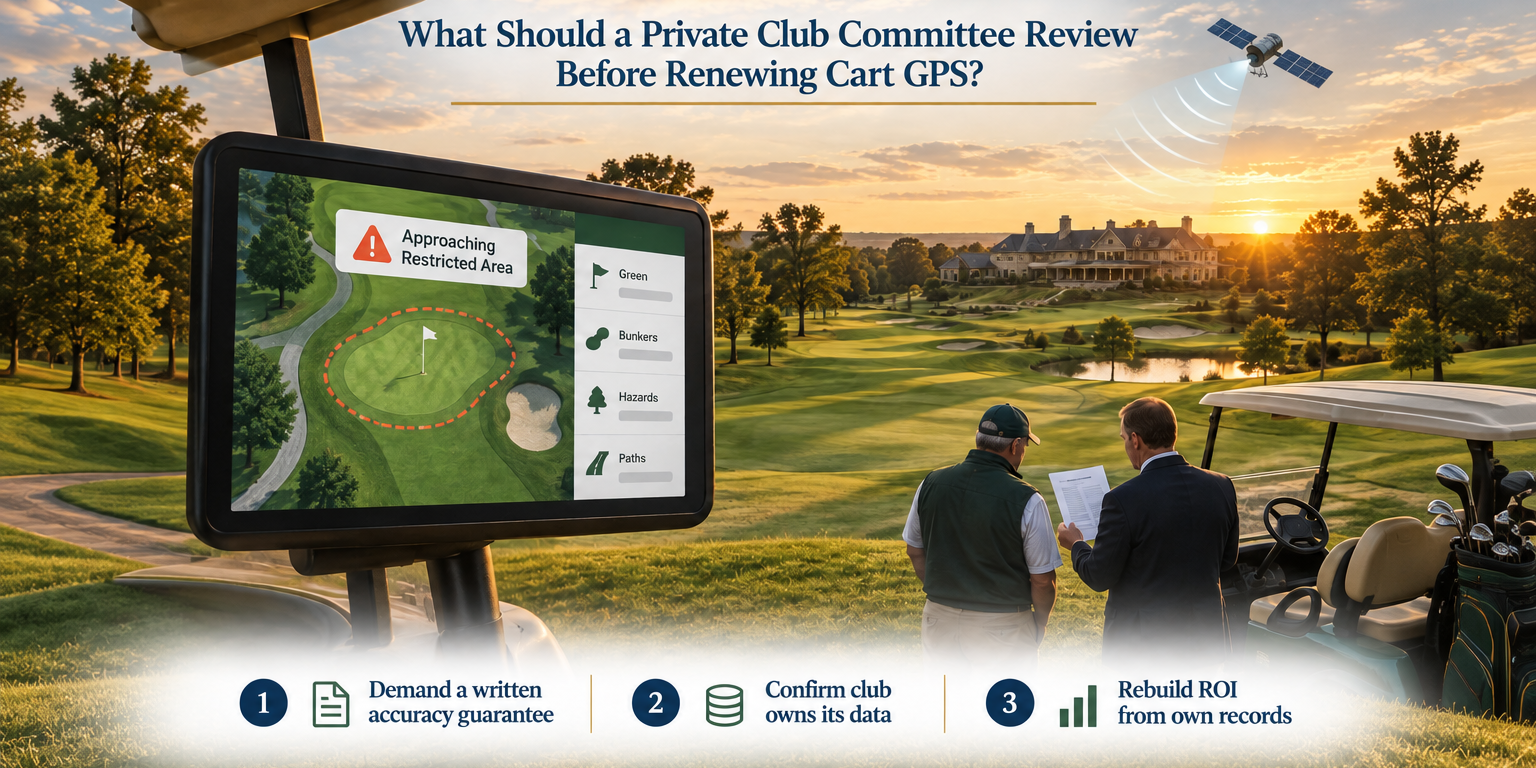
Before renewing cart GPS, a private club committee should review five things: whether members still trust the screen and geofence warnings, a written GPS accuracy guarantee with a named test method, compatibility with any cart brand, club ownership of pace and cart data, and an ROI case rebuilt from the club's own payroll and repair records.
The question usually lands with the green committee or the GM when the agreement comes up for renewal, and the decision is whether to sign again or look elsewhere. The review below works either way.
Do members still trust the screen and the geofence warnings?
Trust is the first thing to check, before price or features. Clubs rarely leave a GPS vendor over cost. They leave because the system stopped being believed.
Ask the pro shop and starters a simple question: do members still read the screen, or have they tuned it out? If geofence warnings near greens or cart paths get ignored, or members complain the location shown is wrong, that is a trust problem, and the renewal needs to address it directly.
Our guide on rolling out cart GPS rules to private club members covers how clubs rebuild buy-in when trust has slipped.
What accuracy guarantee should the new term put in writing?
The new contract term should name a specific accuracy number and a test method the club can verify. Standard GPS drifts 6 to 16 feet. A cart path is 8 to 10 feet wide. That gap is the difference between a geofence warning that fires at the right spot and one that fires in the rough or not at all.
Precision GPS, built on RTK corrections (real-time kinematic positioning, a different measurement category from standard GPS), is what closes that gap. Any renewal conversation should require the number in writing, along with how the club can test it on its own course.
A verbal assurance that the system is accurate should become a contract line with a number attached. For the full criteria list on evaluating a vendor's accuracy claim, see how to evaluate any golf cart GPS accuracy claim.
Will the system work with any cart brand when the fleet lease turns over?
Cart brand independence matters most at the moment a fleet lease turns over. A GPS system tied to one OEM's cart can force the club to either keep an aging fleet past its useful life or replace the GPS system at the same time it replaces carts, which is an expensive coincidence to plan around.
An independent, non-OEM GPS provider installs on any cart brand. The renewal review should confirm, in writing, that the system follows the fleet.
Who owns the pace and cart data, and can the club export it?
Data ownership belongs to the club, and the renewal term should say so in plain language, with an export path the GM can use without calling the vendor first. Pace data, cart movement history and violation alerts accumulate over years. If that record lives only inside a vendor's dashboard with no export option, the club starts the next renewal in a weaker position.
This is also where cart control philosophy matters. A system that only warns carts approaching a restricted zone, then logs a violation alert if the cart crosses anyway, leaves the decision about what happens next with the club's own governance. Forcing a member to stop or reverse out of a zone draws pushback, and a warning is kinder and works better.
For slow play specifically, our guide on how private clubs handle slow play covers the committee governance side.
How should the committee rebuild the ROI business case before the vote?
The ROI case for renewal should come from the club's own payroll, repair, and tee-sheet records. Labor savings average $14,000 a year without cutting staff, and $40,000+ for courses that eliminate rangers and repurpose junior golf professional staff onto the interactions technology can't handle.
Vendors can take a club's past repair and financial records and organize them into an ROI case. With the AI tools every vendor should be using today, that part is straightforward, and it is reasonable to ask the current provider to help build that case and the presentation for the committee.
The approval path that works fastest is winning one committee champion first, then pre-selling individual members before the formal vote. Connecting a hesitant committee member to a peer club's GM carries more weight than any vendor slide. The goal is to fast-track the committee's own understanding of the value so the group can move quickly.
If the review points toward switching rather than renewing, our guide on how to switch GPS providers without the sunk cost covers that process separately. This guide is about the renewal review itself, whichever way it points.
Screen content policy is worth a line item in the same review. See our guide on private club cart screen content policy for what belongs on the screen and what the membership should approve first.
What to do this week
- Ask the pro shop and starters whether members still trust the screen and the geofence warnings, or have started ignoring them.
- Request the current vendor's accuracy number in writing, along with the test method used to measure it.
- Confirm in writing that the system works with any cart brand, ahead of the next fleet lease turnover.
- Confirm the club owns its pace and cart data and can export it without vendor assistance.
- Pull the last year of payroll, repair, and tee-sheet records and ask the vendor to help organize them into an ROI case.
- Identify one committee champion and set up a call between a hesitant member and a peer club's GM.
Frequently asked questions
How often should a private club review its cart GPS contract?
A private club should review its cart GPS contract whenever the term is up for renewal, and again whenever the cart fleet lease turns over, since fleet changes can affect cart brand compatibility. The review should happen before the committee vote.
What counts as a written GPS accuracy guarantee?
A written GPS accuracy guarantee states a specific number, such as a distance figure, along with a named test method the club can use to verify it on its own course. A verbal assurance that a system is "accurate enough" does not meet this standard.
Does the club or the vendor own cart and pace data?
The club should own its pace and cart data, with the ability to export it independently of the vendor. The renewal contract should state this plainly.
Should the committee consider cart lockouts during renewal?
No. A system built on warnings as a cart approaches a restricted zone, with a violation alert if it crosses, keeps the decision with club governance. Locking or shutting down carts removes that judgment and tends to draw member pushback.
Where FAIRWAYiQ fits
We are an independent GPS provider, built on any cart brand, with 11 years serving golf courses. Our Precision GPS carries a written accuracy guarantee with a named test method, and we never lock or shut down carts, only warnings and violation alerts, with the club in charge of governance. Clubs own their data and can export it. We can help a committee organize its own payroll and repair records into the ROI case for the vote.
If your committee's renewal review is coming up, book a call with Mike.
Revolutionize Your Golf Operations with FAIRWAYiQ
Unlock the power of data analytics to optimize your golf course management