
Pace of Play is a Pricing Problem, Not a Guest Complaint
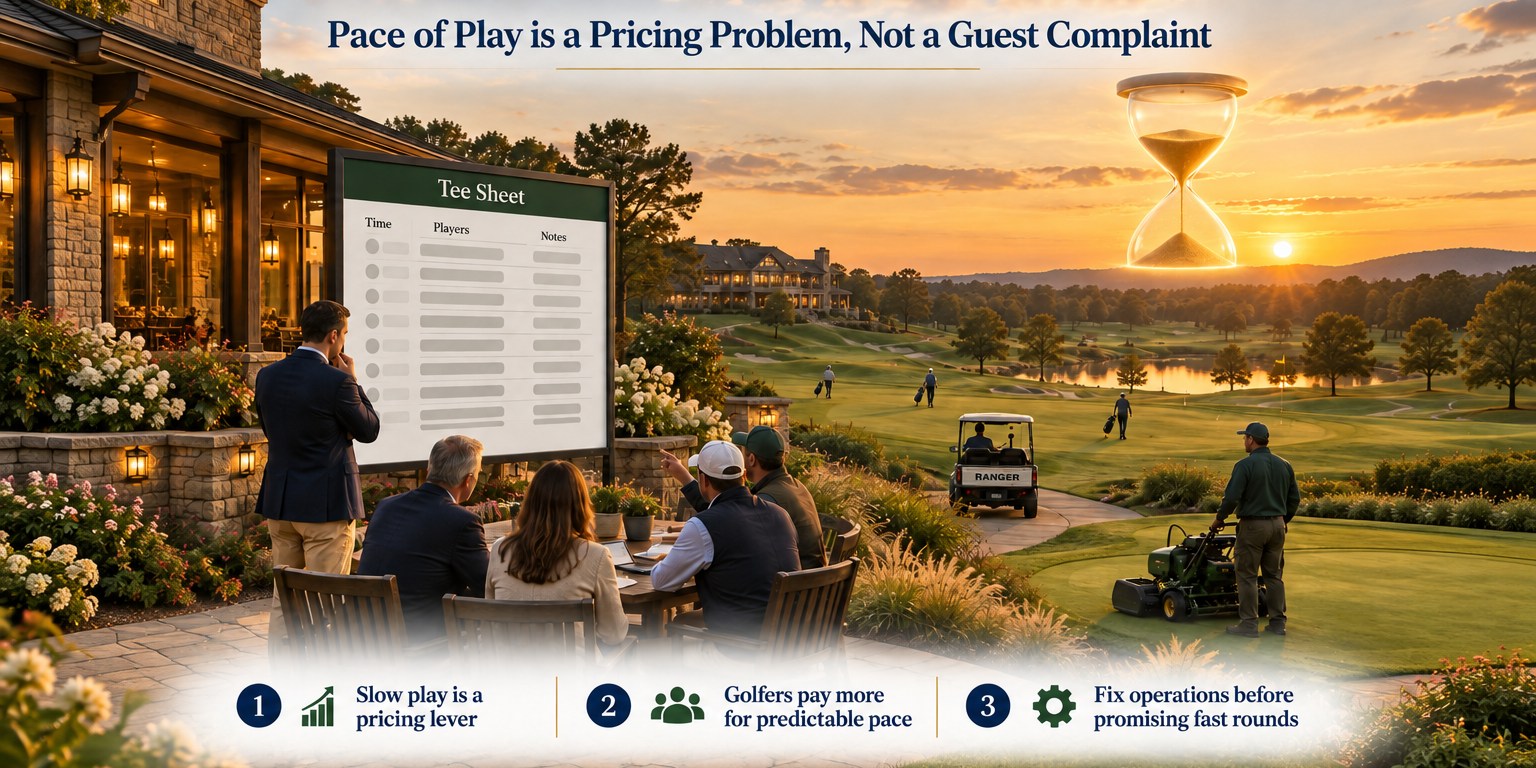
Pace of play is the single biggest driver of golf course online reviews. NGCOA and USGA research puts it in the top three player experience factors for 84% of operators and 74% of players. But most courses still treat it as a service complaint rather than a revenue input. That framing is costing them money.
USGA research is direct: golfers under 40 will pay 14.2% more for a course with predictable pace. Golfers 40-59 will pay 11.5% more. On an $80 green fee, that is $11 per round per player before you have changed a single thing about your product. You are already delivering the pace. You are just not charging for it.
This guide makes the business case and shows what needs to be in place operationally before the pricing premium is real.
Pace variability is what golfers actually feel
Dr. Lou Riccio at Columbia University spent years studying the relationship between tee intervals and round times. His research produced a formula that every GM should know.
Time to Play = 240 + (14 minus Interval) to the power of 2.7, where 240 is the unimpeded round time in minutes and Interval is tee time spacing in minutes.
The results are not intuitive:
14-minute intervals produce 4-hour rounds. A 13-minute interval adds only 2 minutes. A 12-minute interval adds 9 minutes. The curve is not linear.
At 9-minute intervals, rounds hit 5 hours. At 8 minutes, rounds approach 6 hours. At 7 minutes, rounds exceed 7 hours. Most operators have never seen this math.
The reason is cascade. One slow group does not just affect that group. It delays every group behind it. Every lost ball adds roughly 5 minutes to that hole for every group that follows. Every inch above Stimpmeter 10 in green speed adds 5 to 10 minutes to a round. Riccio's core finding: the bottleneck is green clearing time, not the tee-to-fairway segment. Manage the green clearing rate and the rest of the course follows.
Variability is what golfers feel, even when they cannot name it. A round that takes 4.5 hours on a bad Saturday feels different from a course that consistently delivers 4 hours. One of those courses earns a five-star review. The other earns "slowest course I have ever played."
The real cost of a five-hour round
Five-hour rounds have four cost layers.
Direct refund cost. Some players ask for a refund or a comp on the next round. The request takes staff time regardless of outcome.
Lost replay revenue. A five-hour round wipes out the afternoon nine. That player had time for an additional nine. They do not have it now.
Lower review score. Tracked by the next 50 prospective bookers reading that review.
Lost cart fee. A player who walks off after 15 holes does not pay for the cart.
The combined cost per five-hour round at a typical public course runs $30 to $80 in direct and indirect revenue. Across a season with 200 to 300 five-hour rounds, the total is $6,000 to $24,000 — before the review damage compounds.
Reverse the math, and the floor on additional rounds and replay revenue from a consistent four-hour program is $40,000 per season.
The willingness-to-pay premium is the primary story
The $40,000 floor is the cost-avoidance case. The pricing premium is the revenue case, and it is larger.
USGA research puts the willingness-to-pay premium at 14.2% for golfers under 40 and 11.5% for golfers 40 to 59. For a course running 35,000 rounds at an $80 average green fee, that translates to an estimated $110,000 to $130,000 in annual pricing premium — not from additional volume, but from yield on rounds you are already playing.
This is not a volume story. It is a yield story. A course that reliably delivers a four-hour round is selling something genuinely different than a course that delivers a four- to five-and-a-half-hour round depending on the day. One commands a premium. The other competes on price.
There is also a secondary capacity benefit for courses that do not run a full sheet every day. A 15-minute improvement in round time creates room for one to two additional groups. At $400 per group, that adds an estimated $50,000 to $75,000 per year for facilities with open tee time inventory. That is real upside, but it is secondary. The pricing premium matters more for courses already running at capacity.
The operational backstop you need before you publish the promise
The premium is only real if the operations behind it are real. Three things need to be in place.
Pace data at every hole. Not an average across the round. The hole-level data is what tells you where the bottleneck is. A course that averages a four-hour round can still have a 45-minute backup at holes 7 and 8 on Saturday mornings. The average hides it. The hole data surfaces it.
A player services attendant model. A patrol-based ranger cannot deliver on a written pace promise. The attendant model — proactive, data-driven, on the course before groups fall behind — is what makes the commitment credible. The difference is the intervention window. Catching a slow group at hole 3 is a conversation. Catching them at hole 12 is an apology.
A pace-protective tee interval. Eight-minute intervals will break any pace promise on a busy Saturday. Ten-minute intervals on weekend prime time are the floor for most courses. Riccio's formula tells you the expected outcome for any interval. Your GPS data tells you what is actually happening on your specific layout with your specific golfer mix.
If any of those three are missing, do not publish the promise. Write it after the infrastructure is in place.
How to write a four-hour pace promise on your site
Three lines on the booking page that work when the operations are real:
"Four-hour rounds, every round. We track pace at every hole and intervene before bottlenecks form."
"Player services on course every day, with water and pace updates."
"If your round is materially over four hours and 15 minutes, we will make it right."
The third line is the commitment that earns the click. It is also the commitment that requires real operations behind it. Do not write that line on a course where pace breaks every Saturday. Write it after you have the data, the player services model, and the bottleneck hole identified.
The Google review loop
The flywheel is mechanical. Better pace, better reviews, more traffic, higher fees.
At the 18th green. The player services attendant says: "If the round met your expectations, we would appreciate a Google review." Hand them a card with the QR code.
Two days later. An email from the booking system thanks the player and links the review page. Conversion on this is materially higher when the in-person ask came first.
Annually. The course manager replies to every review, positive and negative. The replies show up on the booking page and influence the next read.
The loop runs without much manual labor once it is set up.
What this means for estimated annual facility value
Combining the primary and secondary effects:
Pricing premium: Estimated $110,000 to $130,000 per year at a 35,000-round facility (USGA-sourced willingness-to-pay data).
Replay and capacity recovery: Estimated $40,000 to $75,000 per year depending on current pace reliability and tee sheet availability.
Cart screen ad revenue: $10,000 to $25,000 per year (live customer data from FAIRWAYiQ deployments).
FAIRWAYiQ subscription: $29,000 to $110,000 per year depending on facility size.
Net estimated annual value to the facility: $150,000 to $200,000 conservatively, before review score and loyalty effects compound.
The question is not whether pace management has financial value. The question is whether your current approach is capturing it.
A note on source confidence: USGA willingness-to-pay figures (14.2% and 11.5%) are from published USGA consumer research. Dr. Lou Riccio's tee interval formula and cascade research are from his published work on pace of play management. Revenue estimates are illustrative, based on those inputs and reasonable assumptions about green fee and round volume. Individual facility results will vary.
Revolutionize Your Golf Operations with FAIRWAYiQ
Unlock the power of data analytics to optimize your golf course management