
GPS Drift on Golf Courses: Why Alerts Fire Early or Late
Short Answer
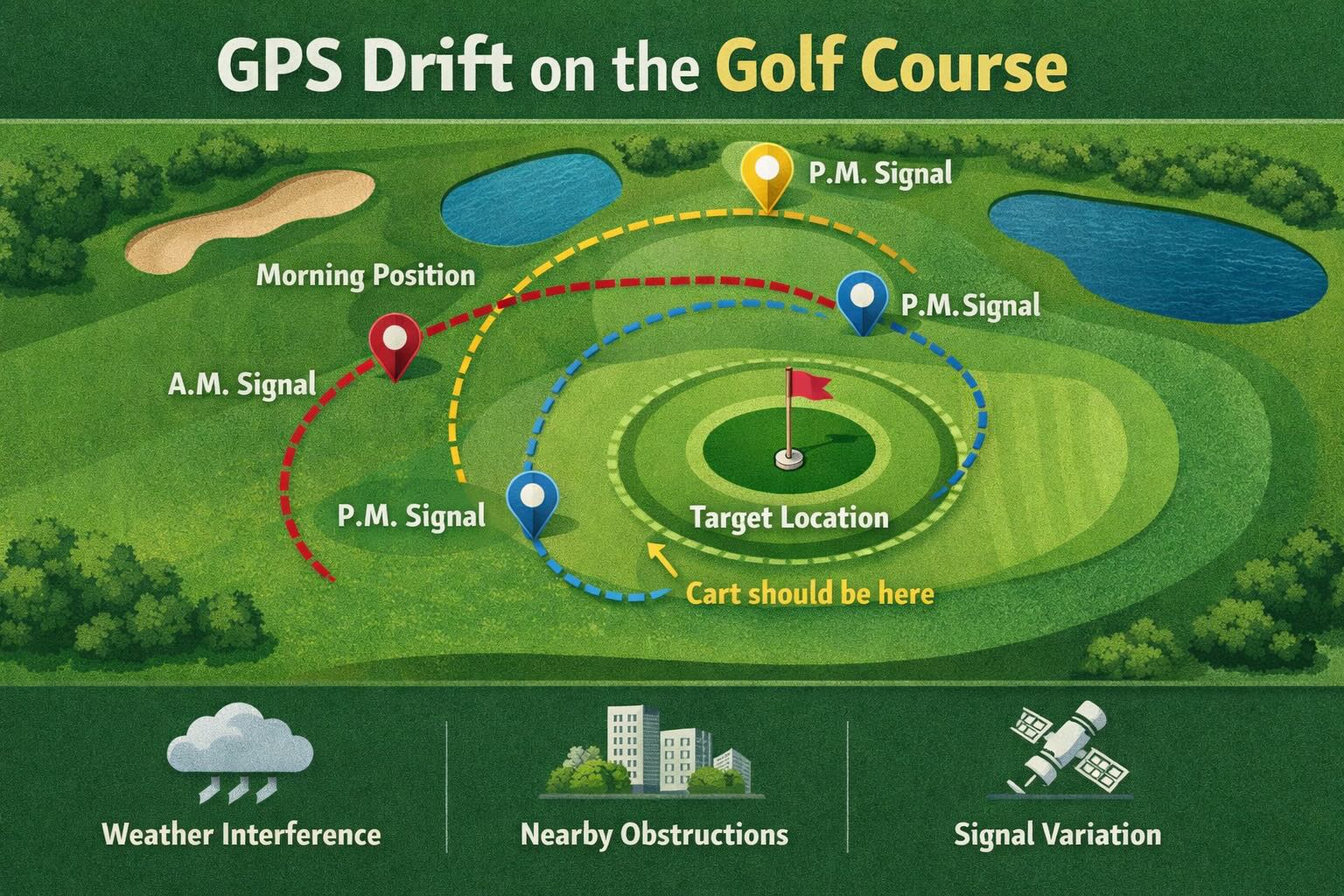
GPS drift is the natural variation in a cart’s reported location caused by changing satellite geometry, tree canopy, terrain, and signal reflections. On golf courses, drift shows up as alerts that fire early, late, or inconsistently, especially near cart paths and restricted areas. The real issue is not a few feet of error, but unpredictable behavior that golfers do not trust.
What GPS Drift Looks Like on a Golf Course
In practice, GPS drift feels like this:
- A cart triggers an alert before it reaches a restricted area
- An alert fires after the cart has already crossed a boundary
- The same spot triggers alerts one day but not the next
When golfers say “the system is wrong,” they are usually reacting to drift-driven inconsistency rather than a true system failure.
Why GPS Drift Happens on Golf Courses
Golf courses are challenging GPS environments.
Tree canopy
Even partial canopy blocks or weakens satellite signals, forcing the GPS receiver to recalculate position.
Terrain and routing
Elevation changes, valleys, and sharp turns alter satellite visibility as carts move.
Signal reflections
Buildings, cart barns, and dense tree lines can reflect GPS signals, slightly delaying them and distorting position.
Changing satellite geometry
Even when a cart is stationary, the satellites overhead are moving, which can change calculated position minute to minute.
Drift is not a bug. It is a normal outcome of standard GPS physics in real-world environments.
Why Drift Matters More Than Accuracy Specs
Courses often ask how accurate a GPS system is. Accuracy numbers matter, but they do not tell the whole story.
What operators experience day to day is behavior. If alerts trigger in the same physical location every time, golfers adapt quickly. If alerts shift even slightly, trust drops.
On narrow cart paths, a few feet of variation can be the difference between compliant and non-compliant behavior.
How GPS Drift Leads to Larger Buffer Zones
To compensate for drift, many systems rely on larger geofence buffer zones. Buffers reduce missed alerts, but they also:
- Trigger alerts earlier than golfers expect
- Make restricted areas feel larger than intended
- Increase golfer frustration
As buffers grow, enforcement moves further away from physical reality.
Why Drift Creates Golfer Distrust and Staff Work
When alerts feel incorrect, golfers begin to ignore them. This leads to:
- Reduced compliance
- More ranger intervention
- Pressure to loosen cart restrictions
Instead of reducing staff workload, inconsistent alerts often increase it.
Practical Ways Courses Can Reduce Drift-Related Issues
Courses cannot eliminate drift, but they can reduce its impact:
- Avoid overly tight geofences in heavy canopy areas
- Focus enforcement on high-impact zones rather than everywhere
- Prioritize consistency over strictness
- Maintain accurate, up-to-date boundary maps
Courses evaluating solutions should ask whether alerts trigger consistently in the same physical locations.
FAQs
What causes GPS drift on golf courses?
Tree canopy, terrain changes, signal reflections, and satellite movement all contribute.
Is GPS drift a sign of poor technology?
Not necessarily. Drift is common in outdoor GPS systems, especially in complex environments like golf courses.
Why does GPS drift affect cart path enforcement the most?
Cart paths are narrow, so small variations have a big impact on alerts.
Can mapping alone fix GPS drift?
No. Good mapping helps, but it cannot eliminate signal variability.
How should courses evaluate drift in practice?
By testing whether alerts trigger in the same place consistently over time.
Related Guides
- Precision GPS for Golf Carts
- Golf Cart Geofencing Explained
- Geofence Buffer Zones Explained
Revolutionize Your Golf Operations with FAIRWAYiQ
Unlock the power of data analytics to optimize your golf course management