
Protecting a Renovated Course: A Turf Plan for the First Three Seasons After Reopening
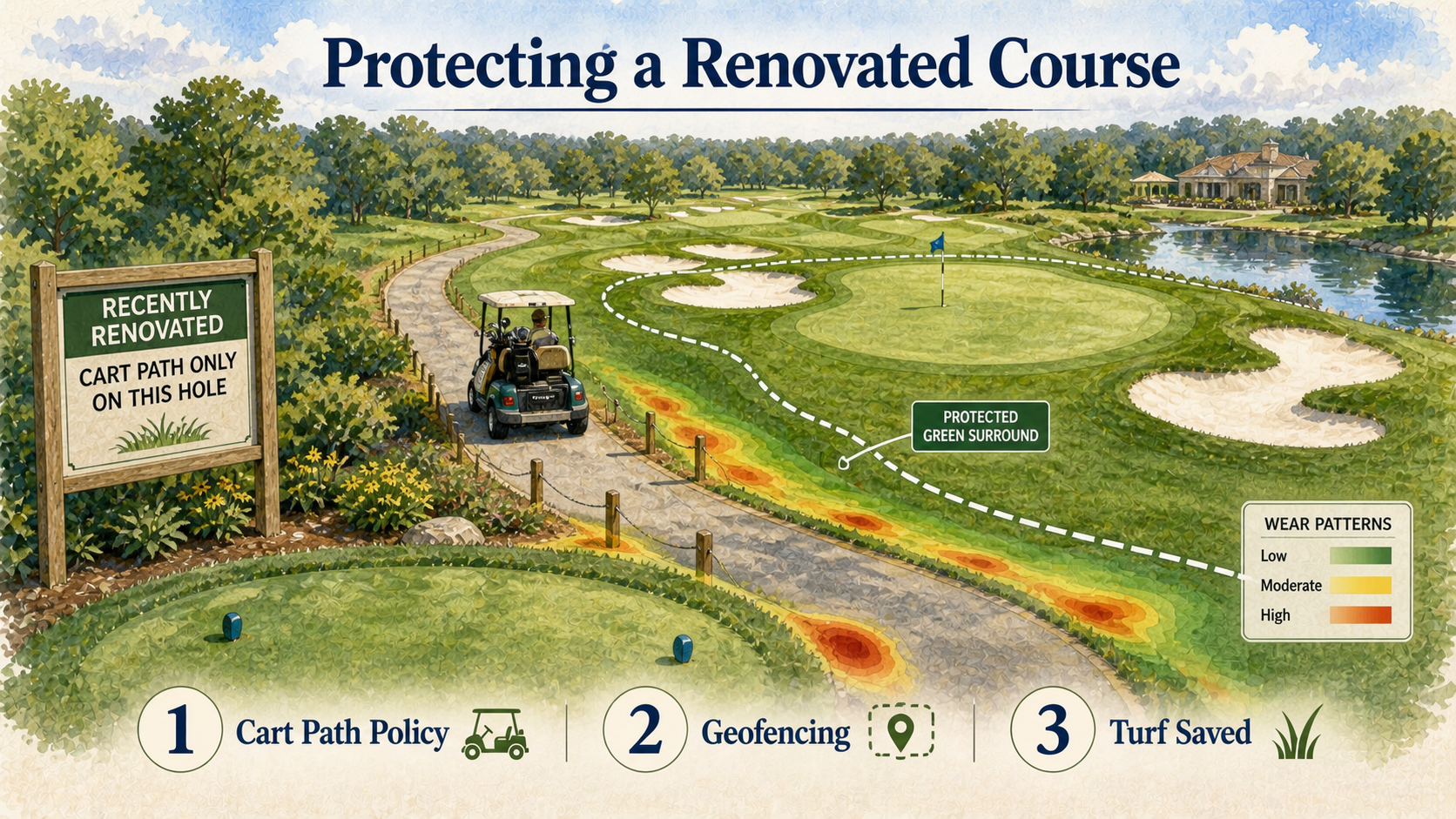
Texas and Florida are leading the country in public course renovations. Memorial Park, Gus Wortham, Lions Municipal in Austin, Jacksonville Beach, Palatka Municipal, and a wave of daily-fee public courses have reopened in the last 36 months with new bunkers, new greens, and new fee schedules. The list is growing on the municipal side and the privately operated side at the same time.
If you just reopened, your turf is fragile for two to three seasons. Cart traffic is the largest variable cost in protecting it. The temptation is to ban carts, but no public course operator can actually do that. The walking population is too small and the green fee economics fall apart. The play is a smarter cart policy, backed by data, that keeps carts off the wear-prone areas without driving away players.
This guide is the cart policy framework for a public course in the first three seasons after reopening. It applies whether the course is municipally owned or run by a private operator.
Why the first three seasons after a renovation are different
A new putting surface needs root depth to handle traffic. New bunker entrances need time for the surrounding turf to mat in. Par-3 tee landings, where one cart per group lands in the same spot every round, take the most direct hit. The first season is the most fragile. The second season is recovery. The third season is the establishment of a long-term wear pattern.
If you protect the wear-prone areas through the third season, you avoid most of the re-sodding work that punishes a renovated course in years four and five. The savings are real. A typical re-sodding bill at a public course, when wear patterns become entrenched, runs $30,000 to $80,000 annually. The floor on protected turf savings is $50,000 per year.
The wear patterns to monitor
Five locations earn the most attention from the GPS data:
- Bunker entrance turf. Every cart that pulls up to a bunker compresses the same square foot of turf. Renovated bunkers with new sand are particularly vulnerable.
- Green surrounds. Where carts park while the player walks to putt, a circular wear pattern develops. New greens fail first at the surrounds.
- Par-3 tee landings. With four players in a cart, one cart in a foursome, the landing spot is identical for the same player position every round.
- Cart path edges on the dogleg side. Players cut the corner. The first three feet of fairway adjacent to the path takes the wear.
- The back-nine drainage swale at peak rain season. Soft turf plus heavy traffic equals visible damage in 24 hours.
A traffic heatmap from your GPS data shows you all five within the first week of operation.
The cart-path policy framework
The right policy is more nuanced than "cart path only." It varies by hole, by season, and by weather.
Always cart path. Holes with new greens in the first season. Bunker-heavy par-3s with new sand. The drainage swale during the rainy season.
Cart path on weekends and tournament days. High-traffic holes during peak demand. Weekends and tournaments produce roughly 60% of the cart traffic at most public courses.
Free cart, with geofenced exclusion zones. Most holes most days. The geofence keeps carts off the surrounds and bunker entrances without restricting the rest of the fairway. Players get the cart experience they paid for, and the wear-prone areas stay protected.
Player communication. Every policy posts on the booking page, the first tee sign, and the cart screen at the start of the round. The player who knows the rule is far less likely to break it or complain about it.
How heatmaps make the case to the player who hates the policy
The most common pushback on a turf policy is "I do not see the damage. Why are you restricting me?" The heatmap answers the question. A printed heatmap on the first tee sign, showing where the cart traffic concentrates and where the wear shows up first, ends most of the conversations. The map also makes the conversation with parks and rec easier when the budget meeting comes around, and it works just as well in front of an ownership group asking why turf maintenance is up.
The geofencing tradeoffs
A geofence is only as useful as it is accurate. A boundary that flickers, fires false alerts, or moves as the GPS drifts during the day trains players to ignore the policy. The boundary has to be tight enough to actually protect the turf and stable enough that the same alert fires the same way every time.
That is a hardware question. A public course evaluating geofencing should ask the supplier directly: how stable is the boundary across a four-hour round, in summer heat, in afternoon rain? Answers in inches are the right answer. Answers in meters are the wrong answer.
Communicating the turf plan on the booking page and the first tee
Three lines on the booking page, written for the player who does not want to read a paragraph:
"Cart paths are required on holes 3, 7, and 12 to protect the renovation.""Carts off the surrounds. Park 30 feet from the green.""Thank you for keeping the course in the shape that earned the rate."
That last line does work. It reframes the policy from restriction to investment.
How public course operators are using geofencing for turf
Quail Heights in Florida operates with FAIRWAYiQ screens, with geofencing as the lead value point in the operating model. Geofencing is the front line of the turf policy at Quail Heights, and the cart fleet runs inside well-defined boundaries year round.
Plum Creek Golf Course in Texas runs FAIRWAYiQ beeper hardware. Plum Creek uses pace and turf protection together, with geofenced exclusion zones supporting the broader turf plan.
Debary Golf & Country Club in Florida and Lozano Golf Center in Texas both apply the same approach on FAIRWAYiQ beeper hardware: build the turf policy on top of the data, not the other way around.
Measuring the savings against the GPS cost
Three line items on the post-renovation P&L tell you the program is working.
- Annual re-sodding spend (target: trending down)
- Bunker maintenance hours per week (target: stable through year three)
- Player complaints tagged "course condition" (target: trending down)
When those three move in the right direction, the GPS pays for itself in protected turf alone. The pace, ad revenue, and labor savings sit on top.
Next step
If you have just reopened or are planning a renovation, request a heatmap walk-through of your course. The first heatmap usually surfaces two or three wear patterns nobody on staff has noticed yet, and the cart policy follows from there.
Revolutionize Your Golf Operations with FAIRWAYiQ
Unlock the power of data analytics to optimize your golf course management