
Why Your Golf Course Geofencing Doesn't Work (And How to Fix It)
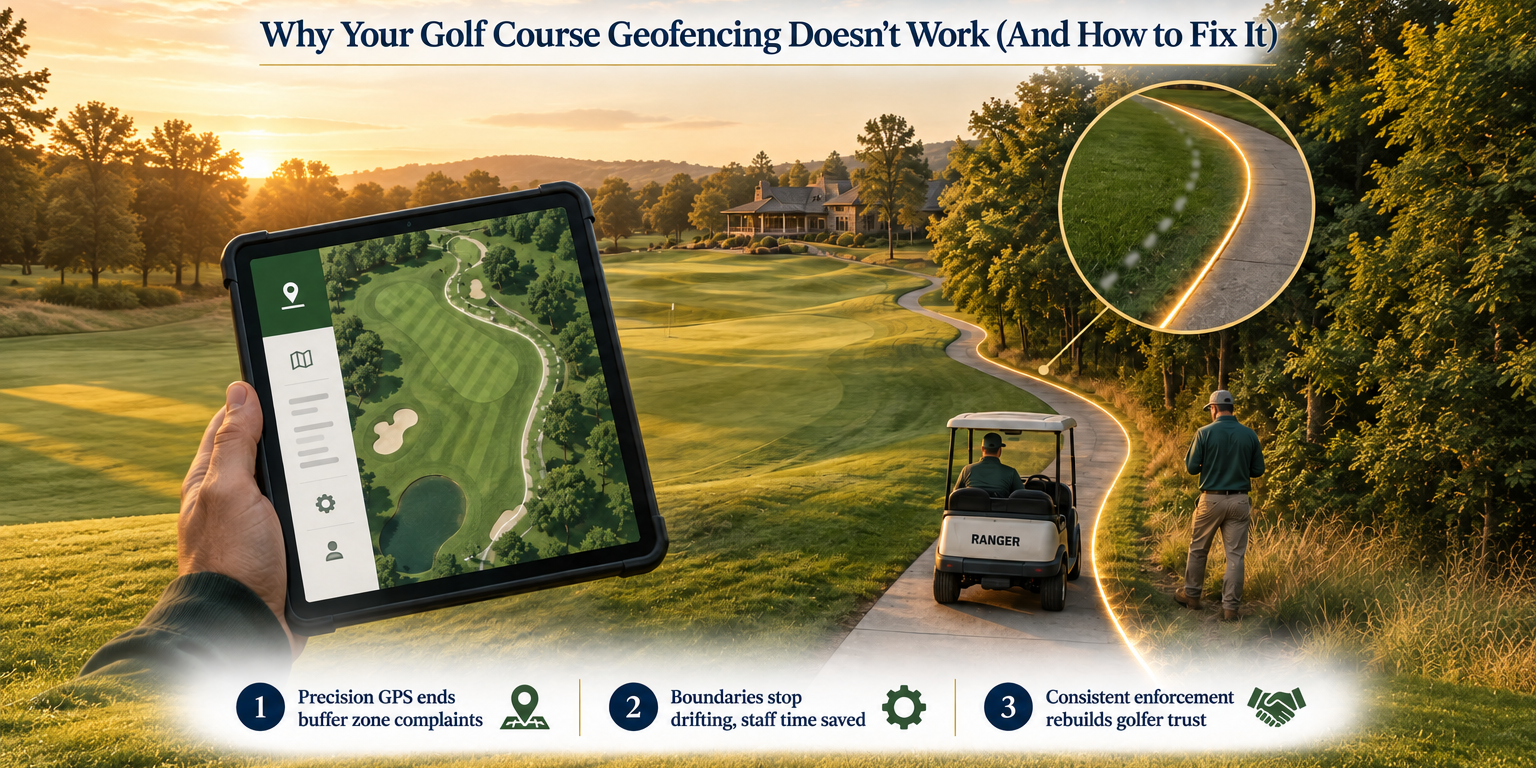
Most courses that have given up on geofencing enforcement went through the same sequence. The alerts fired in the wrong places. Staff spent hours adjusting boundaries. Golfers stopped complying. Eventually someone turned the system off.
That's not bad luck. It's a pattern, and it has a root cause. This guide explains what happened and what precision GPS actually changes.
The math behind the problem
Standard GPS accuracy on a golf course runs 5 to 15 meters under tree canopy. A cart path is 8 to 10 feet wide — roughly 2.5 to 3 meters.
The GPS error is physically larger than the path you are trying to enforce.
That single fact explains every symptom operators report. The system cannot tell which side of the cart path the cart is on. It cannot tell if the cart is on the path at 8am and off it at 2pm when signal conditions change. It cannot draw a reliable boundary around an area narrower than its own margin of error.
No software update, firmware patch, or boundary adjustment changes this. It is a physics problem, not a configuration problem.
The four stages of the geofencing failure cascade
Stage 1: Buffer zones destroy the golfer experience.To stop false alerts from firing when carts are legally on the path, operators add buffer zones — pulling the boundary inward so the alert only fires when a cart is clearly off-course. The buffer works for alerts, but now carts receive warnings while still in the legal zone. Golfers think the system is broken. The first complaint goes to the pro shop.
Stage 2: Drift creates inconsistent enforcement and compliance collapses.Same cart, same path, same boundary setting. An alert fires at 8am but not at 2pm when satellite geometry changes. Golfers learn the rules are random. Once golfers conclude enforcement is arbitrary, compliance falls apart. The social contract that makes cart path rules work — golfers believing they will be caught — is gone.
Stage 3: Staff spend 2 to 3 hours per week adjusting boundaries.To chase the drift, someone on staff starts remapping boundaries. Seasonally, the trees change and the signal changes with them. After a software update, the boundaries shift. Every adjustment takes time, and none of them hold permanently. This becomes part of the job, invisibly.
Stage 4: The system gets turned off.Complaints are piling up. Staff maintenance never ends. The technology investment gets written off as a failed experiment. The course goes back to manual enforcement — a ranger driving the course, arriving too late, having conversations nobody enjoys.
It was not a failed experiment. It was the wrong GPS.
The root cause is GPS accuracy, not software
Most courses believe they have a software problem. They do not. They have a GPS accuracy problem.
The distinction matters because every solution that attacks the software layer — boundary reconfiguration, sensitivity adjustments, firmware updates, switching platforms — leaves the underlying position error in place. You are decorating around a structural problem.
Precision GPS changes the input, not the output. RTK (real-time kinematic) positioning uses a fixed base station on the course to correct satellite data in real time, delivering 1 to 3 centimeter accuracy. That is 100 to 500 times more accurate than standard GPS.
At 1 to 3 centimeters, the system knows which side of the cart path the cart is on. It knows when the cart crossed the line, not just that it was somewhere in the vicinity of the line. The boundary you drew is the boundary that gets enforced.
What zero-buffer geofencing actually looks like
With precision GPS, the geofencing setup changes entirely.
You draw the boundary once, where you actually want it — on the cart path edge, around the green complex, across the fairway at the 90-degree rule line. You do not add a buffer. You do not pull the boundary inward to compensate for drift. The boundary lives exactly where you placed it.
The alerts that fire are accurate. A cart that triggers an alert was off the path. The alert that does not fire means the cart was on the path. Golfers learn the system is consistent. Compliance follows consistency.
Staff maintenance time on geofence boundaries drops to near zero. The maps do not drift. The seasonal signal changes that used to require quarterly remapping no longer move the boundary. Set it once and leave it.
The operational outcome: cart path rules that actually work, turf protection that compounds over time, and staff hours recovered from boundary maintenance.
What to ask before buying or renewing a GPS system
If you are evaluating a GPS platform — new purchase, renewal, or replacement — these four questions separate precision systems from standard ones:
What is the stated GPS accuracy under tree canopy? A vendor who cannot answer this with a specific number in meters or centimeters is running standard GPS. Standard GPS accuracy is 5 to 15 meters. Precision GPS is 1 to 3 centimeters.
Does the system require buffer zones to prevent false alerts? If the answer is yes, the system cannot reliably enforce a boundary narrower than its own error margin. Buffer zones are a workaround for inaccuracy.
How often do boundaries need to be re-mapped after installation? A precision system, once configured, does not require ongoing boundary maintenance. If the expected answer is "seasonally" or "after updates," the position is drifting.
What is the weekly staff time required for geofence configuration? This is the hidden cost of standard GPS enforcement. Two to three hours per week across a season is 80 to 120 hours of staff time that disappears into a problem precision GPS eliminates.
The fix is at the hardware level
The geofencing failure cascade is fixable, but only at the input. If the position is wrong, no software layer corrects it.
Operators who have switched to precision GPS report the same outcome: the enforcement problem disappears, along with the maintenance burden. The cart path rules work because the system finally knows where the cart is.
That is not a feature. That is the prerequisite for geofencing to function as intended.
Revolutionize Your Golf Operations with FAIRWAYiQ
Unlock the power of data analytics to optimize your golf course management