
The Beverage Cart Has Left the Building: How Smarter Routing and Cart-Screen Ordering Lift On-Course F&B
The beverage cart is one of the worst pieces of math in public golf, whether you run a municipal course or a daily-fee operation. A driver, a fully stocked cart, fuel, and a cooler that has to be replenished every three hours, all to drive past players who look up briefly and wave. Most public course operators run the cart for two to four hours on weekend prime time and leave the rest of the field uncovered. Revenue is well below what a fully attended F&B operation should produce, and the labor cost is significant.
There is a better model, and the path to it is already running today on FAIRWAYiQ screens.
This guide covers two things. First, what the smart cart-screen and beverage cart workflow looks like today, and how it lifts on-course F&B without adding labor. Second, where the model is going next, and why the attendant-on-tablet workflow is worth planning for as you think about your 2026 and 2027 operating model.
The math of the underutilized beverage cart
A typical public course beverage cart at $20 per hour for the operator, four hours per day, 200 days per year, runs $16,000 in direct labor. Add cart depreciation, fuel, and stock spoilage, and the loaded cost is closer to $20,000.
Revenue per hour ranges from $40 to $120 depending on the day. The high end is good. The low end is a money-loser. Most public course operators are at the low end on weekday mornings and the high end only during peak weekend prime times. The average is uncomfortable.
Two changes lift that average. The screen prompts the player at the right moment. The beverage cart routes toward the right group. Both are running today.
What the system does today
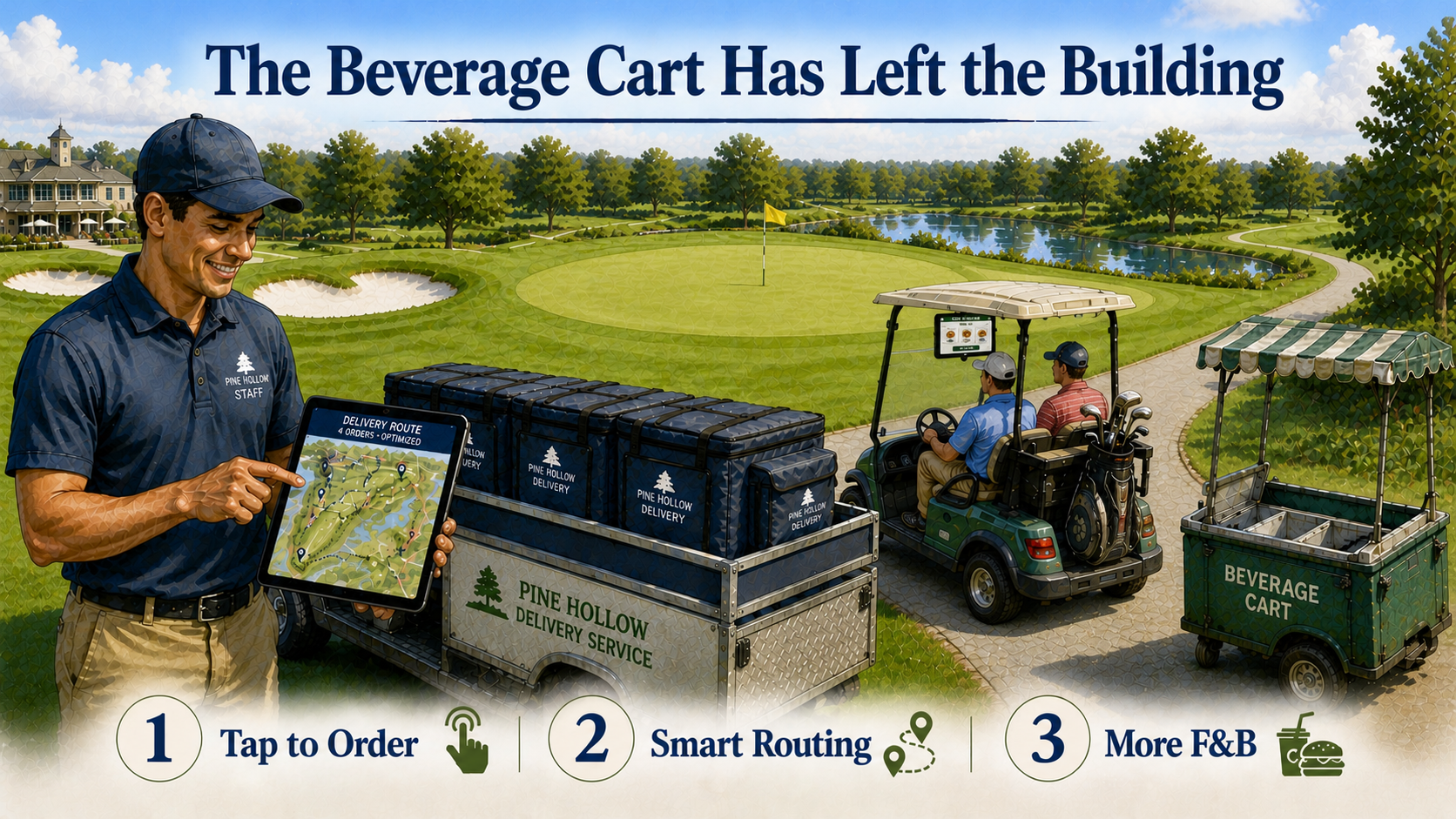
The cart screen prompts the player to order at convenient moments. A short prompt at the turn, when the player is most likely to be hungry. A reminder on the par-3 with the long forced carry, when the cart is going to be sitting still anyway. A drink suggestion on the back nine when the temperature in the cab has been climbing. The player taps the prompt, the order is placed, and the kitchen has line of sight to the request before the cart pulls in.
The benefit at the turn is direct. The player picks up a pre-ordered hot dog and a beer in 30 seconds instead of waiting in line at the grill. The kitchen has the order ready. The cart keeps moving. Pace stays on track.
The beverage cart carries the items that do not require a kitchen run. Beer, water, soft drinks, snacks, the standard cooler stock. The cart attendant is not running back to the kitchen between every interaction. The cart is moving, finding players, and selling.
The attendant tags high-spend groups in the app. When the cart attendant identifies a group that is buying more than the average, the app captures it. The next time that group books, the system flags them. The cart routes toward them on the next loop. Over time, the cart's route stops being random and starts being a deliberate sweep weighted toward the players who actually buy.
That combination, screen-prompted pre-orders at the turn plus a beverage cart routed by data toward the buyers, is what lifts revenue per hour at a public course running FAIRWAYiQ screens today. The labor cost stays the same. The output goes up.
Where the model is going next
The next step is collapsing the kitchen-stocked items and the cart-stocked items into one workflow served by one attendant on a tablet. In that future model, the player orders anything on the menu directly from the screen. The order routes to the kitchen if it needs prep, or to the cart if it is on the standard cooler load. One attendant covers the entire field, batching three to five orders into a single delivery loop and prioritizing the high-spend group flagged in the app.
That is the direction. It is worth planning for. It changes the labor footprint of the F&B operation and lifts revenue per hour materially. But the path there starts with the screen-driven prompts and the data-driven cart routing that are running today.
If you are building your 2026 plan, the smart move is to install the screens, train the cart attendant on the tagging workflow, and start capturing the high-spend group data. By the time the full attendant-on-tablet model is generally available, you have a year of data already in the system and the operational habits already built.
Identifying the high-spending group
The screen plus the booking history surface the groups that spend the most on F&B. The booking system tells you which player has a history of $40-plus on-course F&B per round. The cart attendant's app surfaces the tag in real time. The cart routes toward those groups first.
That is not bad service to the lower-spending group, who is still inside the normal service rotation. It is better service to the high-spending group, who is producing 60% of the F&B revenue and has come to expect a high level of attention.
The metrics that tell you the system is working
Five numbers tell you the screen-prompt and smart-routing workflow is lifting on-course F&B.
- Orders per round (target: up year over year)
- Average order value (target: above $12 at peak)
- Beverage cart revenue per hour (target: $80 or more at peak)
- F&B spend per tagged high-tier group (target: increasing season over season)
- Pre-order rate at the turn (target: 30% or more of players ordering ahead)
When those five move in the right direction, the F&B line is healthier and the labor line is unchanged. The future workflow then sits on top of a system that is already producing.
How public course operators are running the model today
Several FAIRWAYiQ public and municipal course customers in Texas and Florida operate with screens and run this workflow. Their cart attendants tag high-spend groups in the app, the screens prompt orders at the turn, and the beverage cart routes toward the players who buy. The result is more on-course F&B revenue with the same labor footprint.
The next phase of the workflow, with one attendant covering the field on a tablet, is on the roadmap. Operators running the system today are positioned to adopt it without a hardware change.
Training matters more than the technology
The screen and the app do part of the work. The cart attendant does the rest. The attendant who greets the tagged group by name, knows the regular's drink order, and treats the interaction as a hospitality moment is the staff member who actually moves revenue per hour from the low end of the range to the high end.
The hire is closer to a restaurant runner than a beverage cart driver. The pay is similar. The output is materially different.
Next step
If your beverage cart math has been frustrating you for a year, see how the screen-prompt and smart-routing workflow changes the numbers. A 20-minute walk-through covers the player order at the turn, the cart attendant's tagging app, and the data that drives the cart's route.
Revolutionize Your Golf Operations with FAIRWAYiQ
Unlock the power of data analytics to optimize your golf course management