
Municipal Cart Purchase Votes: What GPS Really Costs
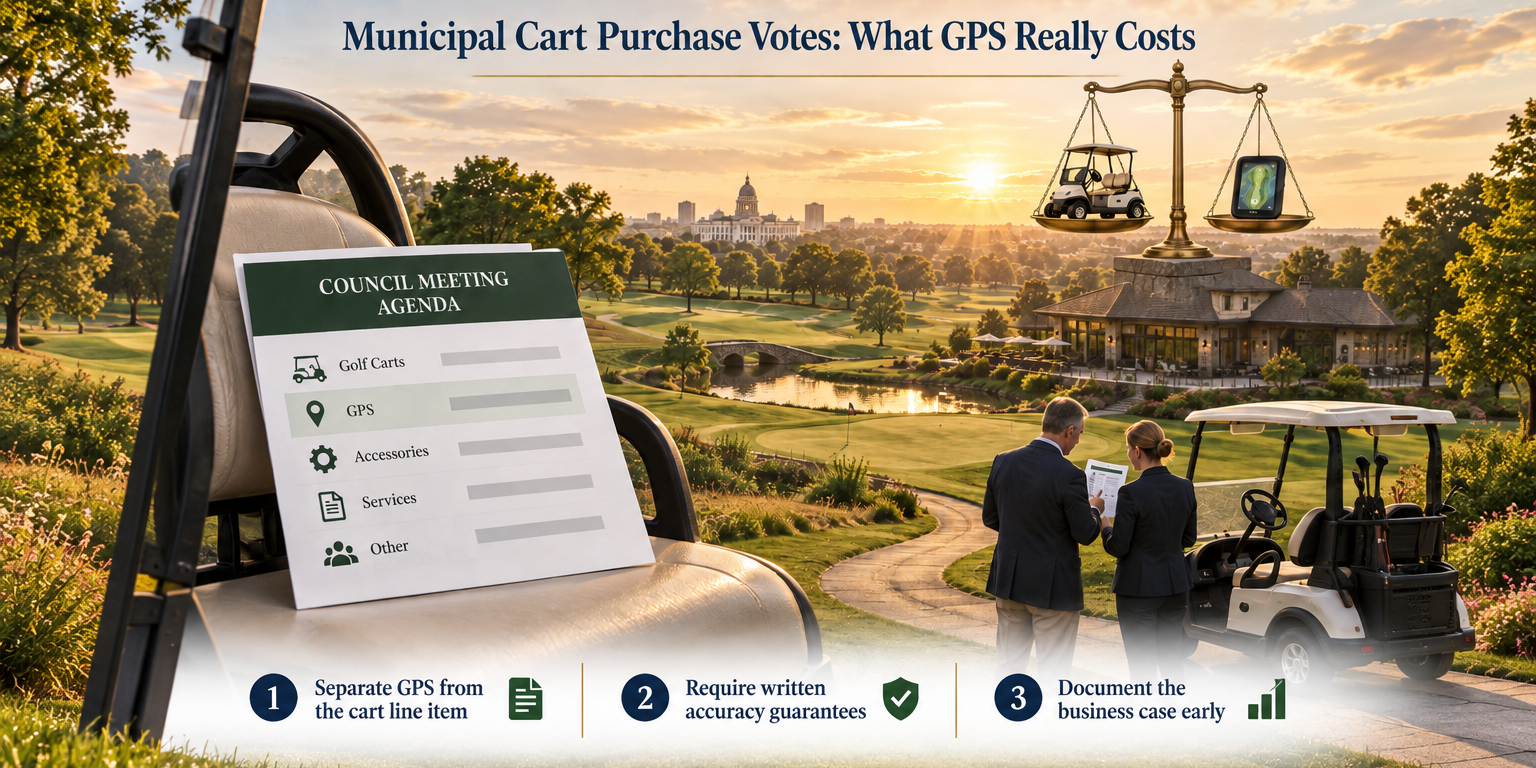
Eaglewood Golf Course in North Salt Lake is replacing its aging gas fleet with lithium carts and GPS. The price tag presented to the city council was $618,870 for 90 carts, GPS units, and charging equipment. This guide is for municipal course general managers and the councils they answer to, since a fleet vote like this puts a GPS decision inside a much bigger capital purchase.
The Eaglewood decision
At a recent city council meeting, Eaglewood General Manager Tyler Abegglen presented the plan, according to the Davis Journal. The current gas fleet is four and a half years old at the end of 2026. Abegglen told the council a typical gas cart lasts five years.
The source reports the fleet has driven an estimated 413,202 nine-hole rounds between July 2022 and December 2026. The prior fleet drove over 293,850 nine-hole rounds in five and a half years, between January 2017 and June 2022. Ninety new lithium carts, GPS units, and charging equipment come to $618,870. The city plans to fund the purchase through its yearly budget plus a $2 increase in cart fees and a $1 increase in green fees starting January 2027.
Why fleet replacement is when GPS gets decided
A cart purchase forces a GPS decision whether or not anyone planned for one. The cart vendor shows up with a bundled screen and a bundled GPS package attached to the quote. The council sees one number, not two decisions.
That's risky because a cart fleet and a GPS system are different assets with different useful lives and different failure modes. One is hardware that wears out on a replacement cycle. The other is a data and accuracy system a course lives with for as long as it takes to switch.
The line-item trap
Bundling GPS into the cart purchase locks a course into one OEM's hardware and screens for the life of that contract. Our guide on OEM lock-in and the hidden cost of buying GPS from your cart brand walks through what that commitment actually costs later, when the course wants a different screen vendor, a different data export, or a different accuracy standard and finds the fleet contract in the way.
The Eaglewood presentation describes GPS units that track cart use and let staff set speed by zone. Those are real features. They don't tell a council whether the GPS was picked because it was the best system or because it was the system the cart vendor sells.
Questions a board or council should require answered
Before a council approves a line item like this, it should have written answers to a short list of questions. A verbal assurance from the presenter is not an answer.
- What is the GPS accuracy in feet, and what test method proves it. Our guide on evaluating any golf cart GPS accuracy claim lays out how to ask this correctly.
- Who owns the location and usage data after the contract ends.
- How does speed-zone control work, and can staff change zones without a vendor visit.
- What is the support response time when a unit fails mid-round.
- Is there a written, contractual GPS accuracy guarantee with a stated number and test method. Not a sales conversation. A contract clause.
Any vendor who can't put a number and a test method in writing shouldn't get a line item on the council agenda.
Separating the fleet decision from the technology decision
A course can buy carts from one vendor and GPS from an independent provider. Our guide on OEM versus independent GPS and what golf courses get wrong covers how that split works in practice, including what changes and what doesn't when the screens aren't made by the cart manufacturer.
Standard GPS drifts 6 to 16 feet. A cart path is 8 to 10 feet wide. That gap is a physics problem, not a settings problem, and it matters more for speed-zone accuracy than any brochure feature list. RTK-based GPS corrects for that drift instead of living with it.
If a course already has GPS attached to an old fleet contract, switching providers later doesn't require throwing out what's already been paid for. Our guide on switching GPS providers without the sunk cost covers how that transition is handled.
What to do this week
Before a fleet vote goes to committee or council, a GM has work to do outside the meeting.
- Pull the course's own repair and cart-fee records for the current fleet, the same kind of usage data Eaglewood presented to its council.
- Build the ROI case separately for carts and for GPS, so the council sees two numbers.
- Win one council member as a champion before the meeting, and give that person the numbers first.
- Talk to committee or council members individually before the vote.
- Ask any GPS vendor being considered for two or three peer references at other municipal courses, and call them.
- Require any accuracy claim in writing, with a number and a test method, before it goes in the packet.
A vendor with modern AI tools can help organize a course's own repair and financial history into that ROI case quickly, and a good one will help build the council presentation too. That's worth asking for.
The GPS side of the case should rest on numbers a council can audit. Labor is the cleanest one. Courses using FAIRWAYiQ save an average of $14,000 a year without cutting staff, and $40,000+ a year for courses that eliminate rangers and repurpose junior golf professional staff onto the interactions technology can't handle. The system crunches the pace data. People handle the sensitive conversations and the member relationships. Cart screens also carry $12,000 to $20,000 a year in advertising potential, a revenue line that belongs in the GPS column, not the cart column.
Where FAIRWAYiQ fits
We work with any cart brand, so a council doesn't have to tie its GPS decision to whichever OEM happens to be selling the fleet. Our precision GPS is built on RTK corrections, a different measurement category from standard GPS, and it includes speed-zone control and geofencing that staff manage from the course, the kind of control Eaglewood's GM presented to his council as a reason to buy. Onboarding runs 1 to 2 weeks, which gives a board a real comparison point when it reviews a bundled line item.
If your council is weighing a cart and GPS purchase together, book a call with Mike.
Revolutionize Your Golf Operations with FAIRWAYiQ
Unlock the power of data analytics to optimize your golf course management