
What AI Actually Does on a Golf Course
What AI Actually Does on a Golf Course (A Plain-Language Guide for Operators)
AI is everywhere in 2026. Golf is no exception. But most of what is being published about AI in golf is long on buzzwords and short on specifics. This piece is for operators who want a plain-language answer to one question: what does AI actually do for my course, today?
Not someday. Not in theory. Today.
The applications are real. The outcomes are measurable. But there is a catch, and it matters more than the algorithm.
What AI Can Realistically Do in Golf Operations Today
There are three practical things AI does in a golf operations context right now.
- Pattern detection across historical pace data
- Predictive pace alerts before a group falls behind
- Automated dispatch routing based on real-time course data
Each one is useful. Each one is also dependent on something that has nothing to do with AI: the accuracy of the GPS positions feeding into it.
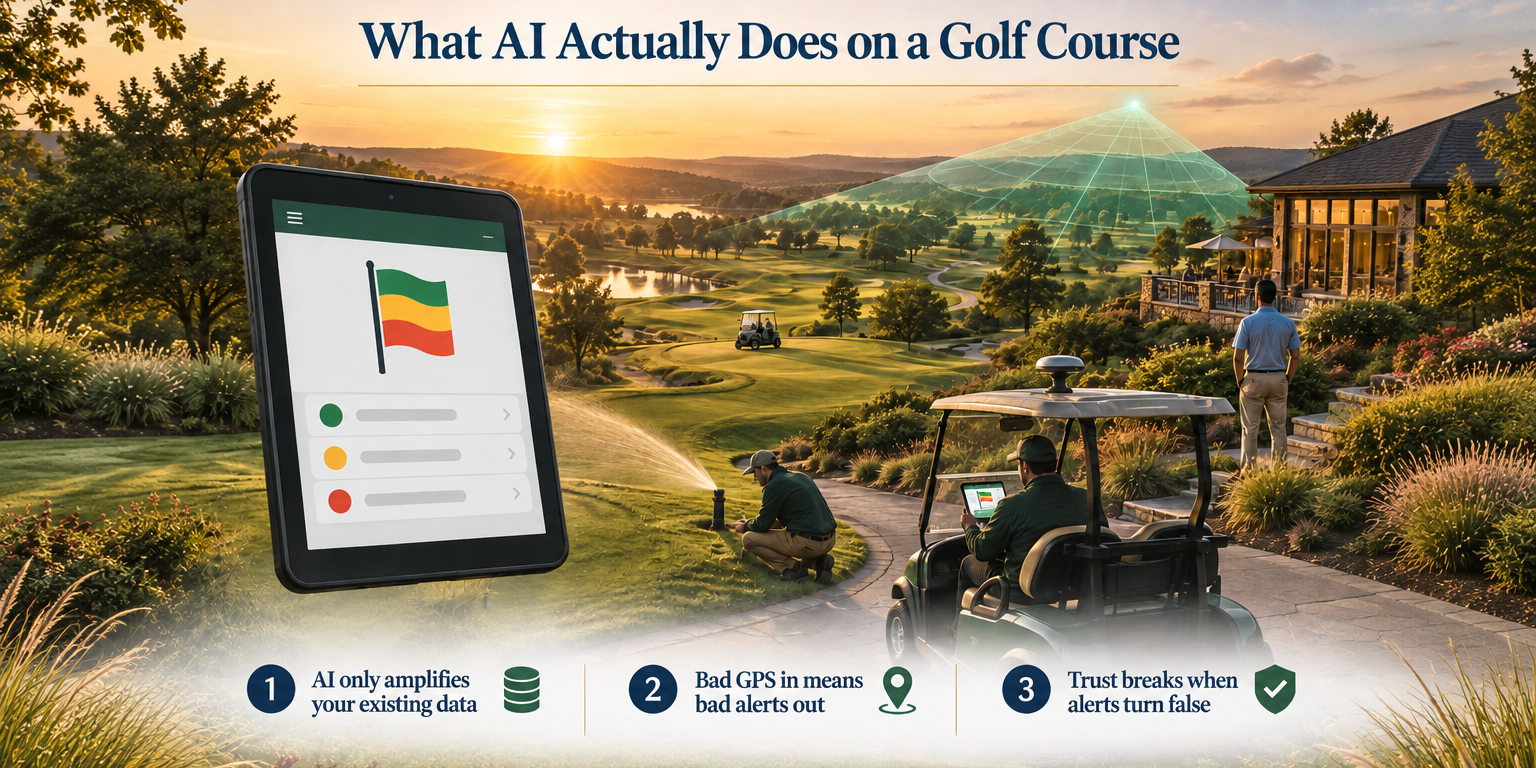
AI does not replace human judgment. It does not fix a broken check-in process. It does not solve a staffing problem. And it absolutely does not fix bad GPS data. It amplifies whatever data it receives, good or bad.
Pattern Detection: Finding the Slow Holes Before the Complaints Start
Right now, most operators identify pace problems one of three ways: a player complaint at the turn, a ranger radio call, or a gut feeling built up over years on that property. All three of those are reactive. By the time a pattern is visible through those channels, it has usually been recurring for weeks.
AI changes that by analyzing historical pace data across every hole on the course, across time of day, day of week, and conditions. It surfaces where backups consistently form, when they form, and how severe they tend to get. That is not something a ranger walking the course can easily calculate. It is something a system running on months of position data can do automatically.
The output is not a report you have to dig through. It is a flag. Hole 7 between 10 a.m. and noon on Saturdays is consistently losing two minutes. That is actionable. You can look at the setup, the marshal coverage, the tee time spacing, and make a change before the next Saturday complaint.
Predictive Pace Alerts: Getting Ahead of the Problem
A reactive alert tells you a group is already behind. That is better than nothing. But by the time a group is 10 minutes off pace, the conversation a ranger has to have is harder, the disruption to groups behind them is already happening, and the options for recovery are limited.
A predictive alert works differently. It spots the trend early. A group that loses 30 seconds per hole across five consecutive holes is mathematically likely to be a problem before it becomes one. A good system surfaces that trend while there is still room to intervene with a light touch, a quick conversation, a wave through, a small correction.
Earlier intervention is a shorter conversation. It is less disruption. It is a better outcome for the group behind them and for the pace of the round overall.
That is what predictive pace management actually means. Not magic. Not a black box. Trend detection applied to position data, surfaced to the right person at the right time.
Why Data Quality Is the Foundation AI Runs On
Here is the part most vendors skip over.
AI is a pattern recognition system. It finds signals in data. The quality of those signals determines whether the outputs are useful or just noise.
Standard GPS systems carry position errors in the range of 5 to 15 meters. That is the same technology in a smartphone. On a golf course, 5 to 15 meters of error means the system may not reliably know whether a cart is on the fairway, the rough, the cart path, or approaching the green. It knows the cart is somewhere in that general area.
Precision GPS built on RTK correction technology works differently. RTK uses correction signals to resolve position to centimeter-level accuracy. That is a different measurement category, not a better version of standard GPS. The architecture is different. The output is different.
When a predictive alert is generated from a position that could be 15 meters off, it may not reflect where the group actually is on the hole. That is a false alert. Rangers who get enough false alerts stop trusting the system. Staff who stop trusting the system stop using it. The AI investment returns nothing.
When that same alert is generated from a centimeter-accurate position, it reflects reality. The ranger trusts it. The intervention happens. The outcome improves.
At FAIRWAYiQ, the 15-minute measured pace improvement we have documented across our customer base is built on that precise data foundation. So is the 96.5% net revenue retention across 150 accounts. Those numbers do not come from a better algorithm alone. They come from an algorithm running on data it can actually trust.
What to Ask Vendors Who Claim AI-Powered Pace Management
If you are evaluating any platform that uses AI language, here are five questions worth asking before you sign anything.
1. What is the GPS position accuracy in meters or centimeters?
Get a specific number. If the answer is vague or framed in terms of features rather than accuracy specs, that tells you something. The measurement system underneath the AI is the most important technical detail in the conversation.
2. How is the AI trained and on what data?
AI models are only as good as the training data behind them. Ask whether the model is trained on data from courses like yours, in conditions like yours. Ask how often it updates and what triggers a recalibration.
3. What does an alert look like and what triggers it?
Ask to see an actual alert. What information does it show the ranger? What was the trigger condition? How long before the problem became visible on the course did the system surface it? A vendor with a real system can walk you through a specific example.
4. How does the system handle GPS signal loss or cart pooling?
Every course has dead spots. Every busy weekend has carts doubling up. How the system handles those edge cases tells you a lot about how robust the underlying data layer is.
5. Can you show measured pace improvement outcomes from current customers?
Not testimonials. Not case study language. Actual numbers. Before and after. How much did pace improve, how was it measured, and over what time period? If a vendor cannot produce that, the AI claim is theoretical.
The Foundation Comes First
AI in golf operations is not hype. The applications are real and the outcomes are measurable. Pattern detection finds problems weeks before they surface through complaints. Predictive alerts create room for earlier, lighter interventions. Automated dispatch routes staff based on what is actually happening on the course rather than instinct and incomplete information.
But the gap between an AI system that improves operations and one that creates noise is almost always the quality of the data underneath it. Centimeter-level GPS is not a premium feature. It is the foundation the rest of this runs on.
Start there. Ask that question first. The algorithm conversation comes second.
Revolutionize Your Golf Operations with FAIRWAYiQ
Unlock the power of data analytics to optimize your golf course management