
Record Rounds in 2026: Turn Traffic Into Throughput
The Demand Is Real. The Bottleneck Is Too.
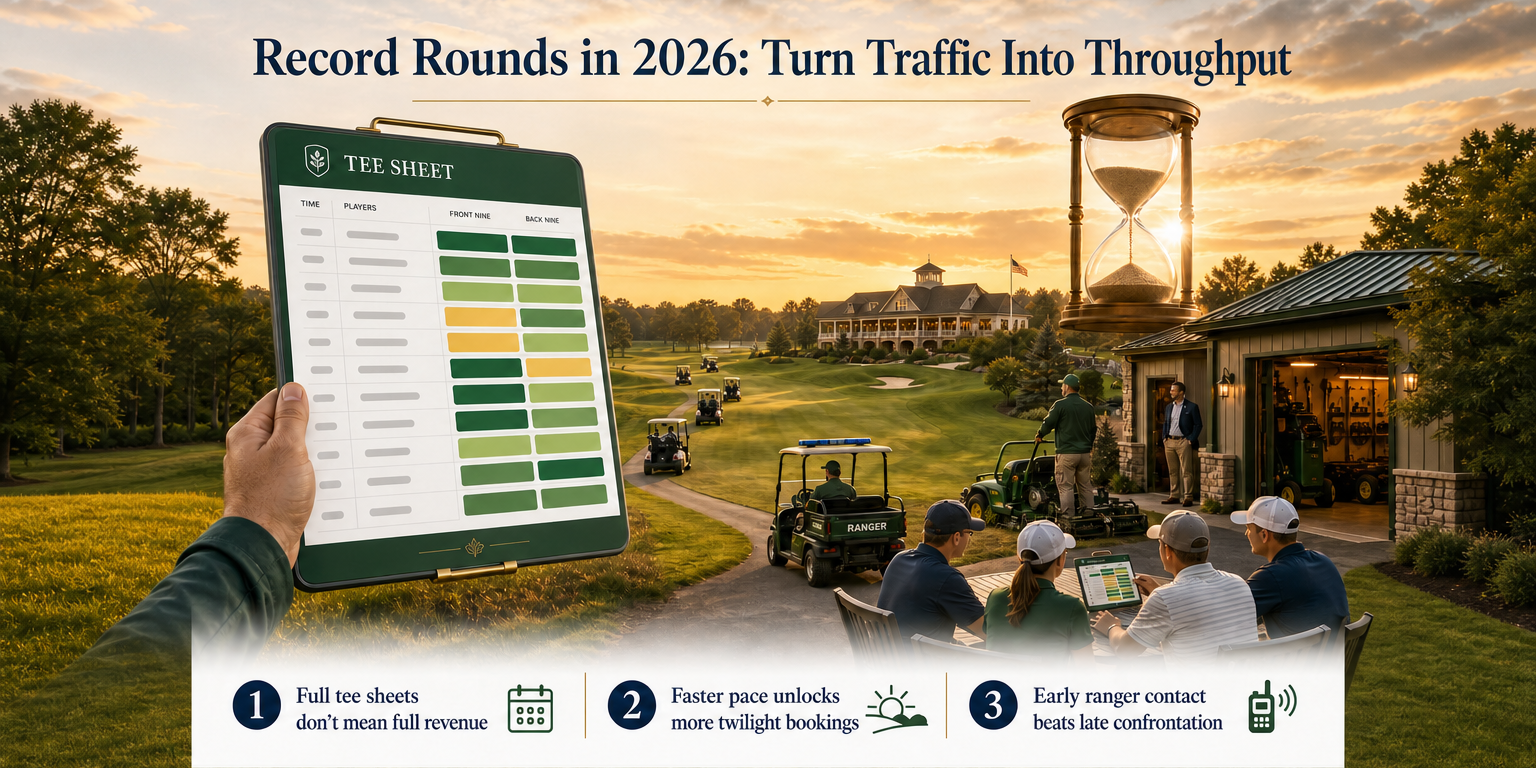
NGF tracking puts June through August 2026 rounds at 14% above the 2017-19 pre-pandemic average. That same stretch sits just 2.6% off the record pace set in 2021. If you run a high-volume public or municipal course, you already felt this in your tee sheet. Walk-ups, online bookings, twilight sellouts. The phone ringing before 7 a.m.
That is the good news. Here is the problem.
A full tee sheet is not the same as full revenue. It is only full revenue when every group moves. The moment pace breaks down on hole four, the rest of the day compresses. You are not adding rounds. You are stacking them on top of each other until the whole course seizes up.
High demand plus slow throughput equals gridlock. Gridlock means your busiest days also produce your worst reviews.
Why Busy Courses Back Up Faster
Pace problems are not random. They follow patterns, and those patterns get worse at high volume because there is no slack in the system.
On a slow day, one group losing two minutes per hole might not ripple. On a day where tee intervals are tight and every slot is filled, that same group creates a chain reaction that reaches the ninth tee before noon and the eighteenth green before sunset.
The mechanics are straightforward. A group falls behind. The group behind them closes the gap. Rangers circle the back nine because that is where the complaints surface. Nobody knows the root cause started on hole three at 8:14 a.m. By the time you see the backup, it is already an hour old.
This is not a ranger effort problem. Rangers cannot fix what they cannot see in real time.
What Precision GPS Actually Shows You
Standard GPS tells you where a cart is. That is roughly the same precision as watching a dot move on a map. It is accurate enough to display a cart icon. It is not accurate enough to tell you whether that cart is on the fairway, the cart path, the green, or the adjacent hole.
RTK correction technology operates in a different measurement category. Position accuracy tightens to the point where the system knows which side of the rope a cart is on. That matters for pace because pace is a time-and-position problem. You need to know exactly where each group is and exactly how long they have been there.
With that data flowing in real time, you get three things that standard GPS cannot provide.
- True pace per hole. Not estimated from tee sheet time and GPS ping, but calculated from actual position transitions. When a group crosses from the approach zone to the green, the clock starts. When they move to the next tee, the clock stops. That is real pace data.
- Early warning by hole, not by symptom. A group losing 90 seconds on hole five is a manageable correction. A group that lost 90 seconds on every hole through nine is a ranger emergency that already cost you the morning. Precision tracking surfaces the former so you never reach the latter.
- Ranger deployment that is proactive, not reactive. Instead of driving around looking for the slow group, your ranger gets a specific cart, a specific hole, and a specific gap. One contact. Thirty seconds of conversation. The group adjusts. The round downstream stays on time.
Throughput Is a Revenue Number
FAIRWAYiQ positions faster rounds as a value driver worth between $40,000 and $125,000 annually for qualifying facilities. That range reflects a real mechanism, not a marketing estimate.
When rounds run four hours consistently, late tee times become viable. Players who would not book a 3 p.m. slot because they are afraid of finishing in the dark book it when they trust the pace. That is incremental revenue from tee time inventory you already own but cannot reliably sell.
When pace holds, walk-up capacity opens. Groups who finish and leave before sunset create a window for a twilight add-on. Beverage cart contact time goes up because carts are spread across the course instead of bunched at the fourth fairway waiting for the group ahead.
On-course F&B revenue correlates directly with time on course and dispersion of carts. Groups stacked together mean fewer touchpoints, lower ticket averages, and frustrated players who have already given up on ordering. Groups moving normally across a full eighteen mean more contact opportunities and players in a better mood when the cart comes around.
None of this requires adding tee times. It requires protecting the throughput of the tee times you already have.
What a Proactive Pace System Looks Like in Practice
The operational model is not complicated once the data is there.
Your course sets a position benchmark for every hole. That benchmark is based on your actual historical pace data, not a generic industry standard. Hole three on your course might play faster than hole three at the course down the road. The system learns your course.
Every cart in the fleet reports position continuously. The software compares each group's position against the benchmark at that moment in the round. When a group is running behind, the system flags it. A ranger gets a specific assignment, not a general directive to go check the back nine.
The ranger makes contact early. The group is only a few minutes behind at that point. A friendly reminder about keeping pace is all that is needed. Nobody gets embarrassed. No confrontation. Just a course ambassador doing their job with information instead of instinct.
That is the difference between a ranger program that works and one that produces complaints. The complaint usually comes from a late-stage intervention where a group is twenty minutes behind and the ranger is forced to have an uncomfortable conversation in front of other players. Early contact, enabled by real data, avoids that scenario entirely.
The Tee Sheet Is a Capacity Ceiling, Not a Revenue Guarantee
A sold-out tee sheet feels like a win. It is a ceiling. The actual revenue that flows from that ceiling depends entirely on how many of those booked rounds produce a good experience.
A player who finishes a five-hour round on a day where the course was advertised as well-managed does not come back. A player who finishes in four hours on a course they know will protect their time books again, brings a guest, buys merchandise, and uses the range before they tee off.
At 14% above pre-pandemic volume, public and municipal courses are operating at the highest demand level most of them have seen outside of 2021. That demand will not hold forever. The operators who build a reputation for reliable pace during this window earn loyalty that survives the next demand cycle. The operators who let gridlock define the busy season train players to look elsewhere when the market softens.
What To Do With Your Current Setup
If you are running standard OEM GPS or no GPS at all, you are managing pace by complaint and observation. That model does not scale at current volume. Rangers are doing their best with incomplete information, and your best days on the tee sheet are also your most stressful days on the course.
The first step is understanding what your actual pace data looks like. Not what you estimate, not what rangers report anecdotally, but what the position data shows hole by hole across a full operating day. Most operators who go through that analysis find the same thing: pace loss is concentrated in two or three predictable locations on the course, and early intervention at those locations would have downstream effects across the entire round.
That analysis requires position data accurate enough to identify which hole a group is on and how long they have been there. Standard GPS does not provide that. Precision GPS built on RTK correction technology does.
If you are heading into the final stretch of the summer at record volume, the time to address this is now, not in the offseason when the data is historical and the damage to guest experience is already done.
The rounds are there. The question is whether you are converting them into revenue and reputation, or into wait times and one-star reviews.
Revolutionize Your Golf Operations with FAIRWAYiQ
Unlock the power of data analytics to optimize your golf course management